
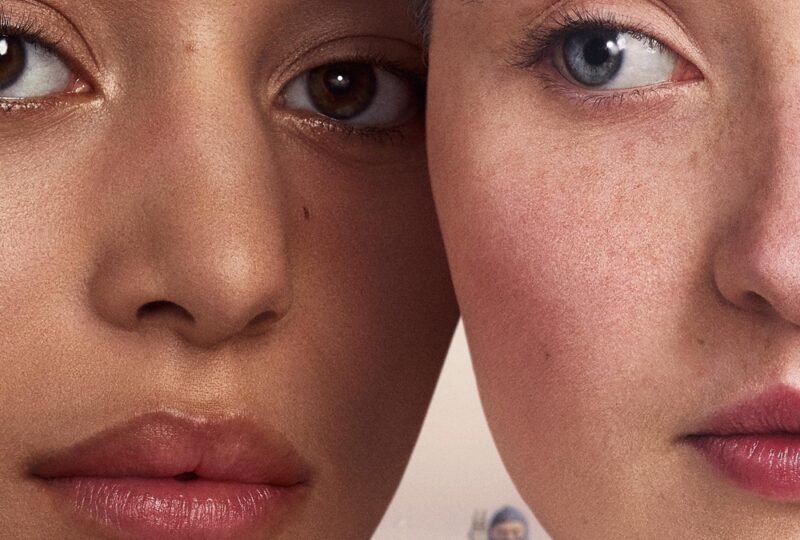
Few television worlds have felt as fully realized – or as suffocating – as Gilead, the theocratic regime at the heart of The Handmaid’s Tale. But with The Testaments, showrunner Bruce Miller isn’t simply returning to that world – he’s reframing it entirely. Based on Margaret Atwood’s sequel novel, the series shifts perspective to a younger generation: girls who have grown up within Gilead’s rigid structures and, in many ways, know no alternative.
At the centre are Agnes and Daisy – one devout and deeply embedded in the system, the other an outsider trying to find her place within it – whose lives intersect inside the austere, quietly insidious world of Aunt Lydia’s preparatory school. It’s a setting that, as Miller describes, represents “the best Gilead can do”: a place designed to feel safe, beautiful, even aspirational. But beneath the polished surface lies the same brutal machinery of control.
That tension – between the illusion of comfort and the reality of oppression – defines The Testaments. Where The Handmaid’s Tale followed those most visibly crushed by the regime, this new chapter explores something more unsettling: how people, especially the young, learn to live within it. Friendships form, crushes bloom, rebellion simmers—often before it’s even fully understood as such. The result is a coming-of-age story with a deceptively lighter touch, one Miller has provocatively described as “Mean Girls in Gilead,” that ultimately reveals how even the most gilded cage is still a cage.
Our Peter Gray spoke with Miller ahead of the show’s premiere on April 8th, discussing his return to Gilead, the specificity in its dialogue, and the importance of the show feeling like its own entity separate from The Handmaid’s Tale.
With The Handmaid’s Tale, you lived in Gilead for all these years. When you came back to it for The Testaments, what felt unfamiliar or maybe even uncomfortable about returning to this world?
I think The Testaments covers such a different part of Gilead that there were so many new things, and that was kind of the exciting thing about it. These are women who are in a very different part of the society, and Gilead really treats them differently. They want their world to be wonderful and beautiful and magical and quiet and safe and godly and all of those things.
So this is girls who have grown up – this is the best Gilead can do. And what I think, overall, what you want to show is the top level in hell is still hell. So these girls are still under a misogynistic totalitarian state and don’t have any rights. It doesn’t matter how gilded the cage is.
But having these young characters and these young actors, having an ensemble of so many young actors telling the story about these girls coming of age – you get such a range of performances and personalities. That really was invigorating. With Handmaids, it was so hard to know who they were because they were so restricted. Here, they could be a lot more funny, a lot more themselves, a lot more light.
It gives you hope and sadness – sadness if they aren’t able to bloom freely, and hope that, wow, they’ve got a lot of gumption, and maybe that’ll turn into a little bit of freedom.
Going off that sort of colorfulness of everybody – because I know you’ve described this as “Mean Girls in Gilead” – that’s such a provocative tonal shift. What was the risk in leaning into that, and what did that unlock that the original series couldn’t?
I think it unlocked how people come to live happily in places like this – not just live, not just survive, but live and have friendships. That’s what it unlocks: this part of it that’s hard to get your head around, which is that people aren’t running out the door every second.
In The Handmaid’s Tale, Margaret Atwood writes that “better never means better for everyone. It always means worse for some.” In that series, we followed someone for whom it was worse. But in this, their world is as good and as beautiful and as full of plenty as possible – and you still see that the construct they’ve built, the life they’re forcing these girls into, is intolerable, even in its nicest form.
Looking at that world, one of the really chilling ideas here is that these girls don’t know any other world. How do you dramatize oppression when your characters don’t yet recognize it as oppression?
I think what you’re saying is…it’s unnatural. They’re being pushed into places that don’t feel right, even if they’re told a thousand times.
They still have very close friendships, and they’re more loyal to their friends than they are to Gilead. They fall in love, they get crushes, they get indignant about things, they fight with their stepmothers, they play games where they smash things under windows – they’re not supposed to do any of those things.
So I think what comes out, no matter what you do, is their innate kind of rebellion. As you keep digging, eventually you’re going to hit that rebellion, no matter where you dig.
And looking at that rebellion – because obviously these characters are of a certain age – did you find yourself writing faster, sharper dialogue because of that, or did you have to resist that instinct?
Well, you know, it’s Mean Girls in Gilead, but they’ve never seen Mean Girls. They’ve never seen Easy A. They don’t know anything about how to talk in that way, so you have to come up with a language that’s theirs.
Their parents have seen Green Acres, but they haven’t. So we thought very hard about how they make this language their own. And the actors…they’re extraordinary young actors. The women on the show took it upon themselves to make it feel like their natural language, and they did such a good job.
By episode two, you can say Shunammite and not even think it’s a weird name, or Agnes isn’t a weird name. You don’t think about those things as strange anymore.
I think they embodied them so much, but as women – not just as characters. They’re young women, and they act differently and speak differently. I had to learn more about how this generation of women would act if they were imprisoned like this. It isn’t the same as what I imagined.
It’s kind of my cross to bear a lot of the time – having to seek out women who will honestly tell me where I’m wrong, because that’s often the entire content of the show. But I think these young women – the actors – have really educated me in how bright that fire is inside them, and how you can do whatever you want, but you’re not going to quench it.
Well, the characters do feel incredibly lived-in, so that’s obviously a testament to you and the actors collaborating. With this as a continuation, did you see The Testaments as a sequel or as a corrective? Is it responding to the original show, or interrogating it?
My sense is that it’s its own side piece. It’s definitely a continuation – so a sequel, absolutely – and I think Margaret wrote it that way. But it’s not just a continuation where we could have done Handmaid’s season seven.
This is a different story about a different part of the world. What I’m hoping is that it’s a bell ringing at the same time – it’s not looking back. You and I are saying, “Oh, it connects,” but in the future, these things will exist at the same time. Some people will just watch The Testaments.
So I don’t think they’ll always exist in the same conversation. What I’m trying to do – what I did with The Handmaid’s Tale – is change as little as possible from the novel and drive people toward that book. If they watch the show, they’re like, “Wow,” and if they read the book, they get to see it come to life.
It’s the same thing with The Testaments. You’re looking for something to sit on the shelf beside a great novel. That’s very different from trying to create a TV show that just lives on its own.
But as a story, The Testaments has to stand on its own and not just be a continuation. You should be able to watch it without having seen The Handmaid’s Tale and really enjoy it. It’s supposed to catch you up and feel very lived-in.
It definitely feels like a show with its own identity. If you haven’t seen The Handmaid’s Tale, there’s nothing stopping you from watching The Testaments – but it certainly helps, and it makes you want to go back and watch it.
I’m so excited for audiences to get behind this the way they did The Handmaid’s Tale. Thank you so much for taking the time to chat with me about it.
Oh, it was my pleasure. No one’s as busy as Chase (Infiniti) (laughs).
The Testaments will premiere its first three episodes on Disney+ (Australia) and Hulu (United States) on April 8th, 2026, with each subsequent episode airing weekly until the season finale on May 27th.
