

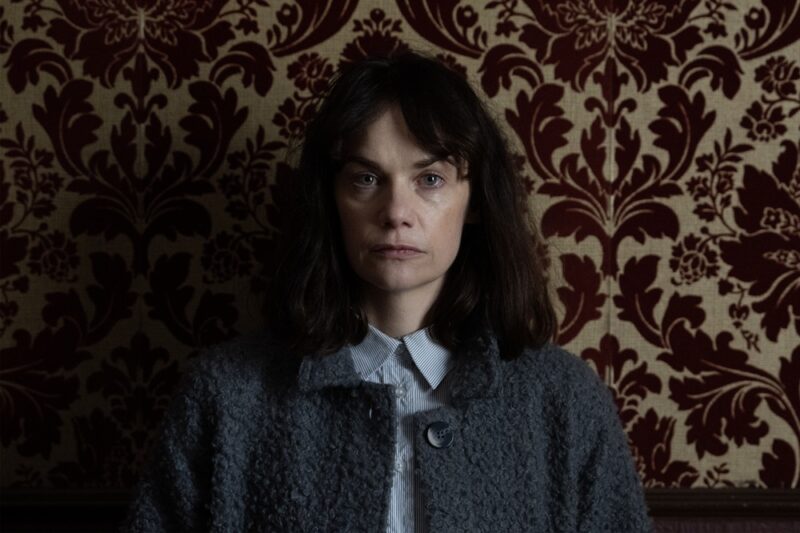
Few television dramas have blended psychological mystery and historical reckoning as effectively as The Woman in the Wall. Led by a remarkable performance from Ruth Wilson, the series follows her Lorna Brady, a woman haunted by trauma and fragmented memories as she becomes entangled in a chilling investigation linked to Ireland’s Magdalene Laundries. While the show operates as a gripping thriller filled with twists, secrets and unsettling revelations, its emotional core is rooted in the very real experiences of women whose stories were ignored, denied and buried for decades.
Ahead of the series arriving in Australia on BritBox, our Peter Gray spoke with Wilson about inhabiting Lorna’s fractured reality, portraying a woman whose memories are constantly questioned, the responsibility of bringing such painful history to the screen, and why the show’s blend of psychological horror, mystery and dark Irish humour was the perfect vehicle for telling a story that still feels urgently relevant today.
I wanted to ask about Lorna’s relationship with memory. One of the most unsettling aspects of the series is that Lorna herself can’t always trust her own reality. As an actor, how do you play certainty and uncertainty simultaneously without tipping the audience one way or the other?
How did I play that? I think what’s interesting about this, and what drew me in, was the sort of ambiguous reality, or the discombobulated reality that Lorna lives in. It’s very subjective. Those first two episodes are very subjective. They’re from Lorna’s point of view, and when you’re in Lorna’s scenes, they feel discombobulating. The way it’s shot, the way the camera moves, you’re very much in her experience. That obviously helps a lot in terms of literally, physically having a sense of being inside her head. The camera really helps with that, in terms of my own idea of being clear and unclear.
I think Lorna would flip between a sense of guilt and shame about what she’s done or the world that she’s living in, and then this very strong sense of justice or clarity about what happened in her past, so I think as the show goes on, you realise she’s definitely got clarity about the truth of the scenario and what happened with her child. From then on, she becomes a sort of fighter for justice. She’s been betrayed and gaslit by everyone in her life from a very young age – her parents, her community, her country. People keep denying her experience, so it’s very hard for her reality for her to tryst what she thinks happened in her life when everyone is telling her the opposite.
I think that was really important to try and get across. And it is hard, but underneath I think she had an instinct. For me it was always if she’s looking for clues to validate that instinct. But it is hard for some. I did find that difficult (to play) that person who can’t trust anyone and can’t trust what they’re being told. I think for me it was about marking out that journey throughout the course of the six episodes.
One of the things that’s really startling when you look at it is that the Magdalene Laundries only closed in 1996. That’s so recent! Were there moments while making this series when you found yourself reflecting on how easily societies can look away from institutional cruelty?
Of course. That’s what the whole show’s about. When I did my research, I was shocked that it was such recent history. And in terms of Lorna’s age when those Magdalene Laundries were closed, it’s like, “Wow, that could have been me in a different…if I was brought up in Ireland. That could well have been my experience.” It was terrifying in that way. I always felt like it’s something that happened in the 50s, or this attitude might have occurred in the 50s, but no.
What you realise is that humans repeat. It could happen again. That’s what you make drama about, or you try to draw attention to these stories to make people aware that this can happen. It can happen in any age, really. It’s not beyond the capability of humans doing that to each other. It’s always a warning shot. I think it’s terrifying to be in a space where you can’t tryst the world that you live in and the community that you live in. I think that would be terrifying. But we see it across the globe all the time, so it’s something we have to be acutely aware of.
And after spending so much time inhabiting Lorna’s world, what was the question the character left you with that you still don’t have an answer to?
One thing we didn’t explore in the show, and if there was a second season – but it didn’t feel appropriate to have a second season on a show like this – but it would be the relationship with the daughter that she meets right at the end. In truth, those meetings and those relationships are incredibly hard and complicated, and not always the ideal that you want them to be. It’s very hard for both parties to reconcile. It’s hard to form a relationship with someone that you haven’t had for many years. We don’t give answers to what happens with Lorna and her child.
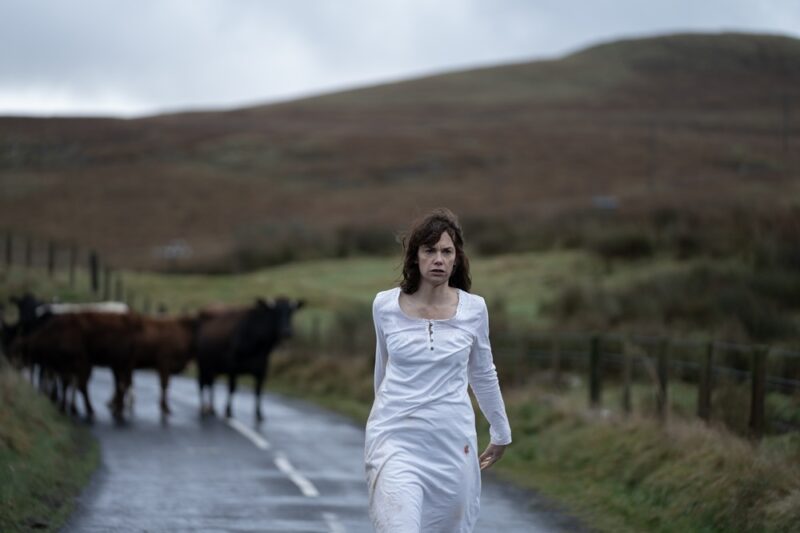
Having the show called The Woman in the Wall, it’s obviously very literal, but I also feel the title suggests something hidden away, someone’s silent, someone’s forgotten. By the end of the series – and this could be me interpreting things more metaphorical than they are – but do you think the woman in the wall is Lorna? Her daughter? The victims of the laundries? Perhaps a part of Irish history that people would rather not look at?
I had never thought of that. There’s lots of interesting literature around women with walls, actually, and photography. Probably because it’s the domestic sphere, and women have traditionally been contained in a domestic sphere or a space in a house, locked. There’s ‘The Yellow Wallpaper,’ which was a reference in some of the designs to Charlotte Perkins Gilman. And there’s a photographer, Francesca Woodman, who did lots of photography disappearing into walls. So I think there is, interestingly, a history of female relationships to the space they’re contained in. I had never really thought of that, or interpreted it like that, but now you come to say I think there is a history of it.
And looking at the historical reality, because this is obviously not a documentary, but it’s rooted in such real suffering. Again, did carrying that historical weight change the way you approached the role compared to a purely fictional thriller?
Yes, I mean, you have a burden of responsibility, which I cherish, to be honest. I took the role because of the historical context of it, and the truth and reality of these experiences. To me, that’s a really important reason to make art and to make drama – to tell real stories that you want to put out there and make people aware of. But it does come with an added responsibility and an added sense of care. I think all of us on the show – the writer, the director, all the actors – many of the people we were working with and surrounded by were Irish and had connections, stories, or relationships with people who had gone through these experiences. So it was very personal to them.
For us, a lot of people didn’t know about this story, so it was really important to get it out there, to get those women’s stories out there, to validate them, and for them to feel like they had been heard in some way. There was always a nervousness around the tone of the piece because it’s such serious material and such important storytelling. You want to serve it properly. But we also felt it was important to reach the widest possible audience. Framing it through genre – and it is psychological horror; what happened was psychologically horrifying – felt like a really smart way to do that. Using the framework of a ghost story and psychological thriller, combined with the sort of black comedy that the Irish do so well, helped make it accessible. With suffering, there’s often a level of absurdity to it.
That’s why it felt so compelling to me as a piece. I hadn’t read anything like it, and I hadn’t read a character like that for a long time. I felt, “Wow, this is really unique,” and it’s also really important. So yes, you do approach things differently when you’re dealing with real stories and real people’s experiences
And before I let you go, if feel like there’s this line of thought that trauma traps people in the past, and watching Lorna I wondered if the opposite might also be true? That trauma can erase the past entirely. Did you think about that paradox while building her as a character?
I didn’t actually think about it in those terms, but I certainly think you feel that her trauma and her past are constantly present in her world. We manage that cinematically through flashbacks and sound design, and the fact that she’s living in the house where it all happened means she’s confronting it every day. But I agree with you – there’s something that’s been erased. Certainly in the context of these particular stories, people denied her experience. The church denied it, her community would have denied it, and the people around her didn’t want to deal with the truth of what actually happened. So they deny these women, tell them they’re mad, that they’re insane, or that it was somehow their fault.
If your experience is constantly being questioned, denied, and invalidated, it’s very hard to hold onto that past. I imagine it’s very difficult to make sense of it, or even to trust your own memories. You start wondering, “Did it really happen? Did that ever exist? Is it all my imagination? Am I the one to blame for all of this? Am I insane?”
When people make you feel like that, your past becomes very difficult to hold onto. I’m sure it becomes something that’s constantly disappearing, shifting, or becoming confusing. So I agree with you – it feels both ever-present and constantly elusive at the same time.
The Woman in the Wall is streaming on BritBox Australia from June 18th, 2026.
