
From David E. Kelley, the multi-Emmy Award-winning creator behind some of television’s most compelling character dramas, comes Margo’s Got Money Troubles – a sharp, funny and deeply human series anchored by a powerhouse cast including Elle Fanning, Michelle Pfeiffer, Nicole Kidman and Nick Offerman. Based on Rufi Thorpe’s bestselling novel, the show follows Margo, a struggling young mother navigating financial instability, online identity, and the complicated legacy of her unconventional parents.
But beneath its chaotic, often hilarious surface, the series taps into something more resonant: the idea that life itself is a kind of performance. Whether it’s the personas we adopt online, the roles we play as parents, or even the masks we wear in everyday interactions, Margo’s Got Money Troubles suggests that identity is constantly in flux – shaped as much by survival as it is by self-expression.
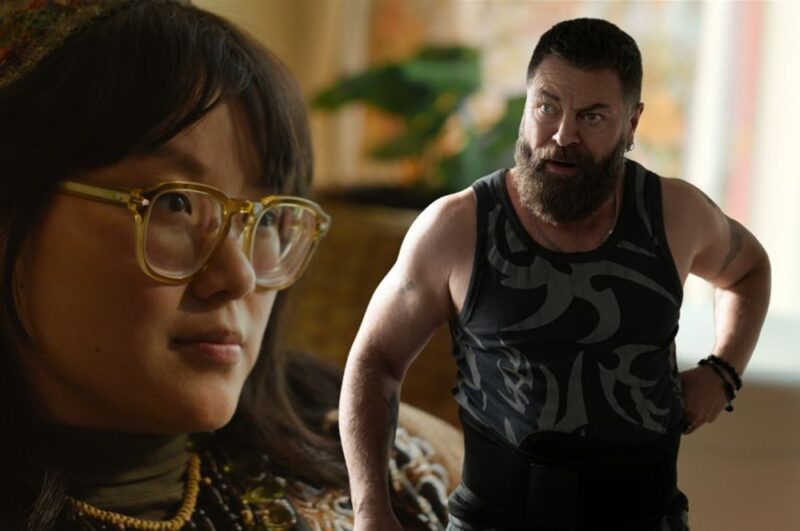
Speaking with stars Thaddea Graham and Offerman, it becomes clear that the show’s deeper power lies in how it reframes those performances – not as deception, but as something inherently human. It’s a perspective that also extends to the series’ exploration of love and family, where connection isn’t defined by tradition, but by the people who choose to show up for one another.
The series deals with performance in many forms. Parenthood. Online identity. Wrestling personas. The show suggests performance can be both a mask and a truth. Do you think the show is arguing that we’re performing all the time?
Thaddea Graham: I think everybody, every single human being, whether you walk into an interview or you’re going to work, or meeting up with someone for coffee that you don’t really want to meet up with…there are performances we play every single day in our life. I don’t think it’s necessarily good or bad or wrong or right. You definitely dial up or dial it down, depending on the situation. But I think what’s so beautiful is that although maybe a wrestler feels like someone you would never meet, or someone who cosplays feels like someone you would never meet, there is something I think everybody can relate to. We’re acting through life. Much like Wicked says, we’re “dancing through life.”
Nick Offerman: We’ve talked about this – that you want to think about people’s journeys before you’re quick to judge them. Maybe I’m not taking off my shirt on OnlyFans to feed my child, but I think everyone in their life is doing some version. I think that’s allegorical. I think everybody’s taking their shirt off for somebody, and before we were so quick to judge people – especially women for doing sex work – I think we all need to look ourselves in the mirror, with or without our shirts on. That’s a very perceptive question. Thank you. I think that’s one of the main truths of the show is wanting the audience to say, “Maybe we should treat everybody with a little more grace and empathy.”
What I really loved about the series is how it explores the power of love – not in a sentimental way, but as something grounded and essential. It suggests that family isn’t always a traditional structure, but something we build with the people who help us get through life. What did that idea mean to you, and did you have any personal references that shaped your approach to it?
Thaddea Graham: I think love comes in many forms. The one that really stands out in this story – for me and for (my character) Susie – is friendship. It’s a kind of love that’s steady, reliable, and unwavering. It doesn’t judge or ask for anything in return. It just says, “I’m here for you because I want to be, because I think you’re brilliant – and I’ll be here as long as you’ll have me.”
Nick Offerman: I love that. I come from a big family in Illinois – farmers, nurses, teachers, paramedics, even a craft beer brewer. I love them deeply, but from my teenage years, I knew I wanted something different. I didn’t have the language for it then, but I was questioning things – like why there was so little diversity in my world.
That’s what drew me to theatre. I wanted to explore those gaps, those injustices, and take what my family gave me into spaces where we could create, understand, and heal together. I’ve kept repeating that pattern, and it’s why this story resonates so much. There’s a line from Wendell Berry: “It all turns on affection.” And I believe that.
In a world where we’re increasingly encouraged to live isolated lives through screens, this story reminds us that we don’t need that. Before all of this, we had each other. We built things together. We shared what we had. That’s the kind of love this story is about – connection, community, and choosing to show up for one another.
And we’ve grown up with Michelle Pfeiffer. Could you talk about how it was to work with her?
Nick Offerman: I found it crazy to work with her after her just being a legend in our life for decades of incredible cinema. I first met her at the first table read, and I was sitting next to her. I was very starstruck. But she immediately was kind of dorky, and also expressed that she was nervous and feeling butterflies. She made herself human immediately. We never looked back. We were just two friends have a great time collaborating and creating these characters together.
There’s so many things she’s done over the years. Her work as Catwoman…especially with a whip. Like, I went out and learned how to use a whip after seeing her do that. We could go on all night about Michelle Pfeiffer roles. I would just say it was so thrilling to see her – after such a legendary career – still surprise us with a new set of colours and come out of her comfort zone, and play this much larger character than we usually know her as. Just really hit a home run.
Thaddea Graham: Quickly, my favourite Michelle Pfeiffer (movie) is One Fine Day. We’re here in New York, and to be in the same city as that movie…I went to Central Park. I saw the fountain. I had my moment of “that’s them running through with the kids,” and it’s just one of my favourites of all time. And to whoever is in charge of putting (movies) on streaming services, please do, I can’t find it anywhere. I’ve got the DVD at home, but I want it on a streaming platform. Please make a few calls if you can.
Margo’s Got Money Troubles will premiere globally on Apple TV on Wednesday, April 15th, 2026 with three episodes, followed by new episodes every Wednesday through May 20th, 2026.
