

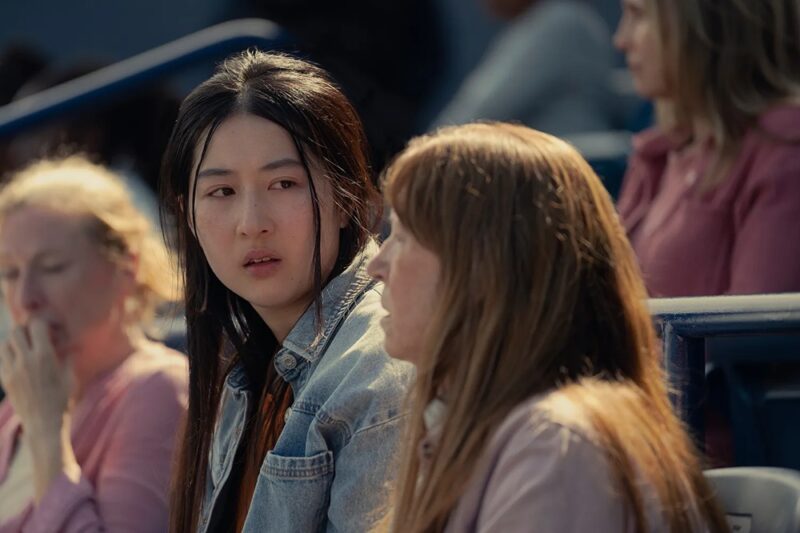
In a world where devotion is demanded and dissent is deadly, The Testaments ushers in a chilling new chapter of The Handmaid’s Tale – one that shifts its gaze to the next generation raised within Gilead’s suffocating grip. At the centre are Agnes and Daisy, two young women navigating the brutal indoctrination of Aunt Lydia’s elite school, where obedience is enforced with both ritual and ruthlessness. But beyond their coming-of-age story lies another, quieter transformation – one shaped by the women who uphold the regime from within.
Enter Aunt Vidala.
Played with unnerving precision by Mabel Li, Vidala is a founding Aunt and formidable disciplinarian whose authority is matched only by her ambition. Yet as the series unfolds – particularly in the harrowing “Stadium” episode (which aired this week) – we begin to see the fractures beneath her icy exterior, revealing a past that complicates everything we thought we understood about her. Is Vidala a true believer in Gilead’s doctrine, or simply someone who has learned to survive by mastering its rules?
In conversation with our Peter Gray, Li unpacks the psychology of power, complicity, and the quiet sacrifices required to endure in a system designed to strip women of both agency and identity.
*Spoilers for the latest episode of The Testaments follow*
THAT episode has now aired, and we get to see everything that made Vidala who she is. I wanted to ask about power as survival versus belief. Your character exists in this very morally corrosive space where cruelty is currency. Do you see her as someone who believes in Gilead? Or someone who has simply mastered it as a survival strategy?
It was a really key conversation we had early on when I got the role with the producers and the writers. Where I landed is that I think (Vidala’s) not as devout as some of the other aunts. I think she has mastered the art of balancing all of those power dynamics. I think she’s surviving, and she knows her place. And she has ambitions.
The stadium sequence was nothing like I was expecting. It’s the birth of complicity, almost, because it’s essentially the crucible for where the aunts are forged. When you approached Vidala in that moment, did you play it as fear, as ambition, or was it something more unsettling? Like there’s almost relief at finally having structure amongst chaos?
I love that. The birth of complicity. The stadium scene…when I found out about their backstory, it just really helped inform their whole dynamic throughout the whole season, about (Vidala and Lydia’s) current dynamic. That sequence, I didn’t preempt it. I didn’t pre-plan it. I just knew that we were going to be shooting in an actual stadium with 300 background actors, and I wanted to be surprised by what I would feel in the moment.
It was so immersive to film those sequences, because we were truly (filming) in a massive stadium with all of these women around us on really hot days. And interestingly, I found it quite freeing to shoot that episode. So much of the time we see her kind of straight-jacketed. At the school in Gilead she’s so stoic and such a mouthpiece for the rules. It was so freeing to finally be out of that costume – to not have the glasses on, and be wearing jeans and a cardigan. For Vidala, in her everyday life in Gilead, she doesn’t have the space to feel many of her feelings, so I think a lot of the time she’s really numb. And even though it was horrible what was happening to her, and that moment where Lydia betrays her was so satisfying as an actor, because I finally got to feel something – even though it’s painful. There was fear, even though it was a fake gun, but being blindfolded and walking out…it was just so immersive.
Did you know much of Vidala’s backstory before that episode? Had you played her a certain way and then realised you had to pivot in any way? Or did you know early on this was always where her character was leading?
Luckily, I did know this from the beginning, and the producers made sure to let me know, because it’s such an integral part of why she is the way she is in her relationship with Lydia. It’s great that I knew that they are also tweaking and writing things as they go, which is a fascinating experience as an actor. They’re always writing to the way you’re playing it, so they learn more about the way that you’re playing it as an actor. But this backstory I knew from the beginning.
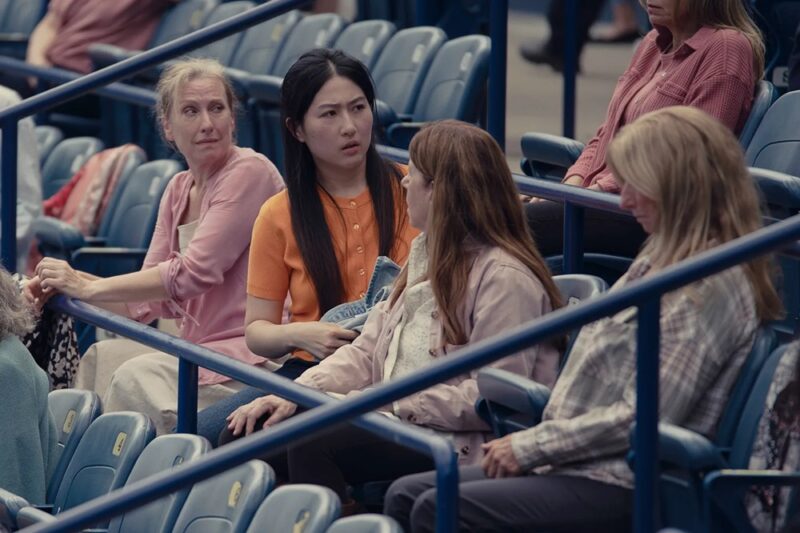
As you mentioned that moment with the gun. The gun is unloaded and it’s so fascinating, because it exposes this illusion of power as much as it reinforces it. How did you interpret the scene in terms of what it reveals about Vidala’s place in the hierarchy?
I think it’s incredibly painful for her to be an experiment in that moment. For Commander Judd to test that loyalty for Lydia, it’s painful. Even if it’s not felt in her position, to be second in command to the person that almost murdered her? I think to almost be murdered, and then pick yourself up and work for the regime is very painful.
One of the most disturbing aspects of the show is watching women perpetuate the system that oppresses them. How did you personally reconcile playing someone who not only accepts that system, but kind of actively strengthens it at the same time?
Yeah, how did I reconcile? I guess, as Mabel, I tried not to judge the character, because I’ve never been in a situation like that, and I’m so grateful I haven’t. I guess you have a couple of choices, which is probably to die, or be killed, or to survive and be complicit to a regime that maybe you don’t necessarily even believe in. I think Vidala doesn’t have the support – the emotional support – in Gilead to unpack her everyday actions. I think there’s this constant trickle down of the commanders yell at the aunts, and then Lydia takes it out on Vidala, and then Vidala takes it out on the girls. I think it just happens so unconsciously.
And watching Lydia begin to question things, whilst Vidala doubles down creates this really interesting contrast. Do you think Vidala is incapable of doubt? Or is doubt the one thing she can never afford?
Oh, this is such an interesting question. In terms of Vidala getting stronger and her ambition growing in the season, I think she has a lot of doubts. I think it’s so dangerous to try to even start thinking about overthrowing the head aunts, but I do think because Commander Judd – a man who is very powerful – opens the door just a crack enough, it’s like she’s given permission to dream a little bit. But you can’t actually stay in doubt for too long, because if you stay still for too long, someone’s gonna get you in Gilead. She has a tricky balance. She has to make some decisions in the future when it comes to her working relationship with Judd.
Before wrapping up, in a world, like Gilead, where loyalty is never free, what do you think Vidala has sacrificed to maintain her position?
I think she sacrificed feeling. That feeling of aliveness. I think it’s buried somewhere deep in there. But something I’ve thought about a lot when we were filming is, “What has she kept in her mind that’s beautiful? What’s truly beautiful from her past life that has sustained her all these years in Gilead?,” I think it’s feeling and aliveness.
Episode 6 of The Testaments is now available on Disney+ (Australia) and Hulu (United States), with each subsequent episode airing weekly until the season finale on May 27th.
