
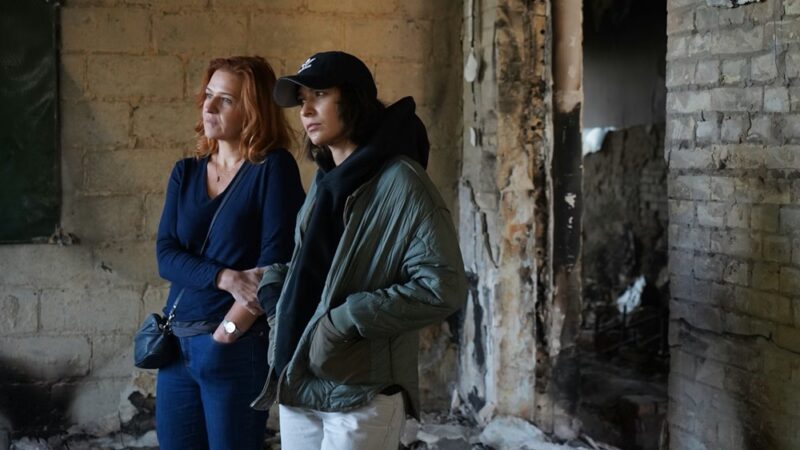
In her real time crime thriller set in a war zone, The Cranes Call, director Laura Warner embeds with war crimes investigator Anya Neistat and her team as they track down a group of survivors bold enough to take a stand against those accused of committing the most heinous crimes of rape, torture and murder against their families. Working with the Clooney Foundation for Justice, led by Amal and George Clooney, Anya joins forces with Solomiia Stasiv, a young Ukrainian woman just entering the field after witnessing the brutal invasion of her homeland. Together, they document evidence of human rights abuses in the fight to bring Russian commanders and soldiers to trial, and justice to the Ukrainian people.
Produced by both HiddenLight Productions, the company founded by Hillary Rodham Clinton, Sam Branson and Chelsea Clinton, and respected Australian journalist Evan Williams, a former ABC foreign correspondent, The Cranes Call is a timely, important documentary, and to coincide with its release on SBS On Demand here in Australia, Peter Gray spoke with Warner about the spark that started her involvement with the film, how she navigated the film’s multi-faceted genre expectations, and if the film has shifted her perspective on what accountability now looks like to her personally.
This is telling a risky story, but a morally urgent one. What was the first spark for you that made you believe you needed to embed yourself in this investigation?
Well, it was actually my producer, Evan Williams, who happens to be Australian. Once the full scale invasion happened in Ukraine, we were all utterly convinced that a film needed to be made about it. But it was asking the question of, “What is that film?” We come from a cohort of journalists, and so we knew that there were going to be lots of frontline films being made. When we found out about Anya (Neistat) and the work that she was doing at the Clooney Foundation for Justice, it just seemed like that perfect angle, because it was something that we also knew hadn’t really done before.
There’s a whole world through the ICC and other human rights activists where you want to get justice for people that have lived through war crimes and atrocities and other human rights issues. But the fact that (Anya) went in only weeks after the full scale invasion, because she knew that war crimes were going to be committed, because she had been getting these Russian generals for decades, so she knew that there was going to be a pattern. There’s this amazing legal system that was put in place after the second world war called Universal Jurisdiction, and it was put in place to prosecute Nazi war criminals, because obviously after the war everybody just dissipated – both victims and the Nazis.
So over 126 countries signed up to it, and it’s a means whereby you can prosecute war crimes outside of the jurisdiction where that crime was committed. So it was quite an audacious plan that she came up with. As soon as the invasion happened, we were in tow and she started investigating the war crimes and putting together all these cases. The idea was that these generals would know that the international community was after them, and it would become a means for them to perhaps second guess their own moves, so they would know if they tried to cross over any border or go on holiday in any other country, there would be an Interpol Red Notice waiting to arrest them. That was the whole principle. We were just like, “Well, this is amazing.” And, from my perspective, I just love the fact that you’ve got Anya, who’s this kick-ass woman, and she’s going in and she’s fighting the bombs and the violence, but very much with her intellect. With the pen, as it were.
As you said that you’re working with the Clooney Foundation for Justice. The film sits at that intersection of journalism, activism and cinema. How do you navigate the responsibility to all three of those?
We were a really tiny team, and we had amazing back support. Siobhan Sinnerton, who is our executive producer, she came from Channel Four. And they have this brilliant track record of really impactful journalism. So we had that support. Evan, I’ve worked for coming up on 15 years now, and he, in himself, is a great journalist. But we were a tiny team. So Evan and I would rely, to keep us alive, on that bare, grassroots journalising, and I obviously sort of was in charge of cinematography, and we were just constantly discussing how we can try and make the story as impactful as possible. Because there’s a legal case that underpins the whole film, (so) it was imperative that, factually, we stuck to…it had to be perfect, because we didn’t want to jeopardise the Clooney Foundation for Justice’s cases in any way. We didn’t want the journalism to be under attack. All of our I’s were dotted and our T’s were crossed on that level.
As far as the filmic elements, that was really important to me, because when you’re in these situations, it creates this world that you’re in and it was really important to me that the audience could feel everything that we felt as well. Ukraine is really beautiful, but then you add that layer of the war on top, and there’s just this sinister atmosphere. You never when the bombs are going to drop. You never know when the bombs are going to go off. You don’t really know whether or not the front line is going to push back again, and you’re going to find yourself sort of imperiled. And this is what the Ukrainians have to live through every day. So there is this sinister (feeling) that’s just bubbling away, and I really wanted that to come through when you’re in the world of the film. When you’re watching the film, for an hour and a half I wanted you to feel that you were in that situation yourself. I put a lot of time into thinking about the music and how we’re going to film it, and making it quite slow. In some ways, because I think a lot of people expect a war movie, but I said from the very beginning that this isn’t a war movie. This is more a crime thriller. I took quite a lot of influence from Tinker Tailor Soldier Spy.
As you mentioned being in the war zone, that line between witnessing and intervening must be so razor thin. Did you ever find yourself questioning when to keep filming and when to put the camera down?
Yes. For two reasons. The first one is that we don’t want to disrupt Anya’s work. You cannot imagine the number of people that she interviewed and that are involved in her cases. There were people that just didn’t want to be filmed. They were really traumatized, and we always respected that, but then, equally, when people did feel that they wanted to be (involved), and not just as part of Anya’s cases, but part of the film, we had to be really respectful. I think it was also something that I felt would make the audience feel more comfortable. Just to feel like we were observing her work. We didn’t want to get in the way of simple thing, like eye contact with the people that she’s bringing on board. She has to earn their trust. She’s going to be working with them as their lawyer for years, so we can’t cut in the way of her conversations. It has to be very respectful. We have to bear in mind that they are reliving these really traumatic events. They’ve lost their families and their loved ones. They’ve been raped, tortured…it’s really difficult.
And the other thing, there are couple of times in the film where you see the bombs raining down. That was quite difficult to capture, because it happened a lot of the time in the middle of the night or when the cameras weren’t rolling. And you end up thinking about either self-preservation and running to the bomb shelter, and taking your kit of all your filmed material and make sure your team is okay. Or do you film? Honestly, the majority of the time you go for self-preservation. At the same time, you really want to capture what felt like on a daily basis of being woken up, because a bomb has just dropped, or the windows of your hotel have been smashed out. That was really difficult to capture, because you’re always caught unaware, and unless the camera is rolling, it’s just something you don’t capture. That was what I found frustrating. That constant chasing of the reality of life that people lead in Ukraine.
Hearing that alone, it’s hard not to imagine how this film would have changed you personally as both a filmmaker and a human. Looking at the personal and professional, how have you seen yourself change from this?
I’ve filmed in quite a few war zones. I went to Iraq. I went to Libya during the height of the Civil War there. Every experience does change you to a certain degree. And, again, this film, it leave its mark, but perhaps in ways that people wouldn’t expect. I wouldn’t say that I’ve come back traumatized. I’m endlessly upset and shocked by what other human beings can do to each other. But everybody that’s featured in the film, and some that aren’t, they leave a mark with you. Their resilience and bravery and ability to stand up, despite seemingly impossible odds, to shout that they demand justice and agency. A lot of the people you see in the film, they’ve been tortured or raped or have seen loved ones killed in front of them. They understand the power of, in this case, the Russian invading forces. They are going to stand up against Putin and demand justice. They still have that hope that they can topple those individuals and the regime, and stand up for what is right. That personally always leaves me feeling really hopeful for the human race. Especially in the world we’re living in today.
Going off that, given the scales of the crimes and the distance between victims and international courts, what does accountability look like to you? Has the film shifted your faith in finding justice?
I mean, for me, this film and then watching everything else that is happening in the world, I think that the one thing that matters more than anything is time. I think that is the main thing. The crux of what Anya is trying to do is to rid that time lag. The International Criminal Court is this amazing institution, and it’s important that there’s a body out there that can hold world leaders to account when they commit war crimes.
The one thing that we all felt when working with Anya is just if that time lag between when people are held to account for the crimes they have committed can be shortened. It becomes a deterrent. And you want to deter people from committing these crimes. For me, it took us two years to make the film. And when you watch the film, you’ll see that we entered Ukraine after the full scale invasion, then, over the course of two years, Anya puts those cases together. There were four cases that we followed that are now with the German and Australian authorities. She now has other cases that she is pushing forward in Australia and Argentina. That’s now three years after we started filming, and three years after the full scale invasion. What you realise is that if you can just concertina that time, then perhaps these generals will think twice before they lock somebody in a dungeon and start torturing them.
The Cranes Call is now streaming on SBS On Demand.
