

Few adaptations have carried the weight of expectation quite like One Piece. Based on Eiichiro Oda’s record-breaking manga – the highest-selling of all time with more than 500 million copies in circulation – the series sailed onto Netflix in 2023 and quickly became a global phenomenon, topping charts in more than 75 countries and racking up close to 100 million views. Now, the Straw Hats are preparing to venture into even more dangerous waters as Season 2, One Piece: Into the Grand Line, pushes the crew toward stranger islands, tougher enemies and the unpredictable stretch of ocean that could bring them closer to the legendary treasure known as the One Piece.
At the heart of the adventure is the unshakable dream of Monkey D. Luffy, played by Iñaki Godoy – the endlessly optimistic pirate with rubber-like powers who believes, without hesitation, that he will one day become King of the Pirates. Sailing alongside him is Sanji, portrayed by Taz Skylar, the sharp-tongued but fiercely loyal chef whose devastating martial arts kicks are matched only by his devotion to finding the mythical All Blue.
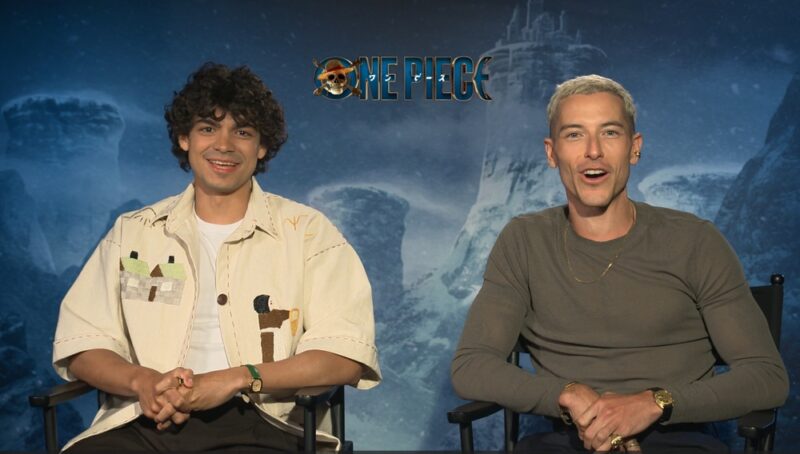
Speaking with our Peter Gray, Godoy and Skylar reflect on how inhabiting these larger-than-life pirates has shaped their own outlook on chasing impossible dreams, discuss the show’s refreshing take on masculinity and vulnerability, and explain why the bond between the Straw Hats – built on loyalty, chaos and plenty of silliness – remains the true heart of the adventure.
I wanted to ask about your characters’ growth. You’re both chasing dreams, but in very different ways. What has playing these characters taught you about how you pursue your own goals?
Taz Skylar: You go first.
Iñaki Godoy: No, you go first.
Taz Skylar: Why do you always make me go first?
Iñaki Godoy: Okay, okay – I’ll go first. But can you repeat the question?
What has playing these characters taught you about how you pursue your own goals?
Iñaki Godoy: When you play a guy like Monkey D. Luffy – someone who’s so confident and so clear about his dream of becoming King of the Pirates – it definitely starts to rub off on you. I feel like Luffy came into my life to remind me that dreaming is okay, and that fighting for your dreams and believing in yourself really matters.
When I have moments of doubt, I sometimes ask myself, “What would Luffy say?” And that actually helps me move forward. Playing him has made me more confident. Maybe it’s not what he’s taught me, but what he reminds me of every day that I play him.
Taz Skylar: Alright, try to beat that answer…
Iñaki Godoy: That was good, right?
Taz Skylar: It was very good. For me, playing Sanji has taught me something slightly different. The biggest similarity between us is that we’re both a little insolent – we’re not great with authority, and we don’t love being told what to do. But Sanji usually channels that through care. He’ll do the right thing no matter what – whether it’s what he’s told to do or whether it’s “cool” or not.
And honestly, that’s what makes him cool: he’s not trying to be cool. So the way Iñaki asks “What would Luffy say?”, I sometimes ask myself, “What would Sanji do?” Usually the answer is that he’d handle the situation far more elegantly than I would — instead of my instinct, which is sometimes to just metaphorically run through a wall.
That makes me think about the show’s take on masculinity. One Piece lets men be silly, emotional, loyal and vulnerable. How important is it for you to show that kind of masculinity on screen?
Taz Skylar: Oh wow, we get to talk about masculinity now – this is great.
Iñaki Godoy: Yeah, social commentary!
Taz Skylar: Go on, you start.
Iñaki Godoy: I think the important thing is that these characters are people first. Not just men – people. Everyone in the show has dimension. They’re allowed to feel things and be vulnerable because that’s the human experience, regardless of gender or age.
That’s also why One Piece is so beloved. At its core it’s about diversity and inclusion. There are so many different types of men in the story. Someone like Roronoa Zoro is very stoic and serious, but he can also get lost and needs help. Luffy might seem silly, but he has incredible conviction and he knows he needs his friends.
If he’s ever going to become King of the Pirates, he can’t do it alone – he needs his crew. And I think that vulnerability is what makes heroes interesting. When you see them struggle, you root for them.
Think about movies like Die Hard – Bruce Willis is crawling across broken glass and you’re just willing him to win. Or Rocky – the underdog who keeps getting back up. Those are the heroes people love. Our characters are kind of idiots sometimes – we joke around, we’re silly…
Taz Skylar: Speak for yourself.
Iñaki Godoy: …but that’s why they feel real.
Taz Skylar: And I think what’s cool about the show is that it gives every version of masculinity permission to exist. With Sanji specifically, one thing I love is his ability to flirt. I actually think it says something interesting about his character.
For him, it’s playful – it’s done in jest, it’s done respectfully, and there’s never an expectation of anything in return. He just throws it out there as a fun way to interact and moves on. That silliness exists alongside his intensity and his emotional side.
And when you put that next to Luffy, Zoro, and the others, you end up with all these different expressions of masculinity existing at the same time. I’m not sure exactly what it says, but it definitely gives people permission to be themselves.
I will say — Die Hard and Rocky were not two films I expected to come up in this conversation. But thank you both so much for taking the time. I’m really excited for audiences to get back on board with One Piece. It’s an amazing season.
Iñaki Godoy: Thank you, bro.
Taz Skylar: Thanks so much for talking to us.
One Piece: Season 2 is streaming on Netflix from March 10th, 2026.
