
Jack’s back – and so is the man who made him. With The Artful Dodger returning for an even darker, wilder second season, Port Victory’s most charming rogue finds himself staring down a noose, a relentless new lawman in Inspector Boxer, and an impossible love in Lady Belle that could get him killed. As the stakes spiral, it’s the ever-cunning Fagin who pulls Dodger back into the fold, luring him into their most dangerous heist yet amid a town rattled by a killer on the loose.
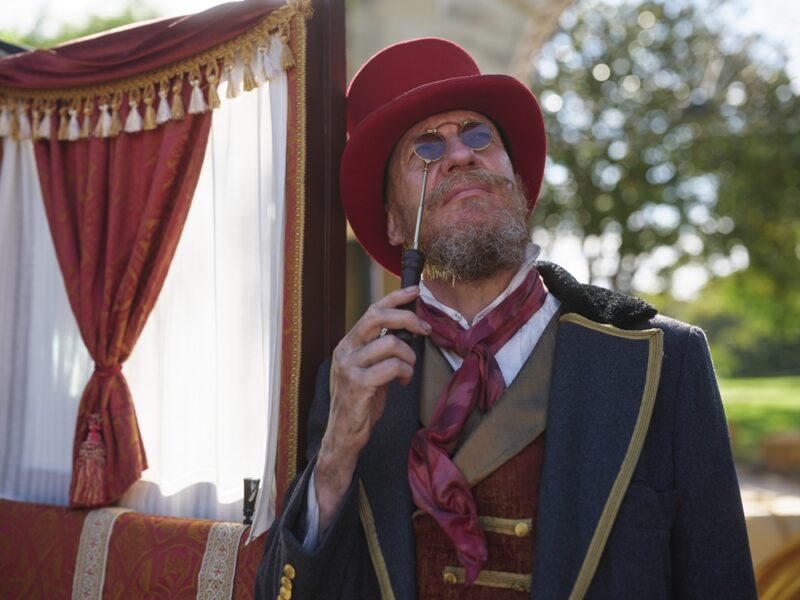
At the heart of this explosive new season – packed with fresh faces, new locations, romance, betrayal, and invention – is the volatile, complicated bond between mentor and protégé. Talking with our Peter Gray ahead of the series premiere, David Thewlis delves into the push-and-pull that defines Fagin and Dodger’s relationship: a dynamic that is at once salvational and suffocating, tender and transactional, comic and deeply tragic. Reflecting on Fagin’s blend of charm and menace, his distinctly physical performance, and the unexpected emotional depths drawn out by Thomas Brodie-Sangster’s Dodger, Thewlis reveals a character driven less by greed than by a desperate need for love, belief, and forgiveness – even as he spins ever grander visions that somehow, against all odds, keep coming true.
Season Two opens with Jack facing the noose while Fagin races across the colony to save him. After everything that’s happened between them, do you see Fagin as Jack’s salvation at this point? Or more of a curse?
A little bit of both, really. He certainly is his salvation, quite literally, in that he saves him from being hanged. But I also think that, in many ways, the best thing Jack could do would be to escape Fagin’s influence and the memories of his childhood that come with him.
Similarly, the best thing for Dodger would probably be for his relationship with Belle to go smoothly, to be accepted by her family, and for Fagin to fade into the background so he can get on with his new life. But then, of course, we wouldn’t have a show. That push and pull between them is where so much of the conflict and drama comes from. It’s a very rich, compelling relationship to have at the heart of the series.
Fagin feels very calculating, but also deeply sentimental about Jack. When you play him, do you feel like you’re leading with your head or your heart?
A bit of both. I always try to remind myself that his core motivation is his desire to gain Dodger’s love, acceptance, and forgiveness. That was my little secret while playing him – a private motivation I didn’t really discuss with the writers or director. Even though it can look like he’s driven by money or greed, the real prize for him has always been Jack’s forgiveness and affection.
Now that we’re in Season Two, I’ll probably have to come up with a new secret motivation, since I’ve just given that one away (laughs). But I think that emotional core is essential. If he were motivated purely by greed, he’d feel two-dimensional. What makes him interesting is that he’s vulnerable, sentimental, sensitive, and a little afraid – especially of death and pain, which is where a lot of the comedy comes from.
Building on that, Fagin can be both charming and terrifying in the same breath. As a performer, how do you balance those energies without tipping too far into either?
Some people might say I do tip too far at times, so I have to keep a close eye on myself and make sure I’m not overdoing it. Fagin is a very big, almost caricatured character, and that’s part of the joy of playing him. I don’t often get to play someone this unashamedly theatrical, even a little old-fashioned – almost like a Commedia dell’arte figure – which is hugely enjoyable for me.
At the same time, I have to make sure he stays within the overall tone of the show. There are certain characters who can afford to lean into that heightened style – myself, the Governor, and Lady Fanny are very much the “fools” of the piece. Then you have someone like Lady Jane, the Governor’s wife – brilliantly played by Susie Porter – who is not funny at all, but instead tragic, terrifying, and heartbreaking.
Alongside that, you’ve got Belle and Fanny as sisters, with Maia (Mitchell) bringing one kind of performance and Lucy-Rose (Leonard) another. On paper, you might think all these styles wouldn’t sit together, but they do beautifully, which I think is a credit to James (McNamara), our writer, who has a great understanding of this kind of tonal balance. So I feel that responsibility not to tip too far into outright ridiculousness, but you do have to push in that direction a little to make Fagin really work.
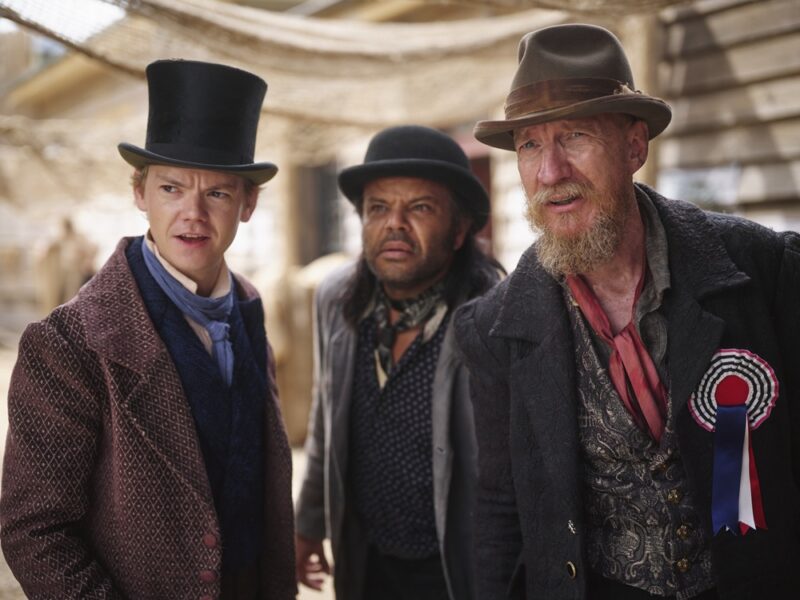
Fagin has such a distinct physical rhythm – the way he watches people, coils, moves, and reacts. Is that something you consciously choreograph, or does it emerge more organically on set?
It’s largely organic. I don’t really set out to work on it physically in a structured way. But once you’re in the costume, on the set, and placed in those situations, I feel the character sort of take over me physically, which tends to happen with most roles, unless you’re playing something that requires a very specific, trained physicality.
That said, I do think about certain things, like how he runs or his general posture. I play him as having a very bad back, which isn’t much of a stretch, because I sometimes have one myself. Before this season, I actually broke my leg quite badly, so I had a limp at the start of filming. In a way, that ended up being useful, because Fagin is a bit decrepit anyway. It’s not like I’m playing an athlete, so anything like that just feeds into him rather than working against him.
There’s a great line where Fagin says, “I bring the vision,” and Jack replies that he brings the plan. Do you think Fagin genuinely believes that? Or is it more part of his own mythology?
It’s very much his own mythology, but what’s interesting is that, especially by Season Two, that mythology is not entirely unfounded. No matter how madcap his “visions” are, they almost always work. When I looked back at Season One, I realised that, in fact, every single one of his schemes succeeds in some way. Even when he ends up in prison at the end of the season, he’s already secured his way out. He has the pardon papers and the money, so he’s never truly trapped, and he never actually faces the noose. Every plan he makes to earn money in Season One does, ultimately, make him money.
So by the time we reach Season Two, he’s living at Darius Cracks with a warehouse full of treasure, he’s wealthy, and he’s even got Dodger in his employ. As the season progresses, you’ll see him move into more “white-collar” crime – less pickpocketing, more land grants, real estate deals, and swindling the upper classes by selling parcels of land in the interior of Australia.
Has Thomas’s (Brodie-Sangster) performance ever drawn out a side of Fagin in you that you didn’t expect to find?
Yes, very much so. Something really lovely has developed between Thomas and me as actors. When we first began, he brought a version of Dodger that genuinely surprised me. When I initially read the script, before I knew who had been cast, I imagined we might get someone doing a kind of pastiche of Jack Wild from the musical, or a slightly oily, grown-up Cockney take on the character.
But what Thomas does is much more human than that – more considered, even intellectual in its approach – and as a result there’s a real sensitivity in his performance. He’s a beautiful actor to work with because he’s completely genuine. When you’re acting opposite someone that good, you feel it in their eyes, and you can find yourself genuinely moved in the middle of a take. That happens quite often with Thomas.
If Fagin could finally speak to Jack with no tricks, no deflection, and no self-protection – what do you think he would truly want to say?
I think, ultimately, it would come back to seeking forgiveness for all the trauma he’s caused Jack throughout his upbringing. He’d also want to be believed, particularly around the idea that he left Jack behind in prison to die. I’m not sure how much the show has fully explored that yet, but in Fagin’s mind, he didn’t abandon him – even though he believes Jack feels that he did.
More than anything, I think he would want Jack to understand that his love for him is real. Jack is all he really has. He doesn’t have a love life, or anyone else in his world, at least not yet, so Jack represents everything to him. I think he’d want Jack to know that their relationship isn’t just opportunistic, that his feelings are authentic.
The Artful Dodger Season 2 is available to stream on Disney+ (Australia) and Hulu (United States) from February 10th, 2026.
