

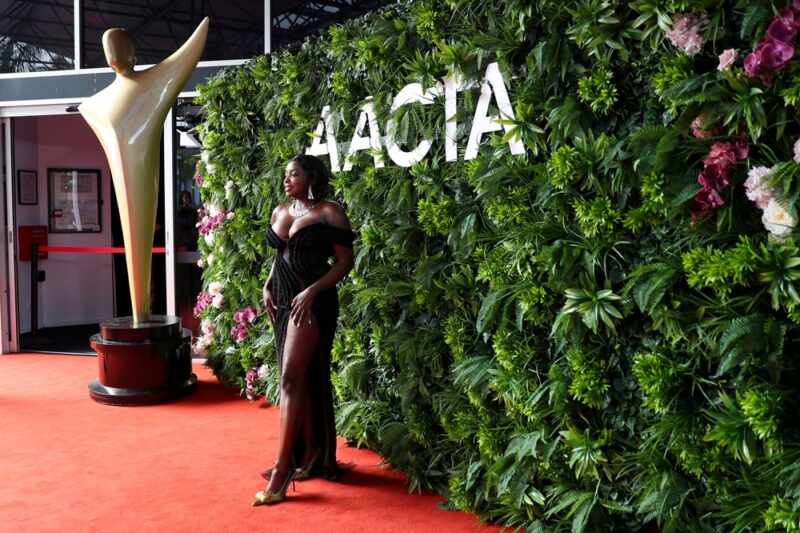
The Gold Coast glittered a little brighter on the first night of the AACTA Festival on Wednesday, February 4th – not because of Hollywood shine, but because of something far rarer and more meaningful: a genuine celebration of Australia’s own.
This opening night wasn’t about red carpets for the biggest stars or the climactic awards speeches still to come. Instead, it was an industry gala – a collective toast to the people who make Australian screen culture possible, from line producers to filmmakers, technicians, actors, and creators who grind away behind the scenes.
As noted, it felt less like an awards ceremony and more like a Christmas party – the kind where everyone finally gets to exhale, look around the room, and realise just how much they’ve achieved together.
“They’re all winners, really”
Shane Jacobson, a beloved fixture of Australian film and television, encapsulated the mood of the night. Asked to single out his favourite Australian film or TV show from the past year, he hesitated – not out of indecision, but out of loyalty.
“So many of these people are friends,” he said. “What I love about tonight is that the people working feverishly in the background finally get recognised. The actors will have their moment too, but this is really for the crew, the creators, the ones who make it all happen.”
He laughed, then leaned into the sentiment. “It’s going to sound corny, but they’re all winners in my eyes. Getting any project up is a mission.”
The night also marked a significant milestone: 20 years since Jacobson’s breakout film Kenny premiered. Reflecting on that moment, he remembered the mix of hope and uncertainty that mirrors the energy of the room now. “You work on something and you hope for the best – but it really is hope. That premiere was the night all of that came true for me. I just hope people here tonight feel even half of what we felt back then.”
The story of Kenny itself felt particularly resonant in a room full of ambitious creatives. Jacobson admitted that when he and his brother first started making it, they didn’t ask for permission – they just did it. “A lot of people said, ‘Oh, that’s cute,’ which really meant, ‘That won’t work.’ But that’s what made it so special when it did.”
Australian stories, told our way
The conversation naturally turned to what makes Australian storytelling so distinct – and why so many filmmakers, even after working overseas, feel pulled back home. Jacobson was unequivocal. “We punch above our weight. We do it incredibly well here. I’ve worked overseas, but Australia is my home. I love making films here.”
That sentiment echoed across the night.
For Kiah Roache-Turner – the filmmaker behind Beast of War and Sting – 2025 had been a particularly strong year for Australian cinema. While joking that he “loved them all,” he singled out Bring Her Back as a standout. “The RackaRacka boys just bleed talent. Talk to Me was incredible, but Bring Her Back showed a real emotional maturity. You watch their early shorts and think you know what they do – then you see these films and realise you have no idea what’s lurking in their heads.”
He also praised The Correspondent, anything featuring Bryan Brown, and even tipped his hat to this year’s crop of shark films – a genre he knows all too well.
As for what’s next? Wolves.
Roache-Turner is moving from sharks in World War II to wolves on the Eastern Front – British troops, Russian snipers, Nazis, and a giant pack of predators. “And after that,” he joked, “I’m doing something where people just sit in rooms and talk. Something like a Ken Loach film. I’m exhausted.”
One of Roache-Turner’s collaborators, actor Jake Ryan, spoke about the importance of being proactive in the industry; “You can’t just wait for the phone to ring. Make your own stuff. Joel Edgerton told me that years ago — he and Nash used to close off streets just to film car races as kids.”
Now, Ryan is moving more into producing, developing projects, and continuing to create opportunities for himself and others – the exact kind of initiative that AACTA aims to celebrate. But not before gearing up for the aforementioned wolf outing from Roache-Turner; “I’ve only got a couple of months to get ready for my next World War II project – so I have to stay ready. I’m definitely not a slow-burn training guy – give me six weeks and I’ll get there. I’m a crash-diet, crash-training kind of bloke.
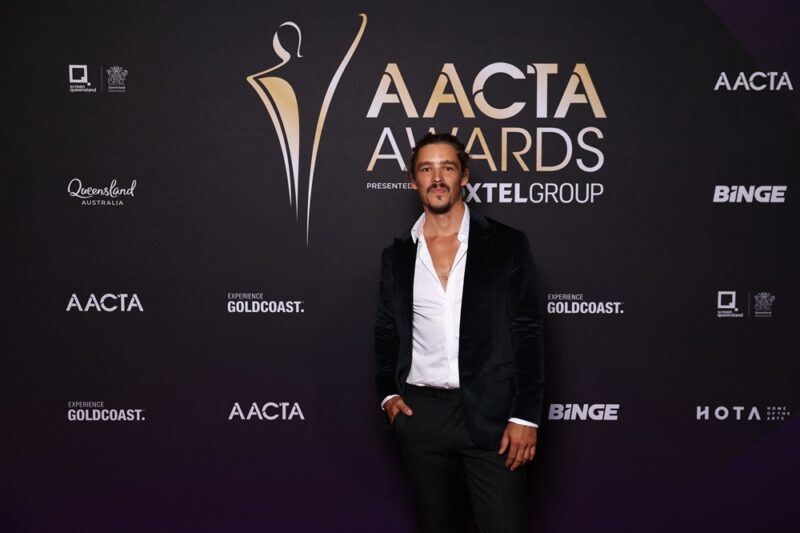
Brenton Thwaites: drama, darkness, and Australian horror’s rise
If Roache-Turner represents the bloodier edge of Australian cinema, Brenton Thwaites embodied another side of its recent success – emotionally complex, character-driven storytelling. Asked about his favourite Australian work from 2025, Thwaites didn’t hesitate.
“I really loved Bring Her Back. I just responded to how emotional and how dark it was. That’s something we do really well here – we lean into the drama and those deeper, darker stories.”
He was equally enthusiastic about his own We Bury the Dead. “It started from something very personal to Zak [Hilditch], and then it turned into this wild, cinematic, daytime horror. It felt beautiful and different – not just another genre exercise.”
Interestingly, Thwaites admitted that horror wasn’t always his comfort zone; “It wasn’t really my favourite genre, but it’s becoming one. Australian horror has developed so quickly in the last five to ten years.”
But beyond horror, Thwaites was drawn to a particular tone rather than a genre.
“I love films like The Peanut Butter Falcon or Little Miss Sunshine – dramas that are funny, where humour comes from character and circumstance, not jokes. That’s the kind of storytelling I gravitate towards.” He pointed to How to Make Gravy as an Australian example of that balance – deeply emotional, but also hilarious.
And of his recent series Later Two Years Later, which is premiering at the Festival, he noted: “It’s got funny peripheral characters that give you relief, but at its core it’s about two people unpacking all their emotional baggage. That’s the kind of story I love being part of.”
Representation without the box-ticking
Another theme that threaded through the night was representation – and doing it authentically.
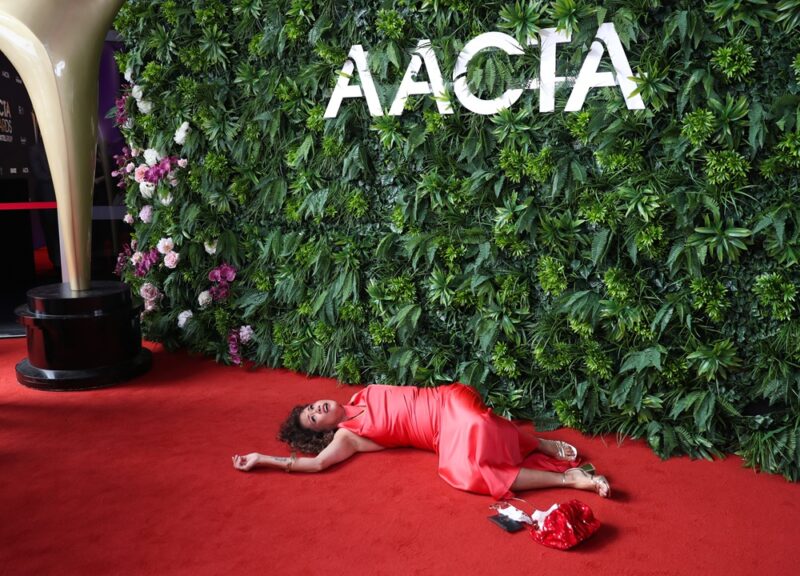
Tracie Filmer (speaking candidly) highlighted how much she loved the series Sunny Nights. “Ra Chapman is Korean-Australian, and nothing in the show is about her ethnicity. She’s just a fully realised character. She’s a journalist, a wife, a person.”
As a woman of colour, she found that refreshing. “So often, characters are defined by their background. But in Sunny Nights, she just exists – and I loved that.”
She also spoke passionately about how the industry is finally starting to embrace stories about women in their 50s. “Women my age are often treated as invisible. But we’re seeing more stories that say, ‘No, we matter.’ I want to be Jackie Weaver one day. Still relevant, still working, still seen.”
The unsung heroes of production
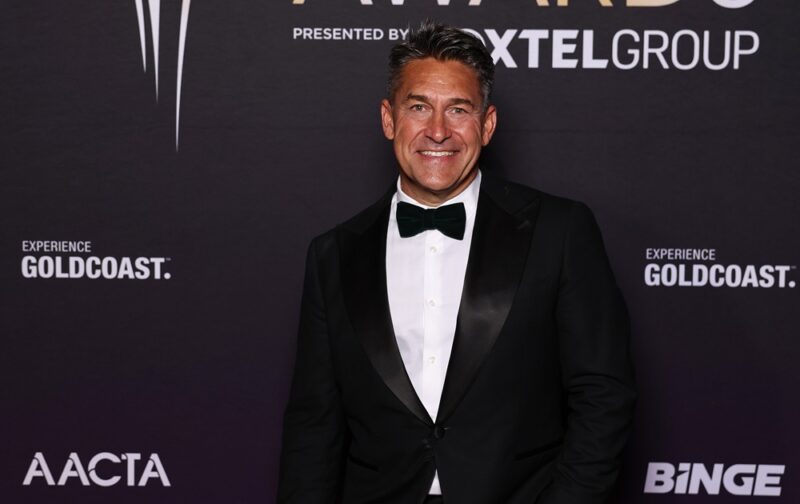
If there was one person who made a case for the real MVP of television, it was Jamie Durie. Asked which behind-the-scenes role deserved more recognition, his answer was immediate: the line producer.
“Every production lives or dies by them. If they’ve got their stuff together, everything runs smoothly. They’re the ones who shape how a story unfolds on screen.”
Durie also reflected on the best – and worst – advice he’s received in his career; “The worst was, ‘When you can fake it with sincerity, you’ve made it.’ I flipped that. I’ve just been myself for 30 years, and that’s kept me on air. People can smell fake a mile away.”
As for what he deemed his most memorable Australian media moment of the last year – it was less cinematic and more…structural. His 3D-printed house famously had a wall come crashing down — live on camera.
“It was meant to be the future of housing, and in that moment, the future did not look good,” he laughed. “But Channel Nine loved it. Great content.”
A night that mattered
As the night wore on, one thing became clear: this wasn’t just a celebration of films and TV shows – it was a celebration of perseverance, creativity, and community. From first-time filmmakers nervously clutching their drinks to veterans like Jacobson reminiscing about their early days, the energy in the room was electric, hopeful, and distinctly Australian.
Thwaites summed it up best when reflecting on the industry more broadly: “There’s something really special happening here. We’re braver with our stories, more confident in our voices, and more willing to take risks.”
This was not Hollywood. This was something better – homegrown, honest, and hard-won. And as the festival continues over the coming days, one thing is certain: whatever awards are handed out, the real winners were already in that room on night one.
The AACTA Festival is currently running on the Gold Coast until 8th February, 2026. For more information, head to the official site here.
