

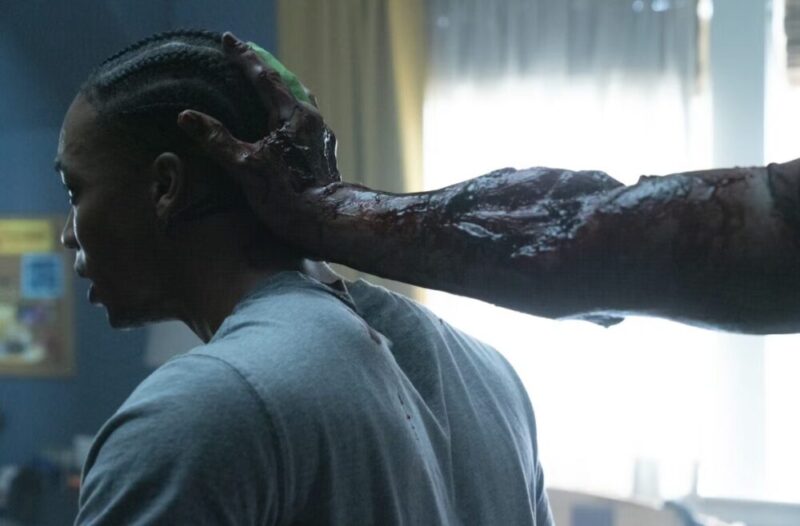
Corin Hardy’s Whistle wants to resurrect the kind of glossy, high-concept teen horror that flooded multiplexes in the early 2000s – and in some aspects, he succeeds. The problem is that it also inherits the era’s worst instincts. Riffing openly on Final Destination’s death-as-destiny mechanics and Smile’s trauma-tinged apparitions, the film follows a group of high school students who discover that an ancient “Aztec death whistle” summons visions – and eventually manifestations – of their own impending deaths. What begins as a detention-room curiosity spirals into a curse narrative where the sound of the whistle marks anyone who hears it. The concept is pulpy and promising, but the execution rarely rises above derivative homage.
The film opens with a fiery prelude involving a star athlete tormented by visions of a burnt man before meeting a spectacularly grim fate, setting the tone for a story steeped in supernatural inevitability. Months later, newcomer Chrys (Dafne Keen), full name Chrysanthemum, inherits the late student’s locker and, with a motley group of classmates (Sophie Nélisse‘s sweet-natured Ellie, Sky Yang as Chrys’s cousin, Rel, Jhaleil Swaby‘s macho jock, Dean, and Ali Skovbye as his girlfriend, Grace), becomes entangled in the whistle’s deadly mythology. As the body count climbs and the rules of the curse become clearer, the teens scramble to find a loophole before their visions catch up with them. There’s enough mystery baked into the premise to sustain intrigue for a while, but the screenplay by Owen Egerton struggles to balance character development with lore-dumping. Exposition arrives in heavy, clunky waves, and emotional beats often feel unearned.
Hardy proves he can stage an image – a hay-bale maze stalked by something unnatural, or a shadowy industrial setting humming with unseen menace – but tension is inconsistent. A couple of late-film kill sequences indulge in impressively grisly gore, briefly delivering the visceral punch horror fans might crave, and these moments hint at a nastier, more confident film lurking beneath the surface, but too often, however, the scares default to loud stings and CGI distortions, diluting any lingering dread.
The performances are a mixed bag. Nélisse emerges as the film’s steadiest presence, grounding her character with sincerity and giving the emotional stakes more weight than the script provides. Keen, tasked with carrying the film, doesn’t quite command the screen strongly enough to anchor its more melodramatic turns; her arc demands a depth the writing doesn’t fully support. Yang, meanwhile, is saddled with a grating characterisation that makes his already heightened reactions verge on tiresome. Veteran performers Michelle Fairley and Nick Frost lend fleeting gravitas, though neither is given enough to elevate the material.
Ultimately, Whistle feels like a throwback in both aesthetic and storytelling – slick, teen-focused, and built around elaborately staged deaths – but without the sharp plotting or sly self-awareness that made its predecessors endure. There’s a modest thrill in its nastier flourishes and a flicker of charm in its central relationship, yet the film never quite finds its own voice. For all its talk of destiny, Whistle ends up feeling preordained in the least exciting way: a familiar echo rather than a scream.


TWO STARS (OUT OF FIVE)
Whistle is now screening in Australian theatres.
