
Colleen Hoover may not exactly be considered one of the great literary voices of our time, but there’s an amusing moment in Verity when struggling writer Lowen Ashleigh (Dakota Johnson) describes the titular author’s output as the type of books you pick up at the airport. It’s a knowingly cheeky assessment of Hoover’s own particular brand of compulsively readable melodrama, and one that perhaps inadvertently highlights the greatest frustration with Michael Showalter‘s adaptation: for all the criticism one can level at the source material, the book ultimately commits to its own insanity more confidently than the film does.
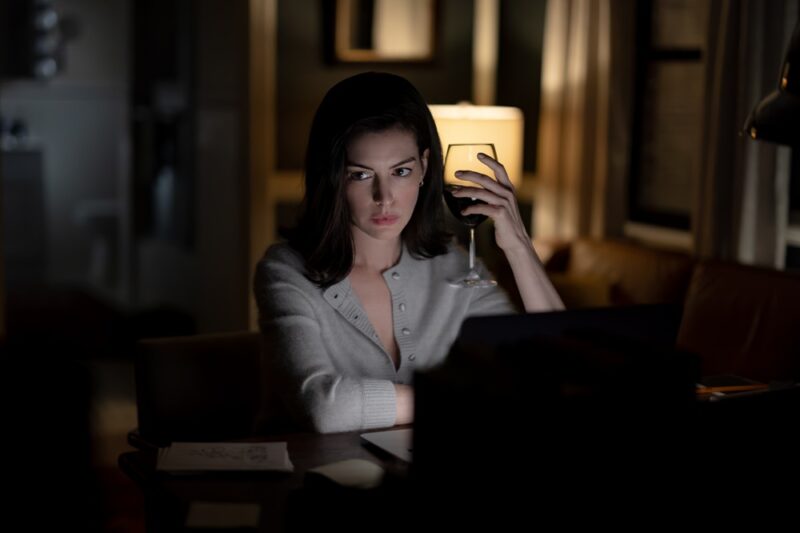
Adapted by Nick Antosca (TV’s Cape Fear), Verity centres on Lowen, whose struggling career receives an unexpected lifeline when she’s hired to complete a successful book series by renowned author Verity Crawford (Anne Hathaway), who has been left incapacitated following a car accident. Moving into the remote home Verity shares with her husband, Jeremy (Josh Hartnett), Lowen begins sorting through the author’s work and discovers what appears to be an unpublished autobiography filled with increasingly horrifying confessions.
As Lowen becomes consumed by what she’s reading, she’s simultaneously drawn towards Jeremy, leaving her increasingly unable to distinguish truth from fiction, victim from perpetrator, and attraction from manipulation.
It’s juicy material, and Verity certainly looks the part. The isolated Crawford estate is all imposing architecture, shadowy corridors and threatening luxury, creating the type of beautiful environment where practically everyone looks suspicious simply by standing still. The production design consciously turns the house into its own psychological rabbit hole, with spaces becoming increasingly oppressive as Lowen ventures further into the family’s secrets.
There’s also an unmistakable throwback quality to the whole affair. Verity wants to evoke the gloriously overheated erotic thrillers of the 1990s and early 2000s, complete with sex, obsession, beautiful people behaving suspiciously and increasingly outrageous revelations. Its creative team even planted visual nods to Dressed to Kill and Basic Instinct, while Showalter has described his intentions as creating something “big” and “operatic.”
If only the movie had surrendered itself to that mentality more completely.
Showalter has proven himself a wonderfully versatile filmmaker, but Verity feels caught between wanting to be an unapologetically trashy erotic thriller and something slightly more respectable. Given just how ludicrously entertaining Hoover’s material is willing to become, restraint isn’t necessarily the virtue the film thinks it is.
Hathaway certainly seems to understand the assignment. As Verity, she gets to weaponise her movie-star beauty and lean into the character’s seductive menace, while Johnson’s naturally understated presence makes Lowen an effective audience surrogate as she’s pulled deeper into the Crawford nightmare. Hartnett, meanwhile, knows exactly how to utilise his brooding charm as Jeremy, presenting the image of a grieving, devoted husband whilst leaving just enough uncertainty underneath that handsome exterior.
It’s difficult, however, not to watch Verity without thinking of the recent success of The Housemaid. The similarities are unavoidable: an everywoman enters an affluent household and becomes embroiled in its increasingly twisted secrets, with a glamorous matriarch and suspiciously handsome husband completing the triangle. Johnson, Hathaway and Hartnett effectively occupy the spaces Sydney Sweeney, Amanda Seyfried and Brandon Sklenar did there.
But where The Housemaid understood the value of throwing good taste out the window and embracing its pulpy absurdity, Verity doesn’t always push far enough.
That’s particularly disappointing because Hoover’s novel gives the story additional texture that could have strengthened the film’s eventual revelations. The reduction of Verity and Jeremy’s three children in the novel to two here, for example, might streamline the narrative, but it also removes an emotional component that contributes to the suspicion surrounding Verity and the lingering questions over her state of mind. Other details inevitably disappear in the transition from page to screen, leaving certain revelations without quite the impact they enjoyed on the page.
For viewers unfamiliar with the novel, such omissions are unlikely to prove as noticeable. The film moves efficiently, its mysteries arrive at a steady pace, and Antosca’s screenplay keeps shifting our allegiance enough that the central question of who is manipulating whom remains engaging.
And when Verity allows itself to get weird, it’s considerably more fun.
One dream sequence involving Lowen, Jeremy and Verity fully embraces the story’s psychosexual possibilities, merging sex, blood and nightmare imagery in precisely the heightened register the rest of the film could have used more of. It’s telling that the sequence evolved beyond what was originally scripted, with Showalter and his collaborators deliberately pushing its hallucination further into heightened craziness.
That’s the Verity this adaptation needed to trust.
Not necessarily a smarter film. Not a more tasteful one. A nastier, sexier and more deliciously unhinged one.
The result isn’t a terrible adaptation by any means. Removed from expectations surrounding Hoover’s novel, it’s a serviceable and slickly mounted psychological thriller that moves at an agreeable clip, benefits enormously from its ridiculously attractive central trio, and offers enough melodramatic thrills to keep audiences entertained until its final revelations. The filmmakers clearly want the ending to leave audiences debating what they believe, maintaining the novel’s distinction between ambiguity and outright vagueness.
But Verity could have been so much more fun.
Hoover’s novel already supplied the sex, obsession, questionable behaviour and ludicrous twists necessary for the type of unapologetic adult thriller Hollywood rarely makes anymore. Showalter gets tantalisingly close to embracing that trashy potential, but too often pulls back when he should be pushing harder.
For once, Colleen Hoover didn’t need someone to elevate her material. She needed a filmmaker willing to get down in the dirt with it.


THREE STARS (OUT OF FIVE)
Verity is screening in Australian theatres from October 1st, 2026.
