
There’s a particular kind of audacity required to make a film like The Testament of Ann Lee. It’s a historical epic. It’s a spiritual fever dream. It’s a full-bodied musical about celibate 18th-century dissenters who worshipped by trembling and dancing themselves toward transcendence. And somehow, under the assured direction of Mona Fastvold, it coheres into something rapturous.
At its centre is Ann Lee – the English-born religious leader who would become “Mother Ann,” founder of the Shaker movement – played with astonishing physical and emotional commitment by Amanda Seyfried. This is not reverent hagiography, nor is it cynical deconstruction. Instead, the film takes Ann’s testament seriously, approaching her visions and prophecies not as historical curiosities but as the animating force of a woman determined to reshape the world.
Fastvold, who co-wrote the screenplay with frequent collaborator Brady Corbet (The Brutalist), structures the film in three chapters: Manchester, migration, and America. The early passages in pre-industrial England are dense and claustrophobic, steeped in mud, candlelight and Caravaggio-esque shadow. There’s a Hogarthian rawness to these scenes – bodies pressed into tight spaces, waste and want visible at the edges of the frame. The aesthetic isn’t just decorative; it embodies the suffocation Ann is trying to escape.
When the film boards the Götheborg – the towering 18th-century replica ship used for the Atlantic crossing – the visual language shifts. Skies open. The camera breathes. The journey feels not just geographic but metaphysical. The transition is palpable: from confinement to possibility.
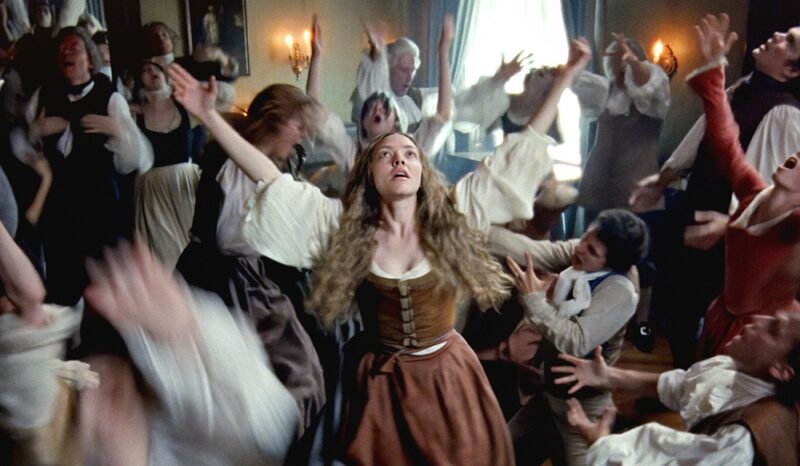
What makes The Testament of Ann Lee genuinely distinctive, however, is its embrace of the musical form. This is not a conventional “period musical” in the Broadway sense. Instead, the ecstatic worship of the Shakers – their trembling, circular dances and embodied confessions – becomes the film’s expressive core. Choreographer Celia Rowlson-Hall crafts movement that evolves from raw, searching gestures in Manchester to distilled, almost geometric clarity in America. The dances are acts of communication: grief passed from body to body, burdens lifted collectively, faith made visible.
Seyfried’s performance anchors these sequences with fearless intensity. She sings live. She speaks in tongues. She collapses, sweats, trembles, and rises again. There’s a moment in which Ann’s spiritual fervour borders on annihilation – and Seyfried doesn’t flinch. The role demands not just technique but surrender, and she gives both. It’s the kind of performance that leaves a mark on the actor as much as the audience.
The film’s soundscape, crafted by Oscar-winning composer Daniel Blumberg, is equally transformative. Drawing from traditional Shaker hymns, Blumberg reimagines them into something at once ancient and shockingly modern. Hand bells, celeste, layered choirs and glossolalic eruptions of voice create a sonic environment that feels devotional and destabilising in equal measure. When, at the film’s climax, a distorted electric guitar tears through the acoustic palette, it lands like revelation.
Production designer Sam Bader and costume designer Małgorzata “Gosia” Karpiuk deserve equal praise. The film’s visual arc – from the chaotic messiness of Manchester to the clean lines and spiritual order of Shaker America – mirrors Ann’s internal journey. The Shaker spaces, particularly, are rendered with reverence for craft: simplicity not as austerity, but as intention. Nature is not conquered; it’s accommodated. “A place for everything and everything in its place” becomes a quiet aesthetic thesis.
What lingers after the credits isn’t just the spectacle, but the film’s conviction. Fastvold frames Ann Lee not as a curiosity of religious history but as a radical visionary – a woman who believed community could be constructed, equality could be practised, and art could be devotion. The parallels to filmmaking are not accidental. The Shakers’ communal labour, their pursuit of perfection in craft, their belief in shared purpose – all echo in the film’s own collaborative spirit.
In a cinematic landscape often allergic to sincerity, The Testament of Ann Lee is boldly earnest. It dares to take faith seriously without proselytising. It finds humour and warmth amid austerity. And it recognises that the desire to build a better world – however impossible – is itself a creative act.
You truly haven’t seen anything like it.


FOUR AND A HALF STARS (OUT OF FIVE)
The Testament of Ann Lee is screening in Australian theatres from February 26th, 2026, including 35mm and 70mm across select locations.
