
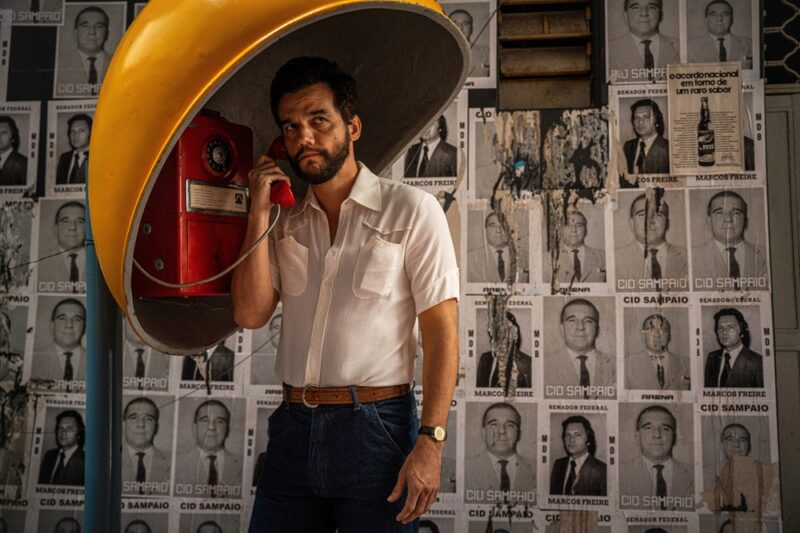
Kleber Mendonça Filho’s The Secret Agent is the type of film that doesn’t merely ask for attention, it commands it. Set against the suffocating backdrop of Brazil’s military dictatorship in 1977, the film unfolds during Recife’s Carnaval, where colour, music and movement become both camouflage and provocation. What should be a time of collective release instead curdles into a paranoid maze of surveillance, brutality and quiet resistance. Mendonça Filho uses this contradiction masterfully, turning celebration into cover, and spectacle into threat, crafting a political thriller that feels urgent not just as history, but as warning.
At the film’s centre is Wagner Moura, delivering a career-defining performance as Armando Solimões, a former university professor forced into hiding under a new identity while desperately trying to reunite with his young son. Moura, fresh off making Golden Globes history as the first Brazilian man nominated – and winning – Best Actor (in a Drama), brings a weary intelligence and simmering moral fury to the role. His performance is internal but volcanic, shaped by restraint rather than grand gestures. The film’s power lies in watching Armando navigate a world where every interaction feels transactional, every kindness suspect, and survival itself a political act. Moura’s return to Portuguese-language cinema only heightens the sense of homecoming and reckoning embedded in the film.
Formally, The Secret Agent is one of Mendonça Filho’s most ambitious works. Drawing inspiration from 1970s American cinema – Robert Altman’s sprawl, Brian De Palma’s paranoia, Sam Peckinpah’s violence, Steven Spielberg’s populist dread – he fuses neo-noir tension with an almost documentary attention to place. Recife is rendered as a living organism: its bridges, cinemas, rivers and colonial buildings soaked in memory and menace. The infamous “hairy leg” subplot, lifted from real newspaper hysteria of the era, exemplifies the film’s sly intelligence, revealing how absurdist sensationalism was weaponised to distract from state violence, corruption and homophobia. It’s one of many moments where Mendonça Filho exposes the mechanics of authoritarian power without ever resorting to didacticism.
The supporting cast deepens the film’s thematic reach. Maria Fernanda Cândido is quietly formidable as Elza, a resistance leader operating through whispered networks and recorded testimonies, while Udo Kier – in his final screen role – brings unsettling ambiguity as Hans, a Jewish Holocaust survivor misidentified and harassed by police. Their presence reinforces the film’s fixation on memory: who controls it, who erases it, and who survives long enough to pass it on. The film’s framing device, following a contemporary history student piecing together Armando’s fate, underscores this obsession, transforming The Secret Agent into both thriller and act of historical preservation.
What ultimately elevates The Secret Agent is its refusal to simplify. It’s expansive, sometimes unwieldy, and deliberately dense, but always purposeful. Mendonça Filho understands that authoritarianism thrives in complexity, confusion and fear, and his film mirrors that reality with confidence and clarity. As Brazil’s official submission for Best International Feature and a critical sensation across Cannes, the Golden Globes and beyond, The Secret Agent stands as one of the year’s most vital films: a work that pulses with anger, empathy and cinematic ambition, insisting that the past is never past, and that looking away is not an option.


FOUR AND A HALF STARS (OUT OF FIVE)
The Secret Agent is screening in Australian theatres from January 22nd, 2026.
