

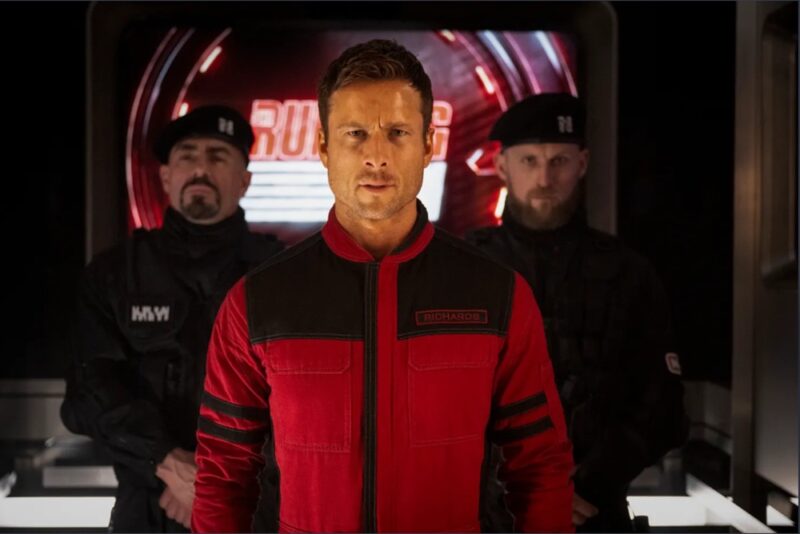
The Running Man is a film that feels as if it’s caught in the middle of two very distinct personalities. So much of the film’s DNA comes from its original source material, Stephen King‘s 1982 novel of the same name (written under the pseudonym Richard Bachman), a dystopian commentary piece set in a futuristic America, where, on a widely broadcast television show, convicted criminal “runners” must escape death at the hands of professional killers; it’s bleak, to say the least.
On the other hand, The Running Man is also a film honouring the violent, campy 1987 mentality of the Arnold Schwarzenegger feature that originally adapted King’s prose. It had the basis of the novel, but very much transformed itself during production into a flashy actioner to cater to the fact that it was more an Arnie feature than anything else.
Given the current climate of media saturation and manipulation, where figures of little importance or controversial standings become beacons of false aspiration, as well as the novel’s stance on voyeuristic entertainment, The Running Man makes sense to be revisited in 2025. Similarly, remakes are at their peak, and the chance to update the commentary somewhat missed in the Schwarzenegger edition is one that shouldn’t be overlooked, nor the ability to enhance the action mentality that drove so much of the 1987 feature too. There’s a lot to balance, but it’s also not an entirely impossible task to execute.
Without entirely drowning in puns, The Running Man can’t quite keep up its own pace, but it’s certainly not for a lack of trying. For starters, this 2025 version has one big thing going for it in the figure of its charismatic lead, Glen Powell. Though the actor has been working consistently for the last two decades, it was arguably Top Gun: Maverick in 2022 that catapulted him onto the cusp of movie stardom, and since then he has rode a continual wave of success, both critical and commercial, with The Running Man very much benefitting from his everyday man charisma, cheeky sense of humour and believable action-ready physicality. His character here, Ben Richards, is a bit more anger-forward than we are used to seeing from the actor, and though the more cocksure-yet-human mentality he has put forward in the aforementioned Maverick and last year’s Twisters seems to suit him better, he injects enough heart into the aggression for us to stay on his side over the course of the film’s sometimes-testing 133 minutes.
The other feather in The Running Man‘s cap is that of director/co-writer Edgar Wright; Michael Bacall (who collaborated with Wright on Scott Pilgrim vs. The World, as well as penning the two 21 Jump Street films) serving as his writing partner. Wright has a pretty enviable filmography as a filmmaker (Shaun of the Dead, Hot Fuzz, Scott Pilgrim, Baby Driver, Last Night in Soho), and the idea that his unique flourishes and personality would be injected into this universe is exciting, and in the opening moments of The Running Man, it appears like the visual storytelling will indeed reflect such. Whether it was studio interference or Wright felt the story demanded less of himself, the film only sporadically feels like it has the director’s fingerprints on it, making it even more feel like a feature of disjointed proportions.
By no means does it make The Running Man a bad film, just one that can’t help but feel like it could’ve been more; it also doesn’t feel like it quite knows where it wants to go as it barrels towards its climax, but along the way there’s plenty of violent, satirical fun to be had. Powell’s Ben, as we learn, is a disruptor of sorts. He’s seemingly unable to hold down a job without causing an issue (“insubordination” is a word thrown around a lot regarding his professional terminations), and it’s why he finds himself desperate enough to try out for a heft of gameshows that all promise a prize of wealth. His wife (Jayme Lawson) isn’t convinced this is the correct path to follow, but with their baby daughter sick, and medication near-impossible to afford, Ben doesn’t see any other way out. “The Running Man” program, which ultimately rewards its winner with $1 billion upon completion of surviving 30 days in the kill-or-be-killed competition, is the one show Ben doesn’t want to participate in, but during the training program for the cavalcade of shows under producer Dan Killian’s (Josh Brolin) smarmy eye, he’s picked for his evident skill and hostile spirit.
Ben, the more comedic and casual Jansky (Martin Herlihy), and the cocksure Laughlin (Katy O’Brian) are the three chosen to participate in the latest “Running Man” season, where, as pronounced by the show’s ringmaster host, Bobby Thompson (Colman Domingo, one of the absolute cast standouts), they are given a 12 hour headstart to venture into the concrete jungle of the city and begin their planning as to how they’ll evade the cast hunters, the general public who can all earn rewards for spotting them, and the security drones that are designed to follow their every move where possible. It’s no surprise that Ben will be our last man standing, but there’s a lot of initial fun to be had in The Running Man when it sets up the differing manners as to how the contestants decide they’re going to play the game. Ben is the smartest, and he initially thinks he’s found a sanctuary to hide in plain sight; thanks to Powell’s evident penchant for a facial disguise and altering voice (see Hit Man or the series Chad Powers), Ben manages to check into a hotel largely undetected. Jansky is kind of oblivious to how serious the game truly is, and Laughlin practically goads the public to find her, but these juxtaposing personalities give way to some of the film’s more fun explorations, and you can’t help but wonder how much more entertaining proceedings could have been if it focused on them as a dwindling – or potentially supportive – trio.
It’s a film that wants to be as serious as it is outlandish, and Wright just can’t seem to marry the two together as cohesively. The commentary around the rising prices of medicine and how deepfakes have become near-impressively undetectable keep The Running Man somewhat grounded and, arguably, depressing. These issues deserve their weight though, and Ben going to such extremes for his family is a temperament I gather many – especially familial men – will resonate with. But it’s also the kind of film that wants to have its cake and eat it too, with moments of lighter action fare introduced to offset, which are undeniably fun (there’s a whole sequence involving Michael Cera that encapsulates the vibe the film’s promotion is selling), but are fleeting in their entirety. Then there’s a whole later-introduced subplot involving Emilia Jones‘s “hostage” that feels like it could’ve been an entire movie on its own. There’s nothing inherently wrong with her character or the narrative, but sandwiched in the film the way it is, as we move towards Ben’s inevitable showdown with Killian, by way of the show’s lead hunter, McCone (an imposing Lee Pace), it feels more like a padded obstacle that the running time didn’t need.
Whilst The Running Man is flawed, with its action mentality and social commentary not quite blended as strongly as it could have been, and Wright’s directorial touch not as pressing, it’s still an enjoyable effort that provides plenty of merit and, perhaps most importantly, continues the trajectory of Powell’s leading man persona – one that he has adopted with particular ease.


THREE AND A HALF STARS (OUT OF FIVE)
The Running Man is screening in Australian theatres from November 13th, 2025, before opening in the United States on November 14th.
