

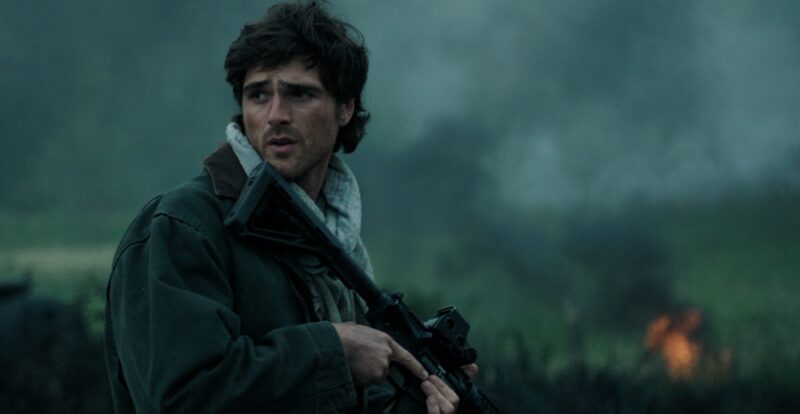
There’s a fascinating film buried somewhere within The Dog Stars. It’s quieter than its marketing suggests, more interested in grief, loneliness and the necessity of human connection than the violent survivalism its trailers have largely sold. And whenever Ridley Scott allows his latest to simply exist in that contemplative space, there are flashes of something genuinely affecting.
Unfortunately, The Dog Stars never quite trusts that version of itself.
Based on Peter Heller’s 2012 novel and adapted for the screen by Mark L. Smith (The Revenant, Twisters), the film unfolds in the aftermath of a devastating flu pandemic that has wiped out the majority of the world’s population. Among the survivors is Hig (Jacob Elordi), a former mechanic and pilot who has fashioned an existence alongside his loyal dog, Jasper, and the considerably less cuddly Bangley (Josh Brolin), a hardened military survivalist whose philosophy regarding strangers essentially amounts to shooting first and eliminating the need for questions altogether.
The two have established themselves at an abandoned airfield, where their opposing attitudes towards whatever remains of humanity create an uneasy but strangely functional partnership. Bangley sees threats everywhere. Hig, despite everything he has lost, remains determined to believe that humanity might still be worth finding.
It’s that tension that provides The Dog Stars with its most interesting thematic terrain. Survival itself isn’t necessarily Hig’s problem. He has learned how to stay alive. The question is whether simply remaining alive constitutes a life at all.
Still grieving his wife, Melissa (Sai Bennett), Hig spends his days flying across the increasingly empty landscape, searching for supplies and maintaining contact with a peaceful Mennonite community that Bangley views with characteristic suspicion. When a fragmented radio transmission suggests that something – or someone – may be waiting beyond the boundaries of his established world, Hig becomes increasingly compelled to investigate.
It’s a familiar post-apocalyptic setup, and therein lies one of the film’s immediate problems. Cinema and television have spent so much time amongst collapsed societies, deserted cities and traumatised survivors that The Dog Stars arrives carrying the burden of everything from The Road and I Am Legend to 28 Days Later and The Last of Us. Scott can still compose an image with enviable confidence, and the natural landscapes provide the film with an unexpectedly beautiful backdrop, but visually striking emptiness can only distinguish the material so much.
Perhaps more surprisingly, this isn’t particularly the action film its advertising has suggested either.
There are certainly bursts of violence, and Scott remains more than capable of staging an effective action sequence when the screenplay gives him the opportunity. The problem is that these moments are relatively sporadic. The Dog Stars is predominantly a slow-burn character drama, and audiences expecting two hours of Elordi and Brolin battling their way across a hostile wasteland may find themselves surprised by just how much of the film is devoted to conversations, flying, fishing, remembering and simply existing.
That isn’t inherently a criticism. In fact, the quieter The Dog Stars becomes, the more interesting it often is.
There’s something compelling about watching Hig navigate a world where the practical necessities of survival have become almost routine. Scott finds an understated poetry in the stretches where very little happens, particularly when Hig is alone in the air or surrounded by landscapes that have continued flourishing despite humanity largely disappearing from them. Nature doesn’t particularly care that civilisation ended, and the contrast between its beauty and Hig’s internal devastation gives the film some of its strongest imagery.
The trouble comes whenever the screenplay appears to panic about that stillness.
Suddenly there are Reapers, attacks and violent confrontations that feel less like organic developments than reminders that The Dog Stars is supposed to be a major studio production. The tonal divide becomes especially pronounced in the final act, when the film takes a bizarre detour that feels imported from an entirely different, considerably more eccentric post-apocalyptic movie. Allison Janney appears in a sequence that certainly jolts the film awake, though whether that’s beneficial is another question entirely.
It’s indicative of the larger problem: The Dog Stars never entirely decides what kind of film it wants to be.
That uncertainty also impacts its characters. Hig eventually encounters Pops (Guy Pearce) and his daughter Cima (Margaret Qualley), themselves surviving on an isolated property. Pops initially regards Hig with understandable suspicion, whilst Cima recognises something more familiar in him. Like Hig, she has lost a spouse, and their tentative connection is built less around conventional romance than the strange recognition that comes from encountering somebody who understands the particular shape of your grief.
Qualley brings a welcome warmth and curiosity to Cima, and her scenes with Elordi are among the film’s more emotionally convincing moments. Their relationship is thankfully allowed some degree of patience, avoiding the sense that two attractive survivors must immediately fall into each other’s arms simply because civilisation has removed most of their other options.
Pearce, meanwhile, is terrific value as Pops. He and Brolin understand how to inject personality into characters who could easily have become interchangeable variations on the grizzled apocalypse survivor. Brolin especially gives Bangley an unexpectedly funny edge, suggesting affection for Hig even when the character would presumably rather swallow ammunition than actually verbalise it.
They also expose one of the film’s weaknesses, however, because both performers manage to suggest histories their screenplay rarely bothers providing.
And then there’s Elordi.
After the physical transformation and impressive dramatic work he displayed in Frankenstein, The Dog Stars should theoretically cement his transition into full-fledged leading-man territory. I’m still not entirely convinced.
He’s by no means bad here. His physicality suits Hig, and Elordi convincingly embodies a man who can repair an aircraft, handle himself in dangerous situations and survive within this environment. There’s also an appealing gentleness to him that separates Hig from the more aggressively masculine figures surrounding him.
But the film asks Elordi to carry enormous stretches through internalised grief, and there remains something curiously remote about his performance. Hig is wounded, lonely and searching for meaning, yet that interiority doesn’t always translate beyond the surface. Elordi gives us the outline of the character without consistently making us feel the weight inside him.
Perhaps some of that is simply the screenplay failing him.
Smith’s writing has an unfortunate tendency to verbalise ideas that would be considerably more powerful left unspoken. Characters explain themselves, their circumstances and occasionally their emotions with a directness that feels at odds with Scott’s more visually instinctive filmmaking. The director understands that a landscape, an empty building or a man sitting alone with his dog can communicate loneliness perfectly well. The screenplay frequently insists on explaining it anyway.
It’s also why The Dog Stars feels as if it may have benefited from television rather than cinema.
There’s a rich world here that the film keeps brushing against without properly exploring. The Mennonite community, Bangley’s history, the lingering consequences of the pandemic, the Reapers, Hig’s former life, Cima and Pops’ experiences and even the mechanics of this newly fractured society all suggest stories that could have breathed across a limited series. Instead, characters and ideas are introduced, briefly examined and then abandoned as Hig moves towards the next stage of his journey.
That episodic quality makes the film simultaneously feel slow and strangely rushed. Individual stretches are given room to breathe, yet the overall narrative struggles to make its various pieces cohere.
And perhaps that’s the greatest frustration of The Dog Stars. There is absolutely material here worth engaging with.
Its most compelling idea isn’t whether Hig can physically survive. He demonstrably can. It’s whether someone who has lost virtually everything can risk caring about anything again. In this world, hope becomes its own form of danger. Trusting another person creates something else that can be taken away from you, and withdrawing from humanity altogether might actually be the safer option.
Hig and Bangley embody those competing philosophies beautifully. One survives by closing himself off; the other survives because some part of him refuses to.
Whenever The Dog Stars concentrates on that divide, Scott’s film threatens to become something special. There’s even something unexpectedly hopeful underneath all its violence and desolation, a suggestion that rebuilding a life requires more courage than merely protecting one.
But those ideas deserve a richer screenplay than the one they’re afforded.
At 88, Scott’s sheer filmmaking energy remains remarkable, and The Dog Stars certainly doesn’t look like the work of somebody losing command of his craft. There are striking images, bursts of muscular action and moments of genuine tenderness. Brolin and Pearce reliably enliven proceedings, Qualley gives the film some much-needed emotional texture, and Elordi continues to demonstrate enough promise that I remain curious about where his career takes him.
Yet the finished film sits frustratingly between identities: too contemplative to satisfy as the action-driven survival thriller it’s been marketed as, but too thinly written to fully succeed as the meditative character study it clearly wants to be.
The Dog Stars isn’t disastrous. In some ways, that almost makes its shortcomings more disappointing. Ridley Scott’s films, good or bad, usually inspire something. This one merely passes the time.
There are signs of life amongst the ruins. Just not quite enough to make the journey worthwhile.


TWO AND A HALF STARS (OUT OF FIVE)
The Dog Stars is screening in Australian theatres from August 27th, 2026
