
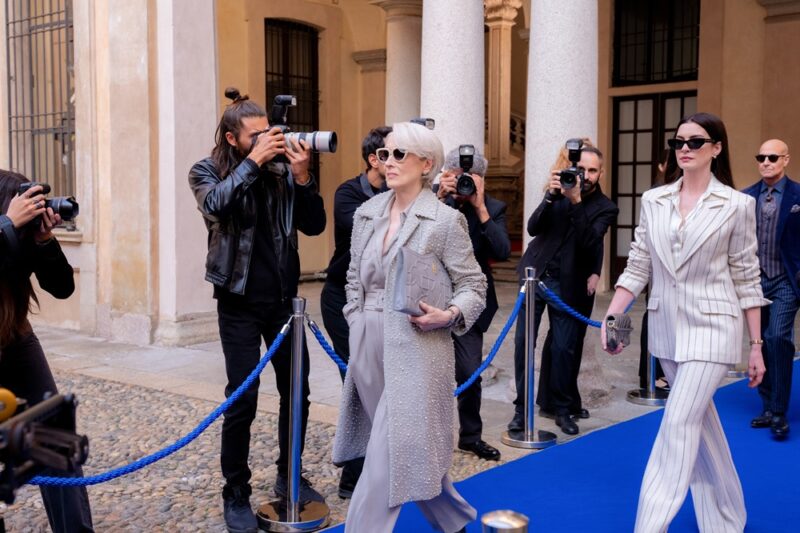
Two decades after The Devil Wears Prada first carved its place in pop culture, its sequel arrives with both the weight of expectation and the benefit of distance – and against the odds, The Devil Wears Prada 2 proves not only worthy, but surprisingly vital.
What could have easily felt like a nostalgic cash-in instead plays like a thoughtful evolution. The return of screenwriter Aline Brosh McKenna – who originally adapted Lauren Weisberger’s novel – anchors the film with a sharp understanding of these characters, while allowing them to grow within a vastly different media landscape. Notably, the sequel sidesteps Weisberger’s follow-up novel entirely, opting instead to chart its own course – one that feels more in tune with where both the characters and the industry would realistically land twenty years on.
The fashion world may still provide the glossy surface, but the film’s true focus is on the erosion of print journalism in the digital age. Runway magazine, once untouchable, now finds itself under threat – its authority challenged by viral outrage, shaky branding decisions, and a culture increasingly driven by algorithmic taste. It’s a clever, pointed backdrop that allows the film to operate as both a love letter to print and a subtle critique of the disposable, scroll-first mentality dominating modern media.
Anne Hathaway’s Andy Sachs re-enters this world from a position of instability rather than ambition, having lost the kind of prestigious job she once fought so hard to attain. Her unexpected recruitment by Runway chairman Irv Ravitz (Tibor Feldman) to help repair the magazine’s reputation – without Miranda Priestly (an expectedly divine Meryl Streep) knowing – immediately reintroduces the delicious tension that defined the original. Andy may believe she’s returning as an equal, but Miranda wastes no time reminding her otherwise, often with nothing more than a glance or a single, perfectly delivered word.
Streep remains magnetic, slipping back into Miranda with effortless precision. Yet the film allows glimpses of something softer beneath the steel. A visit to her Hamptons home reveals a more intimate side – one shaped by vulnerability, romance, and the quiet toll of maintaining power. Her relationship with new husband Stuart (Kenneth Branagh, underused but welcome) adds texture, even if Miranda never fully relinquishes control. The “devil” is still very much present – just more layered.
Emily Blunt arguably undergoes the most satisfying evolution. Emily Charlton, once the razor-tongued assistant, is now a formidable executive at Dior, holding a crucial piece of Runway’s survival in her hands. The bite is still there, but it’s tempered by experience – and perhaps a quiet longing for the kind of connection she once sacrificed. Her dynamic with both Andy and Miranda is richer, more balanced, and far more unpredictable.
Meanwhile, Stanley Tucci’s Nigel remains the film’s emotional compass, bringing warmth and sincerity that grounds the high-stakes maneuvering. His presence feels like a reassuring constant in a world that’s otherwise shifting beneath everyone’s feet.
The film also finds humour in the generational shift. Workplace culture has changed, and Miranda – once the embodiment of unchecked authority – now exists under the watchful eye of HR. A gag involving her being forced to hang up her own coat lands perfectly, as does the stark contrast between how Andy and Emily were treated versus the comparatively cushioned experience of Miranda’s new assistant, Amari (Simone Ashley). These moments aren’t just jokes – they underline how much the professional landscape has evolved, often to Miranda’s visible irritation.
What’s most surprising is just how funny and emotionally resonant the film is. The marketing undersells it; this is a sharper, more character-driven story than the trailers suggest. The script crackles with wit, the performances are uniformly excellent, and the emotional beats land with a maturity that reflects the time passed.
Rather than trying to recreate the original, The Devil Wears Prada 2 builds on it – expanding its themes, deepening its characters, and placing them in a world that feels recognisably modern. It honours what came before while confidently stepping into something new, ultimately proving that this story – and these characters – still have plenty to say.


FOUR STARS (OUT OF FIVE)
The Devil Wears Prada 2 is now screening in Australian theatres, before opening in the United States on May 1st, 2026.
