

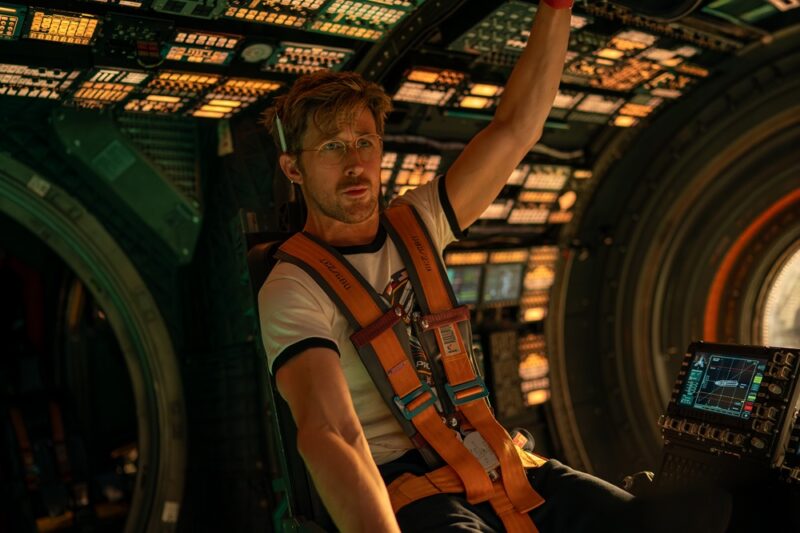
Ryan Gosling has built a career on playing men caught between intellect and emotion, but in Project Hail Mary he delivers one of his most engaging performances yet. Directed by Phil Lord and Christopher Miller (ever the inventive duo), and adapted from the beloved novel by Andy Weir, the film turns a deeply scientific premise into an exhilarating, heartfelt adventure that’s as funny as it is awe-inspiring.
The story begins in isolation. Dr. Ryland Grace (Gosling), a middle school science teacher turned reluctant astronaut, wakes up aboard a spacecraft with no memory of how he got there. As fragments of his memory return, the audience slowly pieces together the same terrifying truth Grace does: Earth’s sun is dying. A mysterious organism is draining its energy, threatening to plunge the planet into a catastrophic cooling that will wipe out global food supplies within decades. Humanity’s last hope lies many light-years away, at a star that appears immune to the phenomenon.
Grace’s journey to that distant system was never meant to be easy. The mission was designed as a one-way trip, a desperate gamble that required the brightest scientific minds on Earth. Yet when he awakens, Grace discovers he is the sole survivor of the crew. With only the ship’s AI for company and a mountain of complex scientific puzzles to solve, he must determine what is killing the sun – and whether there is any way to stop it before humanity runs out of time.
Just when the film seems poised to become an intimate survival story, it reveals its most delightful twist. Another spacecraft arrives, piloted by an alien being Grace eventually names Rocky. Constructed from an intricate blend of practical puppetry and visual effects, Rocky is one of the most endearing science-fiction characters in years. Though they initially struggle to communicate, Grace and Rocky slowly develop a shared language and a remarkable friendship. It’s here that the film truly finds its heart. What begins as a story about planetary survival evolves into a moving tale of cooperation across species, as the two scientists realize their civilizations are facing the same cosmic threat.
The Drew Goddard-penned screenplay cleverly balances dense scientific concepts with humor and warmth, allowing the audience to follow the problem-solving process without ever feeling overwhelmed. Gosling carries much of the film on his own shoulders, delivering a performance filled with curiosity, vulnerability, and comedic timing. Grace is not a traditional action hero; he’s a teacher, a thinker, someone who doubts himself even as the fate of humanity rests in his hands. That relatability makes his journey all the more compelling.
The film’s flashbacks also introduce the formidable Eva Stratt, played with commanding intensity by Sandra Hüller. As the architect of the Hail Mary mission, Stratt embodies the desperate determination required to unite the world behind an impossible task. Her scenes provide the global context that contrasts beautifully with the quiet intimacy of Grace’s experience in space.
Visually, Project Hail Mary is a spectacle. From the sterile corridors of the spacecraft to the alien environments encountered along the way, the production design and visual effects create a universe that feels both scientifically grounded and breathtakingly imaginative. The score by Daniel Pemberton enhances that sense of wonder, swelling at just the right moments to underline the film’s blend of discovery, tension, and emotional payoff.
At over two and a half hours, the film takes its time building the stakes (and perhaps overstays its welcome by about 30 minutes), but that patience ultimately pays off. By the time Grace and Rocky are working side by side to solve the cosmic mystery threatening both their worlds, the story has transformed into something far more profound than a typical science-fiction adventure. It becomes a celebration of curiosity, collaboration, and the idea that intelligence and empathy can bridge even the widest cosmic gulf.
Project Hail Mary succeeds because it understands that the most powerful science fiction is never just about technology or distant stars. It’s about people – and in this case, unlikely friends – facing the unknown together. With Gosling at the center of it all, the film is thrilling, funny, and unexpectedly moving. It’s the kind of big, imaginative cinema that reminds us why we go to the movies in the first place.


