

Whilst he has proved his weight in popcorn comic book efforts (The Amazing Spider-Man), indulgent actioners (Ambulance), and self-aware slashers (2022’s requel Scream and both its sequels, Scream VI and next year’s Scream 7) over his career, writer/director James Vanderbilt has also expressed a certain fascination with the morally grey areas of history (see David Fincher’s Zodiac), which makes him quite a suitable fit for Nuremberg, which almost reimagines the historic trials of Nazi war criminals as a slick courtroom thriller.
Set in the days following Adolf Hitler’s death in 1945, the film opens with the surrender of Hermann Göring (Russell Crowe, finally delivering a heavily-accented performance fitting of his talent), Hitler’s second-in-command, in Austria. Informed of said surrender, Associate Justice Robert Jackson (Michael Shannon) sees this as an opportunity to establish an international tribunal to charge the surviving Nazi leadership with war crimes, leading to an eventual agreeance from the U.S. in favour of his summary executions following some controversial knowledge he implies towards Pope Pius XII and his relationship with the Nazi regime; blackmail – works every time.
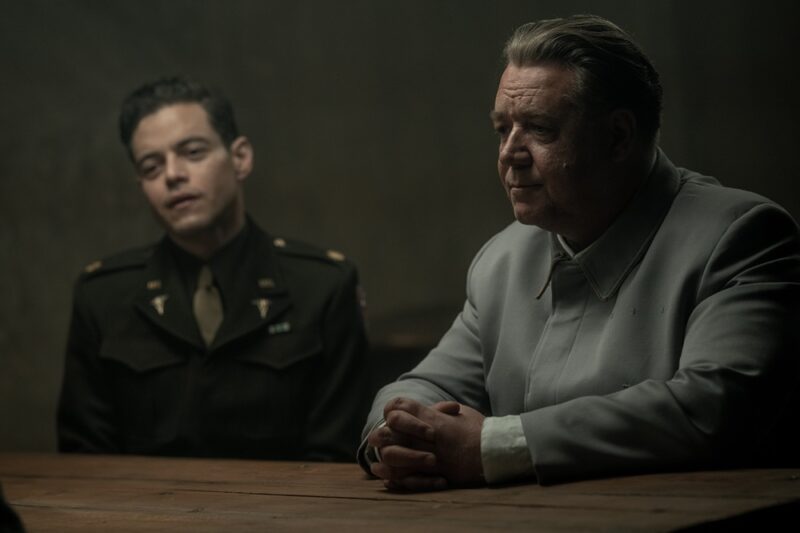
Elsewhere, U.S. Army psychiatrist Douglas Kelley (Rami Malek) is summoned to monitor the mental health of the captured Nazis ahead of the trial. What is believed to be a simple routine observation morphs into a battle of manipulation and opposing intelligence between Kelley and Göring, two men whose own egos refuse to relinquish control to the other.
Whilst Vanderbilt’s script – based off Jack El-Hai‘s book “The Nazi and the Psychiatrist” – doesn’t take its subject matter lightly, it does crackle with a certain Aaron Sorkin-esque snappiness, especially in the courtroom scenes that are undeniably bursting with energy. None of this takes away from the seriousness at hand, and when the trial itself fuses its visuals with that of real-life concentration camp footage, the gravity to proceedings feels that much heavier.
Similarly, Crowe’s performance is one of absolute domination. There’s a magnetism to him, but he’s a monster, without question. He understands both the power he holds and exactly what actions he has undertaken, and it’s the charm he infuses that makes his turn all the more unnerving. It’s a real return to form for the actor, and in a cast that’s so impressively stacked as it is (next to the aforementioned Malek and Shannon, is John Slattery, Colin Hanks, Richard E. Grant, and a tender Leo Woodall), it’s a testament to his presence that he stands out as much as he does.
Whilst those with historical knowledge will be able to tear the film apart on a more accurate level, and it’s difficult to not see its award-bait-like structure with certain lines of dialogue, Nuremberg still proves itself a handsomely crafted thriller in spite of the deep complexities of its subject. Perhaps more successful as a character study and an examination on the psychology of such, Nuremberg is still a haunting feature that feels eerily, and unfortunately, relevant in today’s political climate.


FOUR STARS (OUT OF FIVE)
Nuremberg is now screening in Australian theatres.
