

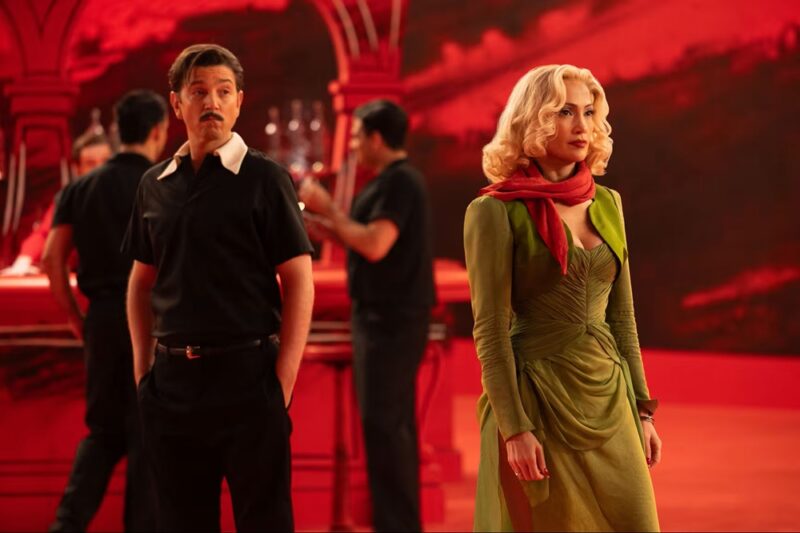
Given how effortless a performer she is, it’s quite incredible that, prior to Kiss of the Spider Woman, Jennifer Lopez hadn’t appeared in a movie musical.
Thankfully, Chicago scribe and helmer of such filmic musicals as Dreamgirls and the live-action Beauty and the Beast, Bill Condon, has corrected such a travesty with his vibrant, beautifully queer, and utterly romantic adaptation of the 1992 stage musical of the same name, itself based on Manuel Puig‘s 1976 novel, which was previously given a more traditional narrative in 1985.
Lopez has rarely been better than she is here, evoking the spirit of grand screen sirens of the past, ala Marilyn Monroe and Ginger Rogers, as she glides across as the screen as Ingrid Luna, a vampy, musical star, which Condon’s drama devotes half of its running time to as it focuses on her movie-within-the-movie – Kiss of the Spider Woman, a melodramatic tale of her Aurora, a successful magazine publisher caught in a love triangle.
These musical sequences, which are presented in lush, stunning technicolor – further evoking the spirit of classic musicals of the golden Hollywood heyday – offset the more grounded, dramatic story around Molina (Tonatiuh, an absolute revelation), a queer window dresser who has been arrested for public indecency, and Valentin (Diego Luna, quietly brilliant), an imprisoned Marxist political dissident, who are thrust together in a jail cell. Valentin’s not one for conversation, which doesn’t sit well with the particularly chatty Molina, who eventually breaks down Valentin’s resistance by recounting him the plot of his favourite movie (the aforementioned Kiss of the Spider Woman), detailing their absolute adoration for Ingrid and imagining both themself and Valentin in proceedings for the sake of our visual enjoyment.
Whilst audiences haven’t been starved for musicals in the last cinematic year (Emilia Perez, Wicked), Kiss of the Spider Woman is an entirely different beast than what we’ve experienced recently, with Condon clearly understanding how important light and colour are within the genre. The musical sequences are some of the most dazzling put to screen, with Condon taking full advantage of Lopez’s physicality as a dancer, shooting her in her full glory, rarely cutting away during her numbers as to highlight just how full bodied she is in her commitment; the colour of the screen is also an important aspect as to differentiate the vibrancy of Molina’s storytelling and the reality of their dark cell.
Only rarely does Molina’s cell become blurred in the lines of their existence and their escapist temperament, with one of the film’s most memorable numbers (“Where You Are”) bringing them temporarily out to break the fourth wall as the prison bars become the backdrop to Ingrid’s advice (“You’ve got to learn how not to be where you are, the more you face reality, the more you scar. So close your eyes and you’ll become a movie star. Why must you stay where you are?”), as she perfectly high-kicks in a tuxedo jacket and fedora (the Judy Garland reference is real!), her lyrics hoping to soothe the increasingly guilt-ridden Molina, who has more of a say over Valentin’s future than they realise.
Them sharing a cell is not a coincidence, with Molina being specifically sent by the warden (Bruno Bichir) to extract information from Valentin in exchange for their freedom. The two having something of an acerbic relationship means Molina shouldn’t care too much about using Valentin for their own gain, but the more the two are forced in close proximity, the more they understand the heart and the soul of the other; Molina learning to respect Valentin’s integrity, whilst Valentin warms to Molina’s unapologetic queerness and sees how someone could place such value in films.
And it’s their gradual understanding of each other that forms Kiss of the Spider Woman‘s most romantic aspect. Despite his staunch heterosexuality, Valentin doesn’t pander to the insulting nature so many of the guards do regarding Molina’s queerness, and as Molina tends to him in his hours of need across the torture he endures in prison, Valentin can’t help but succumb to a genuine care for Molina in return. Their love story weaves in and out of Condon’s script, which also places a romantic magnification on how Molina sees themself within the construct of Ingrid’s film, which, in itself, has an amorous throughline of its own; though Molina’s pronouns are never specified, they look to Ingrid as a figure to aspire to, more than being adored. Molina’s love for Ingrid is no less rich than had it been sexually charged, but they makes it no secret of their desire to be a woman, which is ultimately beautifully realised in a stunning number that encompasses their truth and love for all things theatrical (“Only in the Movies”).
It truly is a breathtaking piece of cinema, and though Luna and Tonatiuh remain utterly captivating in their tango of gentlemanly passion, it’s difficult to deny just how much Kiss of the Spider Woman catapults itself to another stratosphere of awe whenever Lopez graces us with her magnetism. Her beauty and charisma unmatched, her turn as Ingrid, Aurora, and the film-within-a-film’s mystical villain, the titular Spider Woman, feel as if she’s truly being reborn a star in front of our very eyes. Equally vampy as she is the ingénue, Lopez’s commanding vocals and unwavering commitment to the material should silence any of her detractors as she gleefully ensnares us in her web of radiance.

FIVE STARS (OUT OF FIVE)
Kiss of the Spider Woman is screening in Australian theatres from October 30th, 2025.
