

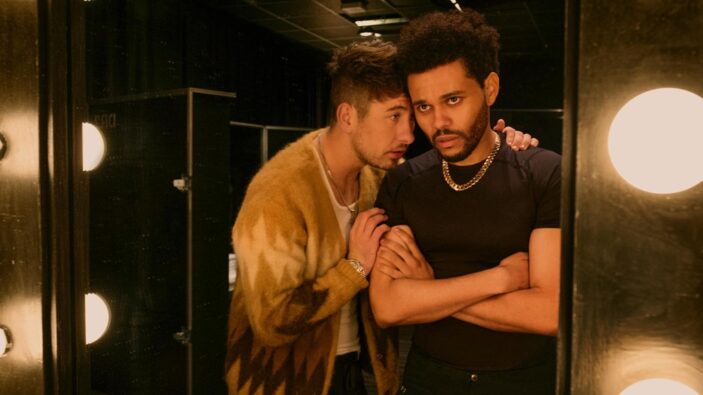
Whilst I had heard all the discourse around his performance (among other things) in the much maligned HBO drama series The Idol, it was not a show I particularly wanted to seek out – even out of curiosity. So, with that, I came into Hurry Up Tomorrow free from any of that baggage, here merely to view The Weeknd – or Abel Tesfaye, as he’s credited – in his cinematic form. Given how excruciating he is to endure across this film’s 105 minutes, I can only imagine how insufferable 5 episodes proved, as Tesfaye’s forte is clearly very much not acting.
I will give him the fact that he’s clearly immune to criticism, with him doubling down on such acting attempts, but Hurry Up Tomorrow doesn’t remotely serve as a way to prove he was done wrong by the series in any manner; and if you can’t even act when you’re essentially playing yourself, it’s very telling. But that’s what Tesfaye is doing in Hurry Up Tomorrow, a wholly misguided vanity project that celebrates his artistry in the most pretentious fashion, starring as a fictionalised version of himself, who is apparently such a genius in his lyricism that he inspires his fans in the most visceral manner possible.
One of those fans is Amina (Jenna Ortega, giving a far better performance than this slop deserves), a mysterious drifter type, who is introduced to the film as she burns down a house – something that seems to be a recurring feature to her psyche – before driving her way to The Weeknd’s latest show, where he practically breaks down on stage in a fit of vocal frustration. In the lead up, which feels more like thinly scripted sequences to highlight the indulgent lifestyle and grueling schedule that comes with being an acclaimed pop star, we see that The Weeknd is worried about the longevity of his voice, though his manager, Lee (Barry Keoghan, shockingly awful here), is more concerned with his mental state, as The Weeknd is finding it difficult to recover from a seemingly painful breakup; Riley Keough earning a minor credit through the use of her images and voice.
There’s massive potential in exploring the psychology of what such self-pressure can do to someone’s being, as well as the horror aspect of a fan going too far to right the supposed wrongs their idol indulge in (which Amina attempts as she holds him hostage to save his soul), but Tesfaye’s script, written in conjunction with Reza Fahim (who also penned The Idol) and director Trey Edward Shults (who helmed the stunning drama Waves), never delves deep into either of these narratives. The Weeknd is supposedly such a tortured genius, but the film tries far too hard to pay tribute to the fact, without the character earning it; as well, incessant crying does not a tortured genius make.
On no level does Hurry Up Tomorrow work. As a visual component to The Weeknd’s album of the same name, it doesn’t celebrate the music enough, and as a film on its own accord, it’s too pretentious and meandering to make any sense. It’s almost impressively audacious as to how important Tesfaye views himself here, and that he’s gone for something so large as his introduction to the world of cinema, but I doubt enough people will see this to give the film the longevity he’s managed with his far more successful singing career.
Ortega’s character might dance and wax lyrical about the deep importance of The Weeknd’s music – yeah, there’s actually a whole sequence devoted to her praising and dissecting his work to his face – but she’s likely to be the only one in a post-Hurry Up Tomorrow existence, as whatever artistic clout he had is in danger of being revoked in the face of his own self-importance. Less a title and more a statement as to how one can get further away from this film, Hurry Up Tomorrow should’ve been shelved yesterday.


ONE STAR (OUT OF FIVE)
Hurry Up Tomorrow is now screening in theatres in Australia and the United States.
