
A loud ticking clock accompanies the opening minutes of After the Hunt, Luca Guadagnino‘s topical #MeToo drama that presents the mundane actions of its central focus, Professor Alma Imhoff (Julia Roberts), as she goes about her day at Yale. It feels as if perhaps the ticking is leading to something substantial – a revelation – but then, in a move that ultimately feels quite telling of how Guadagnino takes on Nora Garrett‘s slow burn script, it simply just stops, transitioning to a plain credit list of names against a black screen that feels not unlike what you would expect Woody Allen to adhere to.
“It happened at Yale,” states the ominous opening sentence which precedes the set-up dynamic of Alma, her understanding husband, Frederik (Michael Stulbarg), close friend and colleague Hank Gibson (Andrew Garfield), and prize student Maggie Resnick (Ayo Edebiri), who are all waxing lyrical about philosophy one evening in a sequence that suggests how insufferable much of the film’s mentality may prove to be. Maggie excuses herself from the action for a moment, finding herself in the bathroom and, unintentionally snooping, in possession of a mysterious envelope that Alma clearly had hidden away for specific reasons. Unbeknownst to the party outside, and to us as an audience at this point, this one action will cause a spiral of consequences that the film takes delight in not necessarily solving.
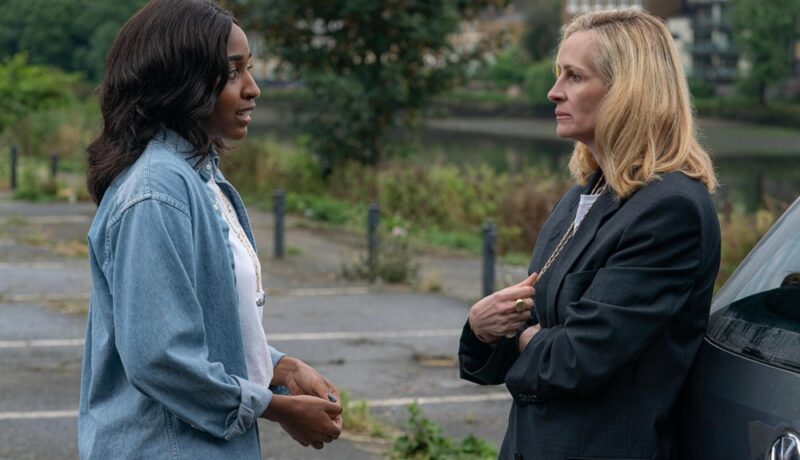
Following a day of Maggie surprisingly missing in action, she arrives on Alma’s doorstep, informing that Hank has assaulted her. There’s a surprising understated temperament to this scene – Alma seems to barely react – but it all leans into the ambiguity the film rides for the majority of its bloated 140 minute running time. It also sets up the “He said/she said” dynamic that so many of these stories have at their core. Given Hank’s youthfulness, the overly familiar manner in which he interacts with Alma, and the clear willingness to socialise with his students, Maggie’s accusation has a base. On the other side of it all, Maggie’s imputation lacks specifics, and the way in which she explains the accusation to Alma feels quite performative.
Such an allegation is enough to ruin a career, but it oddly sidelines Hank for large portions of the film, with Alma’s reputation the one that suffers; though purely for reasons of her own doing. It’s not that After the Hunt is taking sexual assault accusations lightly, but it becomes secondary to character mystery and questionable integrity; once it’s revealed what was in the envelope, our view of both Alma and Maggie drastically changes. But in that, surprisingly, it doesn’t make Hank a casualty either. Guadagnino clearly wants us to decide just who is telling the truth, and the film offers up moments of genuine interest and intrigue as it plays with their individual projection, but it also is mainly telling a story through Alma’s lens, so there’s something of a singular viewpoint that isn’t always trustworthy.
Circling back to the aforementioned performative nature of Alma’s accusation, the film, as a whole, very much adopts this mentality. Aside from a final word that’s yelled across the closing frame – you’ll see what I mean if you brave this film – there’s an oddness to the musical score from Trent Reznor and Atticus Ross, collaborating with Guadagnino for the fourth time following Bones and All, Challengers, and Queer; echoing piano notes and intrusive musical whangs interrupting scenes of apparent depth, fueling the obnoxious reminder that we are indeed watching a film.
Ultimately, After the Hunt proves just how much of a reliable anchor Roberts is as a presence on screen. As flawed and as unlikeable her Alma may be, she’s inherently interesting in all of her complications. She is effortless in how she commands both the unmoved moments of Alma’s strength and the devastating pockets of her vulnerability. Stuhlbarg, similarly, walks away with the film as its only true sense of good, whilst the divisive nature of Maggie and Hank as characters are wonderfully embodied by Edebiri and Garfield, though the latter’s insufferable nature does make it difficult to muster much sympathy for his plight.
A crucial story frustratingly undone by its own self-importance.


TWO STARS (OUT OF FIVE)
After the Hunt is now screening in Australian theatres.
