

Truth. Justice. Whatever.
Next July, audiences won’t be looking up, they’ll be looking out for Supergirl, as the DCEU continues on from this year’s Superman with the hotly anticipated feature-length take on the Man of Steel’s more reckless cousin.
Starring Australia’s own Milly Alcock as the Woman of Tomorrow and directed by fellow countryman Craig Gillespie (I, Tonya, Cruella), Supergirl will focus on the reluctant superhero as she celebrates her 21st birthday by travelling across the galaxy with her dog Krypto. Along the way, she meets the young Ruthye Marye Knoll and encounters a tragedy that leads her on a “murderous quest for revenge”.
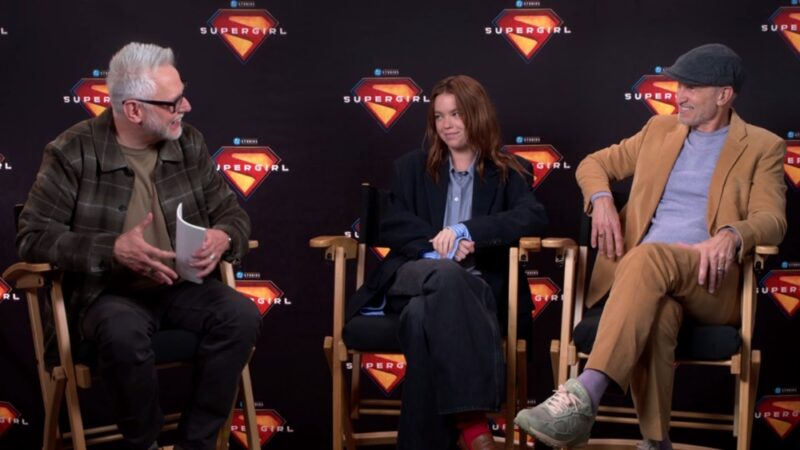
As the trailer arrives online, The AU Review’s Peter Gray was one of a select number of journalists from across the world to be invited to preview the footage, as well as join DCEU producer James Gunn who moderated a Q&A with Alcock and Gillespie, revealing what audiences can expect from next year’s super flick!
Why was Supergirl chosen as the DCEU’s follow-up movie to Superman?
As we await to see just who Gunn will cast as the inevitable Batman, Wonder Woman and Aquaman of this new universe, he was asked why a more familiar character wasn’t chosen to follow-up Superman? As he revealed, it was all in Ana Nogueira‘s script.
Citing it as the best script he’d read in a long time, Gunn went on to say that “At the end of the day, everything we do at DC is story driven. But unlike those other characters… Supergirl is not someone who we’ve seen in the big screen for a long, long time. And I loved the Tom King book, Woman of Tomorrow, so it was always something I wanted to do.”
Supergirl is stepping out of Superman’s shadow
The trailer makes it clear that this story is very much Supergirl on her own terms. And director Gillespie made it intentional, both tonally and visually, to differentiate her world from what audiences might expect from a Kryptonian story.
Following Gunn’s adoration for Gillespie’s I, Tonya, the director knew that he had permission to put his own stamp on proceedings. Saying that “Every DC project that (the studio) is going to do is its own graphic novel,” before noting that he was already sold on Nogueira’s script after the first two scenes.
Milly’s performance is grounded in humanity and humour
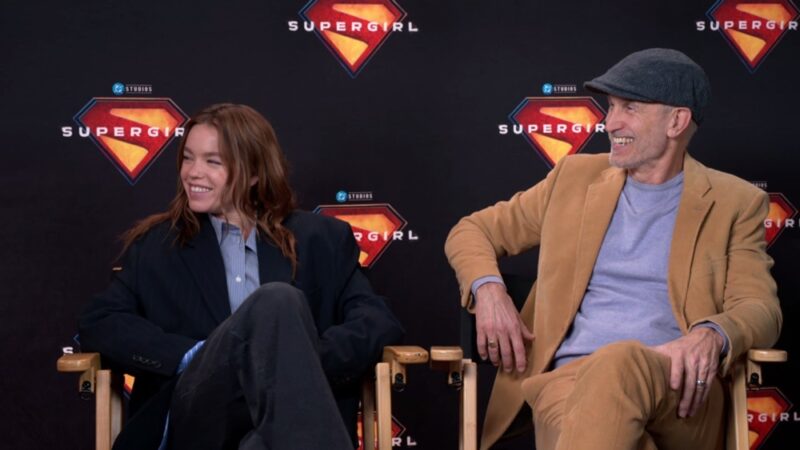
After the burst of energy she provided towards the tail-end of Superman, Gillespie enthusiastically praised Alcock’s performance as Supergirl, describing how she managed to break through all the mechanics of such big action films as this.
“At the end of the day, every time I turn the camera on Milly, she just grounds it. There’s this humanity to (her) and there’s this vulnerability and there’s this humor and there’s this strength that you just can’t get enough of it. It’s amazing.”
There’s emotion injected into the action
When Gillespie was asked about how he approached the film’s action sequences to make them distinct from other superhero ventures, he joked that he doesn’t watch superhero films! As he explained, there’s always an emotional component to the action, asking where is Supergirl coming from.
“How angry she is, how frustrated, how playful she is in these scenes. And that’s part of the action sequence for me. And then musically what we’re going to do to enhance that or contradict that. I try to vary it within each sequence and go through that, and just let the character’s emotion dictate how aggressive the camera work is, how operatic it is, depending on what her groove is.”
She’s an anti-hero
Noting how so many superheroes hide their emotions behind their abilities, Alcock spoke of what specific human flaw she chose to lean into to make her characterisation feel raw and genuinely real. Basically, she doesn’t want to be a hero, with the movie being about the opposite of her person.
As she explained, her strength is that she doesn’t hide; “She doesn’t mask behind her abilities. This journey that we watch her go on, she has to become the hero of her own story.”
She continued how the film balances Supergirl as a strong, powerful figure with her being a young woman navigating the galaxy.
“She doesn’t adhere to that standard of her being a vulnerable woman navigating the galaxy because she’s just so who she is. She can really hold her own. I think that the balance is actually between the audience’s expectation of who this person is going to be and how they’re going to have to behave. Thematically, the film looks at just the position of being a woman and the standard of what you can and can’t sacrifice.”
Supergirl is screening in Australian theatres from June 25th, 2026.
