
I think it’s important to have “favourite” artists.
Creatives whose words, thoughts and/or works resonate with you so hard that they bypass traditional modes of communication. They don’t speak to your consciousness, they dive to the bottom-of-the-iceberg part of your brain where memory and emotion lie. Music, paintings, books. Any work that speaks to you has a chance to help you sublimate complicated emotions and memories, so you can better orient yourself to live your life on your terms.
That is the true value of art. It helps you understand both the world and yourself. And that process is deeply personal.
I have several favourite artists; some confoundingly controversial (like Kanye West), some as offensive as a slice of bread (like Max Richter). Yet their works and the stories behind them have shaped who I am today and how I view life.
Art can do many things. It can help you reshape your memories and how they impact you in the present, which is the closest thing we’ll ever get to changing our past and learning to live with life’s inevitable regrets. It can influence how you engage with the world and what kind of perspective you take. It can comfort you in times of need. And it can help you write your own rulebook.
Wait, what does this have to do with Yosemite National Park?
Scale meant a lot to Georgia O’Keeffe. Perhaps more so than her abstracted natural landscapes, magnified flowers and bleached cow skulls. Yes, she adored the beauty of New Mexico, and it informed much of her life. But she also had a fondness for New York City and its towering skyscrapers.
She imagined them as great big mountains and purveyors of perspective, at their most profound when they’re framing the sunlight that beams down each avenue. When I stumbled upon her My New Yorks exhibition in 2024, at The Art Institute of Chicago, it immediately struck. I walked out of the renowned institution with a new lens through which to view the city’s man-made beauty. Chicago, after all, is where the skyscraper originated. O’Keeffe found beauty in a skyscraper’s bigness in the same way she found beauty in New Mexico’s sprawling desertscapes.
As I wrote in my reflections on Alice Springs:
“O’Keeffe knew the value of being around things much, much bigger than yourself. That’s why forest bathing has become such a central component of “wellness”. It’s why people find hiking through the national parks so important. And why Alice Springs is famous for Aboriginal art. After all, traversing the region is like stepping inside an immersive landscape painting.”
Yosemite National Park is one of the world’s greatest examples of big, imposing natural landscapes.
As soon as you enter the 747,956-acre land, the scale hits in waves.
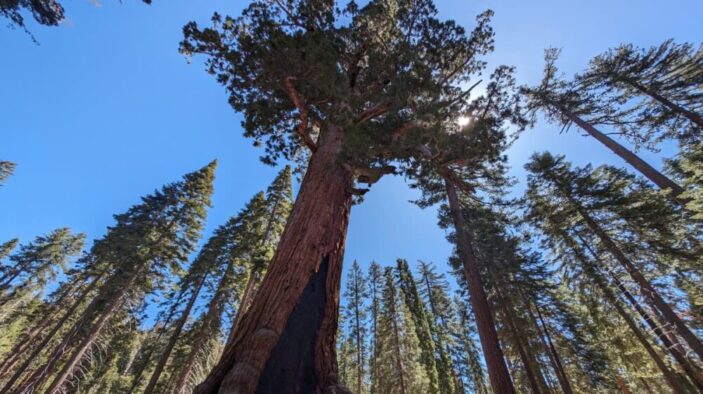
First, the visual shock of Mariposa Grove’s Giant Sequoias, which seem to scrape the sky. Then the acoustics: your voice, your footsteps, even your breathing, feel absorbed by the… vastness. Unlike O’Keeffe’s urban mountains, Yosemite’s ancient giants offer something skyscrapers cannot: the humbling reminder of deep time. The surrounding granite walls have stood for millions of years, carved by glaciers and weathered by countless seasons, making our human timescale feel impossibly brief.
But such grand nature doesn’t just dwarf us physically. It shrinks our inner monologue and helps us zoom out of ourselves. Given how much social media has, and will continue to, decimate communal mental health – particularly in the US – I see America’s unique National Parks system taking on new meaning in the coming years. These spots have always been essential escapes for campers, hikers, nature lovers, artists and soul-searchers for good reason.
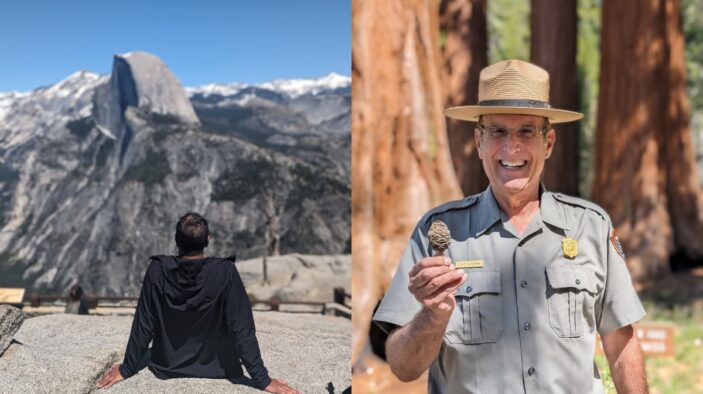
I feel it first in Mariposa Grove, where around 500 giant sequoia trees have stood tall for centuries, some dating back thousands of years. I’m here for work, so I am being guided around with a group of other travel writers and led by two of the park’s head rangers. A rare treat.
The sense of awe pulls out a tear or two at times. 2024 was a very dark time for me personally, and so I was the perfect guinea pig for nature’s restorative embrace. In Yosemite, she hugs tighter; embraces harder. Mother Nature clearly saved some of her best work for this part of California, and so I feel the head noise sink into the soil as I gaze up at those magnificent barky beasts.
Each breath feels like an exchange; I release the accumulated weight of a difficult year, and these giants offer back their patient wisdom.
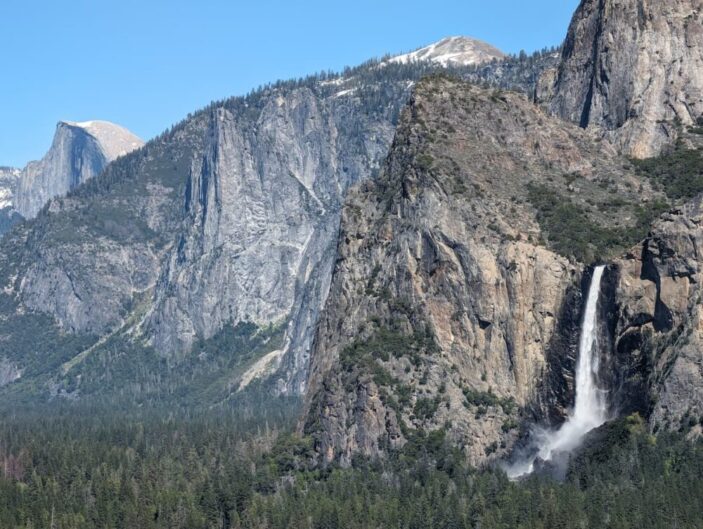
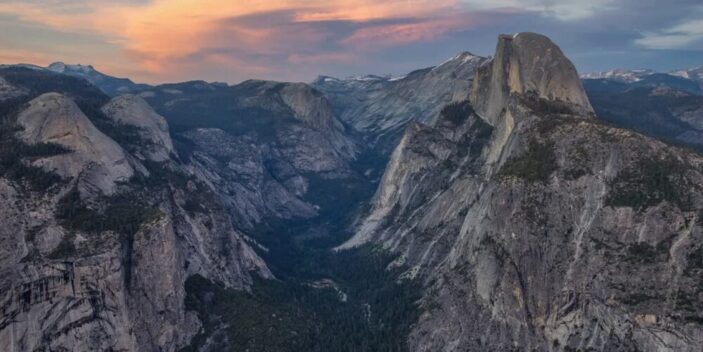
The rangers take us up to Tunnel View for a different kind of blockbuster. Craggy granite peaks rise from the expansive valley, with a vista that takes in three of Yosemite’s signature sights: El Capitan, Half Dome and Bridalveil Fall. I find myself wondering what kind of abstractions O’Keeffe could have pulled from this view. To my knowledge, she visited Yosemite in the 1930s with a nature photographer, Ansel Adams, but had never produced a painting of this majesty. A shame.
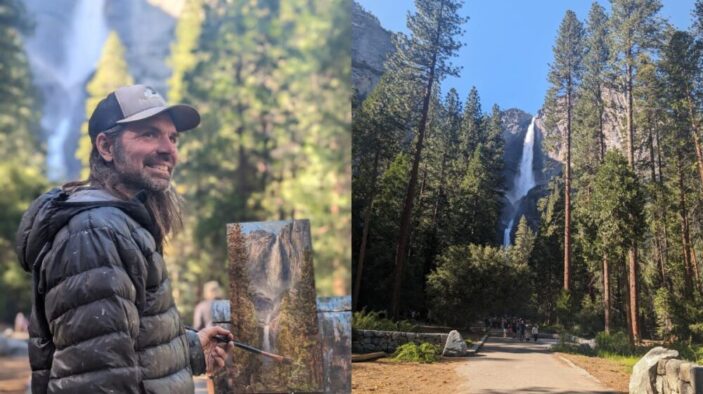
But artists seem to be drawn to Yosemite every day. I run into a few patiently painting Yosemite Falls, and doing a damn good job as well. By my count, at least four people are sitting from different perspectives, methodically dabbing the rougher textures that frame that distant waterfall. It’s approaching sunset, and most of these works seem near finished, each as fascinating as the view itself.
“Yosemite inspires me every day,” local artist James McGrew turns to me and smiles. “I’ve been coming here for years to capture what I see.”
Modern American art wouldn’t be anywhere near the same if it weren’t for America’s national park system. In the 1870s, a collective known as the Hudson River School painters would tirelessly capture these grand Western landscapes, helping the public connect with the soul of these places and deepen that sense of freedom that Americans hold so dear.
And I guess that’s another way the nature of this magnitude can easily squeeze out any inner tension. These settings don’t just make you feel small, and shift your perspective when needed, but they can also widen your imagination and capacity for deep introspection – the pre-requisite of true freedom.
I do believe that transformative, off-the-grid travel is about to take on an even greater importance in the coming years as we realise how much damage social media is doing to us. Yosemite National Park – or just California in general – is perfect for this.
The ego can’t stand against nature this shouty and brilliant. That’s what we need more of. Not just as travellers seeking perspective, but as a culture drowning in the noise of social media. In a world that constantly inflates our sense of urgency and self-importance, places like this remind us that some of the most profound travel experiences come not from making ourselves bigger, but from being humbled.
Where to stay in Yosemite
Yosemite isn’t just big, it’s enormous. Even some US states aren’t as big as this Californian icon. Book your pass ahead of time, make use of the free shuttle to get around, download offline maps (as reception can be patchy), and stay a few nights. Unless you’re camping, here’s where to rest your head each night.
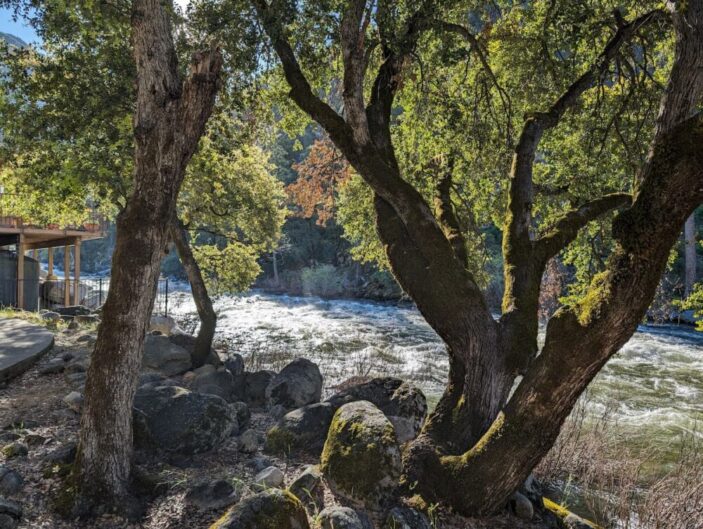
Yosemite View Lodge offers comfortable, rustic accommodation with rooms looking over a beautifully noisy creek. Mornings here feel natural and intimate, and the property is only a 30-minute drive from Half Dome, making this one of the most premium offerings that’s only around 3km from the park’s west entrance. Starting from around AU$269 per night.
Rush Creek Lodge & Spa is a bit further out but noticeably more luxurious with a fantastic restaurant, cutting-edge spa facilities and an excellent collection of paintings and sculptures. I can’t claim to have stayed everywhere in Yosemite National Park, but it’s hard to imagine any property around the area being as upmarket as this. Private balconies have remarkable views and rooms are deliciously modern, but don’t feel inauthentic pr cut off from the natural surroundings. Starting from around AU$369 per night.
And needless to say, leave absolutely no trace. Bring your own bin, do not litter, and please don’t feed the wildlife. It’s not just stupid and cruel; it can be dangerously irresponsible.
The writer visited Yosemite National Park as a guest of Visit California.
