
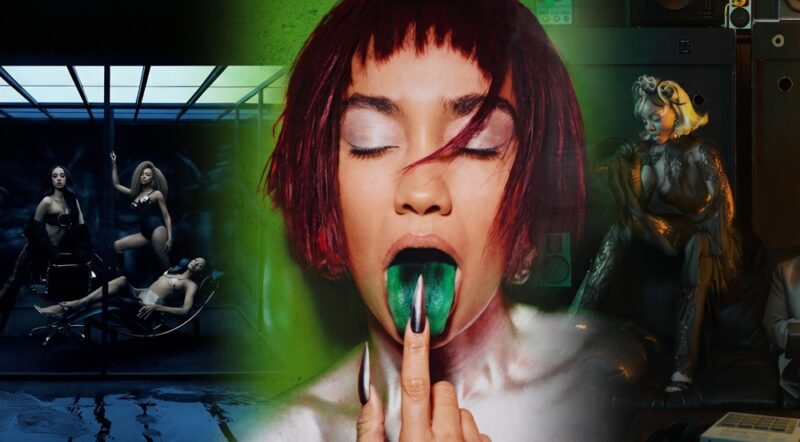
For all the conversations surrounding the supposed decline of R&B, or the increasingly difficult task of breaking through as a female artist in a musical landscape dominated by streaming algorithms and fleeting social media trends, 2026 has quietly delivered some of the genre’s most rewarding work in years. And whilst the likes of FLO, Leigh-Anne and Chlöe Bailey are hardly struggling for recognition, there’s a persuasive argument that their respective projects deserve considerably more attention than they’ve received. Not necessarily because they’ve reinvented the genre, but because they’ve each demonstrated an understanding of what makes a body of work worth returning to long after its promotional cycle has ended.
With FLO’s Therapy at the Club, Leigh-Anne’s My Ego Told Me To and Chlöe’s Timbaland-assisted Resurrection, three distinctly different approaches to contemporary R&B have emerged, united by a shared commitment to musical personality, creative conviction and the increasingly undervalued art of making a cohesive record. Each draws from the genre’s rich history without sounding entirely beholden to it, and each makes a convincing case that longevity shouldn’t necessarily be measured by how loudly an album announces itself upon release, but by how comfortably it settles into our lives in the months and years that follow.
And perhaps most encouragingly, none of these women sound particularly interested in chasing whatever the industry has decided is fashionable this week.
For British trio FLO, the comparisons to Destiny’s Child, SWV and Sugababes have been practically unavoidable since they emerged in 2022, their impeccable harmonies and unapologetic affection for late-1990s and early-2000s R&B immediately positioning them as potential successors to the great girl groups of that era. Their 2024 debut, Access All Areas, confidently embraced that lineage, but it also presented the challenge of establishing an identity beyond the artists who had so clearly influenced them.
Their sophomore effort, Therapy at the Club, feels like a natural progression rather than a calculated reinvention. There’s a greater emotional complexity to the songwriting, a willingness to sit with the uncertainty of modern relationships, and an understanding that romantic disappointment doesn’t always need to culminate in a triumphant declaration of independence. Sometimes you’re still thinking about the person you shouldn’t be thinking about. Sometimes you miss being wanted more than you miss the person themselves. And sometimes the healthiest response to heartbreak is simply getting dressed up and going out with your girlfriends.
The album’s central concept, using nightlife as a form of emotional release, could easily have resulted in a collection of interchangeable dancefloor anthems. Instead, FLO approach the club less as a destination than a state of mind, a place where confidence and insecurity can coexist, and where the women standing beside you might ultimately prove more important than whoever you’re hoping to attract.
The woozy vulnerability of “I Can’t Be High Around You Anymore” captures the uncomfortable ambiguity of wanting someone whose intentions remain frustratingly unclear, whilst “Miss U Missing Me” finds its emotional centre in the desire to feel significant to someone who has seemingly moved on. “Small Doses” explores the overwhelming nature of attraction, and the wonderful “Don’t Break Her Heart” shifts the focus away from romantic relationships altogether, celebrating the fierce protectiveness that comes with female friendship.
It’s that emphasis on sisterhood that gives Therapy at the Club much of its personality. FLO understand that the relationships between women deserve just as much musical attention as the men who disappoint them, and the album’s title track, alongside the more exuberant “Remedied“, reinforces the idea that emotional recovery can be a collective experience.
Musically, the trio remain an absolute pleasure. Their harmonies are rich without becoming excessive, their individual voices distinctive without competing for attention, and their ability to move between contemporary production and more traditional R&B arrangements speaks to an increasingly assured understanding of their strengths. “Leak It” brings a playful, seductive confidence, “Floating” allows their vocal chemistry to take centre stage, and the closing “Haterbooth” injects a welcome burst of funk-pop energy.
At 16 tracks, the album occasionally overstays its welcome, and its predominantly mid-tempo approach means the promised club atmosphere isn’t always reflected in the music itself. A few more moments of genuine dancefloor abandon wouldn’t have gone astray. But there’s also something refreshing about a group refusing to mistake volume for confidence. FLO aren’t interested in overwhelming the listener with constant spectacle. They’re building a sound, and more importantly, a relationship with their audience.
And if the commercial response hasn’t quite matched the enormous expectations placed upon them, their ability to deliver two top-five UK albums suggests that there’s already an audience invested in their continued evolution. In an era where girl groups are frequently expected to arrive fully formed and immediately dominate, FLO deserve the opportunity to develop without every release being treated as a referendum on their viability.
A similar argument could be made for Leigh-Anne, whose long-awaited debut solo album, My Ego Told Me To, is perhaps the most personally revealing of these three projects.
After spending more than a decade as one-quarter of Little Mix, one of the most commercially successful girl groups of their generation, Leigh-Anne could easily have pursued the most straightforward route to solo success: polished, radio-friendly pop designed to reassure an established audience that the transition would be relatively painless.
Instead, she’s delivered something considerably more interesting.
Drawing heavily on her Jamaican and Bajan heritage, My Ego Told Me To is an exuberant fusion of R&B, reggae, dancehall, Afrobeats and pop, its stylistic diversity reflecting an artist who finally appears comfortable placing every aspect of her musical identity at the forefront. It’s an album that feels less concerned with introducing Leigh-Anne as a solo star than with reintroducing her as a person whose artistic interests extend well beyond the parameters of the group that made her famous.
That distinction feels particularly significant given Leigh-Anne’s previous openness about the isolation she experienced as the only Black member of Little Mix, and the challenges of navigating an industry in which she didn’t always feel equally seen or celebrated.
There’s something quietly triumphant about hearing her embrace those influences so wholeheartedly, particularly after her departure from the major-label system and decision to pursue greater creative independence. The album doesn’t sound like an artist desperately attempting to prove her commercial worth. It sounds like someone finally making the music she’s wanted to make.
“Look Into My Eyes” establishes that confidence immediately, whilst the reggae-infused “Dead and Gone” and vibrant “Revival” showcase an instinctive understanding of how Caribbean rhythms can complement her pop sensibilities without feeling like decorative additions. “Burning Up” is an infectious Afrobeats-leaning highlight, and “Most Wanted“, featuring Valiant and Rvssian, further demonstrates her ability to inhabit these musical spaces with an ease that makes the transitions feel organic.
But the album’s most rewarding moments aren’t necessarily its most energetic.
“Sunrise” is a gorgeous reminder of the warmth and intimacy that defined some of the finest R&B balladry of the early 2000s, whilst “Best Version of Me” finds Leigh-Anne exploring a softer, more introspective side of her artistry. The unexpected rock-inflected aggression of “Goodbye Goodmorning” is another welcome surprise, revealing an edge that her previous musical identity didn’t always allow her to explore.
And then there’s “Heaven“, the album’s deeply personal closing track, which brings proceedings to an emotional conclusion and reinforces just how much of herself Leigh-Anne has invested in the project.
If My Ego Told Me To has a weakness, it’s that its sheer musical breadth can occasionally work against its cohesion. Not every stylistic detour lands with the same impact, and some songs feel more fully realised than others. But even its less successful moments are interesting because they sound like genuine creative decisions rather than attempts to capitalise on whatever happens to be dominating the charts.
That distinction matters.
The album’s number-three debut on the UK Albums Chart, making Leigh-Anne the first Black English former girl-group member to achieve a top-three solo album, was an encouraging commercial achievement. But its more meaningful success may ultimately lie in establishing a musical identity that can sustain her beyond the inevitable comparisons to her former bandmates.
Leigh-Anne has spent years being part of something bigger than herself. My Ego Told Me To suggests she’s finally discovered the freedom of allowing herself to be the main event.
For Chlöe Bailey, meanwhile, the challenge has been somewhat different.
As one half of Chloe x Halle, Bailey established herself as an extraordinarily gifted vocalist, producer and performer, with the duo’s acclaimed Ungodly Hour demonstrating a musical sophistication that made their eventual solo pursuits particularly intriguing. But despite flashes of brilliance, her first two solo albums, In Pieces and Trouble in Paradise, struggled to consistently reconcile her considerable talents with a clear artistic direction.
Enter Timbaland.
On paper, their collaborative mixtape, Resurrection, could have been little more than an exercise in nostalgia, pairing one of contemporary R&B’s most technically accomplished young performers with a producer whose groundbreaking work helped define the sound of the late 1990s and early 2000s.
And whilst the project certainly doesn’t shy away from those influences, its greatest achievement is how naturally Bailey inhabits Timbaland’s distinctive sonic world without surrendering her own identity.
The syncopated rhythms, unpredictable percussion, unusual instrumental textures and hypnotic grooves that made his productions for Aaliyah, Missy Elliott and others so influential are all present, but there’s a refreshing restraint to the arrangements. Rather than attempting to recreate the past on an unnecessarily grand scale, Timbaland provides Bailey with a rhythmic playground in which her voice, personality and increasingly assertive songwriting can take precedence.
“Talking Dirty” is an immediate highlight, its slinky production and playful sensuality recalling the effortless cool of classic turn-of-the-century R&B. “Hold It” is similarly seductive, whilst the dramatic “World on Fire” allows Bailey to indulge her more theatrical vocal instincts without losing the emotional thread of the song.
“Sensitive“, with its unusual combination of harpsichord flourishes and dissonant strings, is another standout, even if its abbreviated running time leaves you wishing the idea had been developed further. “Better Than She Can” brings a welcome injection of pop accessibility, and the adventurous closing track “Jittery” hints at just how exciting this partnership could become if Bailey and Timbaland continue pushing beyond their established musical comfort zones.
But perhaps the most satisfying aspect of Resurrection is the growing sense of self-possession in Bailey’s songwriting.
Throughout the project, she’s frequently the one establishing the boundaries, setting the conditions and deciding when a relationship has exhausted its usefulness. Whether confronting infidelity on “Caught“, dismissing emotional immaturity on “Mama’s Boy“, or asserting her independence on “Priorities“, Bailey sounds increasingly comfortable occupying a position of control.
Interestingly, though, some of the mixtape’s strongest moments arrive when that confidence begins to fracture.
“On Your Own” briefly acknowledges the emotional needs of the person she’s otherwise dismissing, whilst the aforementioned “Jittery” introduces a welcome degree of self-reflection and regret. These moments of vulnerability suggest a potentially richer direction for Bailey’s songwriting, one in which emotional complexity proves just as compelling as defiance.
The project isn’t without its shortcomings. At approximately 29 minutes, Resurrection occasionally feels more like a collection of tantalising musical sketches than a fully developed body of work, with several tracks ending just as their ideas begin to take shape. Some of the more straightforward romantic material also lacks the specificity that makes Bailey’s sharper, more confrontational writing so engaging.
But there’s an undeniable confidence to its overall sound, and its brevity arguably contributes to its replay value. It’s the sort of record that can initially seem slight before gradually becoming a regular fixture in your rotation, its pleasures revealing themselves through repeated listens rather than demanding immediate attention.
And perhaps that’s precisely what makes it such an encouraging development in Bailey’s solo career.
For all her extraordinary vocal ability, she’s never needed to prove that she can sing. What she’s needed is a musical environment that allows her talent to feel purposeful rather than simply impressive. With Timbaland, she’s found a collaborator who understands the value of space, rhythm and restraint, and the result is arguably her most focused solo project to date.
Taken together, Therapy at the Club, My Ego Told Me To and Resurrection represent three very different interpretations of what contemporary R&B can sound like, but their similarities are arguably more important than their differences.
FLO are refining the art of the girl group, drawing upon a rich musical lineage whilst gradually developing the emotional maturity and collective identity that could sustain them for years. Leigh-Anne is reclaiming her artistic independence, embracing the cultural influences that have always been part of her identity and refusing to dilute them for the sake of commercial expectations. Chlöe is discovering the benefits of creative restraint, allowing her extraordinary abilities to exist within a more focused musical framework.
None of these projects are flawless, nor should they need to be.
What makes them so rewarding is that they each have a discernible point of view. They sound like records made by artists who know what they want to communicate, even when they’re still figuring out the most effective way to do so. And crucially, they feel like bodies of work rather than collections of potential singles assembled in the hope that something might catch fire on TikTok.
That might seem like a relatively modest achievement, but in an industry increasingly driven by immediacy, it’s becoming something worth celebrating.
Of course, nostalgia plays a role in their appeal. FLO’s harmonies evoke the golden age of R&B girl groups, Leigh-Anne’s more intimate moments recall the genre’s early-2000s warmth, and Timbaland’s production on Resurrection is unmistakably informed by his own extraordinary catalogue. But there’s a difference between drawing inspiration from a musical tradition and simply attempting to replicate its commercial success.
These artists understand that distinction.
Rather than chasing the sound of 2026, they’re making music that could comfortably exist beyond it. Their albums aren’t entirely dependent on the production trends, viral gimmicks or fleeting cultural references that can make contemporary pop records feel dated almost as quickly as they’re released. There’s an emphasis on melody, vocal personality, emotional connection and musical craftsmanship that gives each project the potential to age gracefully.
And that, ultimately, is where the conversation surrounding their success deserves to shift.
We shouldn’t need FLO to deliver an enormous crossover single to justify their continued existence. Leigh-Anne’s solo career shouldn’t be measured solely against the commercial achievements of Little Mix, or those of her former bandmates. And Chlöe shouldn’t have to repeatedly reinvent herself to convince an industry that has already witnessed her extraordinary talent that she’s worthy of sustained investment.
They deserve the opportunity to build careers, not simply moments.
Because whilst commercial success is undeniably important, particularly in an industry where women, and especially Black women, are frequently subjected to unforgiving expectations, longevity is often built through something less immediately measurable: trust.
The trust that an artist will continue to deliver music worth hearing. The trust that their creative instincts are worth following, even when the results don’t immediately translate into chart dominance. And the trust that audiences will remain invested in an evolving musical identity rather than abandoning it the moment a particular release fails to generate the expected level of attention.
It’s why some of the most beloved R&B albums of previous decades have endured long after their initial commercial performance ceased to matter. They weren’t necessarily the biggest records of their respective years, but they possessed a personality that made them worth rediscovering, reassessing and returning to.
There’s every reason to believe these three projects could enjoy a similar afterlife.
Perhaps Therapy at the Club will eventually be recognised as the album where FLO truly established themselves beyond their influences. Perhaps My Ego Told Me To will be remembered as the moment Leigh-Anne finally claimed the artistic freedom she’d spent years working towards. And perhaps Resurrection will prove to be the beginning of Chlöe’s most creatively fulfilling chapter.
Whatever comes next, these women have already demonstrated that R&B doesn’t need saving, nor does it need to constantly reinvent itself to remain relevant. It simply needs artists with something to say, the confidence to say it in their own musical language, and an industry willing to give them the time and space to grow.
The underrated R&B girlies of 2026 aren’t necessarily making the loudest music of the year. But they might just be making some of the music we’ll still be listening to long after everyone has forgotten what was trending.
