

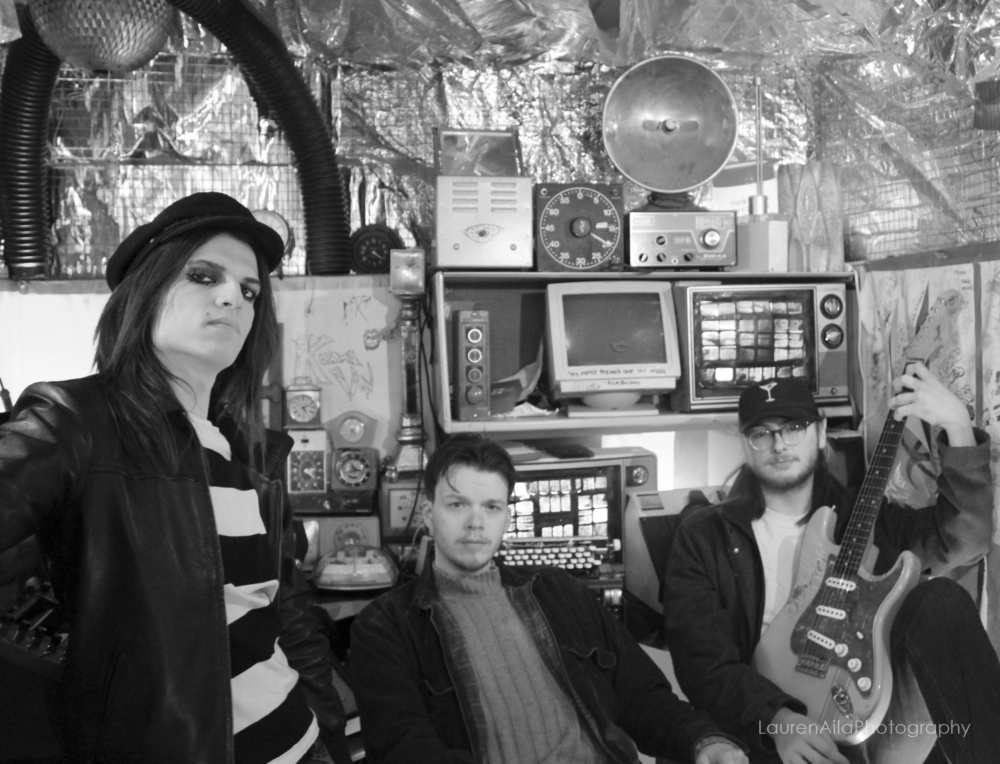
Nine years ago, Nothing If Not frontman David Maginity began writing a collection of poetry as he grappled with growing up and finding his place in the world. Those poems eventually became Gutter Gardens, the Indiana progressive rock band’s debut album, released on Friday, 30th October.
It’s a beautifully lush record, with an expansive sound that gives each song room to develop. Even when the tempo picks up, nothing feels hurried. There’s plenty of drama, some epic guitar solos and a richness to the arrangements that makes you want to explore every corner of the music. These are songs that have been given the time and space they deserve.
There’s an ambitious concept behind it all, too. Gutter Gardens follows a character searching for identity and meaning in a dystopian world, and is the first of three planned interconnected concept albums. Much of the story draws on Maginity’s own experiences, lending a personal weight to the album’s more philosophical questions.
For this exclusive Track by Track for the AU review, Maginity takes us through all 11 songs, sharing the stories behind them and how they fit into the world of Gutter Gardens.
Do press <play> and enjoy the beauty of Gutter Gardens.
Nothing If Not – Gutter Gardens – Track by Track
The conceptual framework for this album has been in the making since I was a freshman in college, nine years ago. Because this concept has been such a long, personal journey to turn into something real, it carries a lot of meaning for me — some of it private, some of it central to the story itself. I want you to be able to take your own meaning from this album, the same way I took mine from writing it. So for most of these songs, I’m going to let the story do the talking. But a few of them came from places too real to leave out of the room, and for those, I’ll tell you exactly where they came from.
It started as a book of poetry, one I wrote to disguise the pile of overlapping existential crises staring me down as I marched into adulthood. They were written almost like prayers — asking an indifferent, loud universe for an answer to the one question that never really has a definitive answer: why? For something so loud, the universe always seemed to go dead silent the second I wrote the question mark. Eventually I wanted to build a narrative around that book of poems — to forge those prayers into something closer to an answer by giving them a story. The story I landed on was about a background character in a plotless movie, who suddenly realizes just how irrelevant they are to the setting around them. That realization blurs the character’s sense of identity so badly that their gaze turns outward, onto the world itself — and that world becomes the story’s real antagonist: the broken people factory. It chews up the worn-down veterans of the dystopian terrain it runs on, and spits out new broken people to take their place in an endless, meaningless march toward their own death.
Our background character runs face-first into every flavor of hell on earth — devaluation, alienation, indoctrination — and in the search for some kind of meaning in a place built to have none, they end up borrowing an identity that was never theirs to begin with: one of nationality, one of some convoluted moral duty. Dreams leak through the cracks in the ruined concrete of this world, reminding the character who, what, how, and most importantly why they are — but the smog rushes in to seal those cracks the second any light gets through. This album is about that character’s search for meaning and identity, in a world built specifically to strip both away and repurpose them for its own oppressive survival.
“Gutter Gardens”
“Gutter Gardens” is the thesis statement for everything that follows, not just on this album, but on the two that come after it. All three tell some version of the same story: a character dropped into a world they weren’t built for, spending their whole life adapting to a setting that was never built for them either, and spending just as long trying to remember who they were before the adapting started. Different characters, same seed, same message: plant your seeds of hope in the gutter gardens.
I wrote this song because that’s exactly how it felt growing up. I felt broken — like everyone else had been handed some manual for fitting in, keeping up, making friends, managing the basic mechanics of being a person, and mine had pages missing. I felt like a seed that landed in a gutter instead of a garden.
It took me a long time to see that differently. Weeds don’t get rich soil — they grow straight out of cracked concrete, fed on nothing but runoff, and you can pull them up a hundred times and they’ll come back stronger every single time, because growing in spite of the ground is the only kind of growing they’ve ever known. My loneliness is what taught me to actually love the handful of friends I let close. My dysfunction is what forced me to get creative, to build my own tools for the things I couldn’t do the normal way. I didn’t pick the gutter. But I learned how to grow in it anyway, and that’s the whole song.
“Rootless”
“Rootless” is the paradox that answers “Gutter Gardens”. The message of that song was optimistic, but it left out the long-term problem: no matter how strong the stock, the roots are only as grounded as the soil holding them. Plant your seeds of hope in the gutter and they’ll grow — but grow them too tall, and the foundation underneath starts to crumble, dooming whatever comes after them to the same lifelong fight against their own surroundings just to exist.
“Background Character”
“Background Character” opens on an unwelcoming noise under a static guitar line, laced with the faint, subliminal ring of an alarm clock. The last two songs were dreams — this is the song that pries our protagonist’s eyes open every morning.
This one comes from the thing I was most afraid of as a kid: growing up. The adults around me always looked miserable to me — people who worked most of their lives just to come home too drained to live any life outside of work, who spent the rest of their energy worrying about the bills that kept them working in the first place. I didn’t want that life. I wasn’t sure anyone actually did.
That’s where the Camus reference comes in — The Myth of Sisyphus, one of my favorite pieces of writing by one of my favorite philosophers. The essay compares the redundancy of modern life — working to afford to eat, so you can sleep, so you can work again tomorrow — to Sisyphus’s punishment: eternity spent rolling a boulder up a hill just to watch it roll back down so he can do it again. I make that same comparison, but instead of following Camus to his conclusion — to imagine Sisyphus happy — I show the modern condition for exactly what it is. Sisyphus isn’t happy. He’s been defeated by the gods, damned to a brutal, empty, meaningless task for the rest of forever. Imagining him happy wouldn’t improve his sentence one bit — it would just be a denial of the unnatural thing he’s been forced to submit to.
“Faded Strip of Film”
“Faded Strip of Film” picks up right after our Sisyphus’s “two tired green eyes compress.” The second he lays his head down to dream, nothing happens. His dreams have been siphoned off by the redundancy of his waking life — his memories blurred and faded by the mind-numbing repetition of his own existence. He tries to picture happiness, but his mind has become an empty theater, and the only thing on the black screen is his own obscured reflection.
“Film in flames, colored from the ink it bleeds, a shared soul grows within realities” — his waking life robs him of his dreams, and the lack of dreams robs him of real rest, which only distorts his view of waking life further. The cycle stops connecting to itself and starts spiraling.
“Toothpaste-Stained Reflection”
Our character opens his eyes to a reflection stained by water spots on the mirror. He knows it’s him, but he can’t find anything in it that still feels distinctly his. This is the song where he finally asks the question out loud: who am I? With no real plot of his own to answer that with, he tries answering with his function instead — “I’m but the pointy tip on the cog of an engine, I’m but a tiny blip in an infinite sequence.” The harder he examines his life, his purpose, the less he actually understands about either one.
“Falling into greys so dark, you see things black and white. Certain shades can make any man lose sight.” We complicate our own condition to make our decisions easier to rationalize, to better explain the reasoning behind our lives — but in doing it, we lose sight of the one objective reality we all actually share.
“False Gods”
The last song ended on a question. This one answers it. Right where our character finds the dissolution of self, he also finds a bigger sense of purpose and belonging. Seeing yourself as a cog in a machine, a blip in an infinite sequence, can feel like you’re shrinking — but take one more step back and the same idea flips. Being part of something bigger doesn’t make you small. It can do the opposite.
Maybe it’s the sleep deprivation. Maybe it’s the lack of answers. Or maybe he’s finally found the one answer that actually matters. The ego is something we built to repurpose our own awareness and brand it with an identity — that’s not inherently bad, but it narrows how we see, and even though it’s the source of every pleasure, it’s just as much the source of every pain. “A fractal of god calls himself a man, there’s only me, myself and you. A thumb looks at the rest of its hand, and pulls the other way till it turns blue.”
The last chorus threads a second conversation between the verses: “The devil’s in the heart of a kid told to fear the being he is. The dialogue ‘tween the ego and id — hell isn’t a place that exists, it’s in the state of being alone.” This whole album only ever has one character in it. He’s so consumed trying to define himself that he’s forgotten there’s a world outside his own head and body — outside the factory, even. His personhood is a speck in a vast universe, and that’s a hell of a mindset to live inside of, unless you remember you’re more than just that speck — that your awareness is a fractal from, and of, the mind of god.
“In the Dome”
This song existed before the moment that gives it its real meaning. I wrote it first, and only afterward did its lyrics become something else entirely — a description, almost word for word, of the worst and most traumatic stretch of my life.
Our character is waking up into the same dystopia again, except something in him has shifted — he knows there’s something beyond the day-in, day-out of the factory now, even though the factory hasn’t changed at all. One of its cogs isn’t turning quite right anymore, and like any system, this one corrects whatever stops performing its function. Emily Dickinson has a poem I think about a lot, “Much Madness is Divinest Sense,” in it, she claims that when someone falls out of step with the status quo — even an irrational one — the status quo decides they’re the one who’s crazy. That’s exactly how this dystopia runs. If a cog won’t turn right, it gets reshaped until it does.
I’m neurodivergent, and for most of my life I’ve felt like I couldn’t keep pace with what the world demands of me — couldn’t function at the level my job needed. I was prescribed a stimulant to help close that gap, and for a while it worked better than almost anything had. Eventually, however, I stopped eating, and I went four nights straight without sleeping at all. That combination — not any ongoing condition, just a dose and a body that had gone that long without rest — is what caused everything that happened next. For about a day, I lost touch with reality completely. I believed, for the first and only time in my life, that I was God — a delusion that, strange as it sounds, was its own unwell echo of the very idea I’d later write about more clearly in False Gods.
It ended with me sedated in a hospital bed, where I wrote the rest of this song’s lyrics. It’s the only time anything like that has ever happened to me, and it hasn’t happened since. I understand exactly why it happened, which is part of why I can write about it now without flinching from it.
That’s where the first verse comes from — a slot in the door sliding through a tray of food and pills, and the desperate, repeated idea that there has to be a loose panel somewhere on the wall of the dome. I didn’t write that as a metaphor that time. I meant it literally, and I needed it to be true.
“The cycle restarts tomorrow, but your body ages. Yet corpses emerge from the people factory, smiles on their faces.”
“Isolation”
I wrote this one during the pandemic, in the stretch where I lost basically all will to be around people. By the end of it, if I’m honest, I didn’t want that to change. I wanted to stay exactly where I was.
“Isolation’s a self-perpetuating and unforgiving curse. The motivation to join a population after all of this is absurd.” That’s not an exaggeration — being alone long enough rewires what normal feels like, until you’re almost addicted to the quiet of it. Why would I want to be around anyone else, when the only person I know anymore, the only person I’ll maybe ever really know, is myself? The chaotic drum solo and string breakdown in the back half of the song are a straight callback to the hell described in False Gods — we’ve arrived there. Hell is the state of being alone, and now we’re living inside of it.
“A Flag Half-Mast (Still Flies)”
This song ties the dissolution of identity we’ve been tracking into something far more dangerous: the identity of a nation. Once our character has lost his own sense of self, been forced into submission by the brutal reality around him, and isolated from any real sense of belonging, he goes looking for anything that can hand him purpose. That’s exactly how nationalism gets its foothold. “A Flag Half-Mast (Still Flies)” is about the shifting identity of a nation that’s permanently mourning a version of itself that was always half-fiction to begin with.
The first verse is the individual’s experience inside nationhood. The second is about the people trying to make the nation stand for something righteous, something good — and falling short every time, because it was born out of sin and is run by men just as flawed, propped up by the half-finished, unsustainable dreams of the dead. The third verse turns to the nation itself, and compares it to the ship of Theseus: every plank replaced, every crew that ever ran it long gone, each new crew reshaped by the same oppression as the last. No matter how much of it gets swapped out, it still sails under the name of the same ship — flying a flag at half-mast that can only move at all because of an unrelenting storm.
“Broken People Factory”
This song just names the thing the whole album has been walking you through. It asks the real question: is this factory actually broken — is that why it keeps spitting out broken people on their meaningless march — or is it doing exactly what it was built to do? Manufacturing people with an emptiness inside of them that they can only fill with duty — handed down by the only people with the power to define it, the very system that’s draining their ability to go looking for meaning on their own.
“Optimistic Omniscient”
There’s so much darkness in this album — so much suffering, so much of an oppressive force stripping meaning out of everything it touches — but if you look hard enough, there’s light in even the darkest corners of it. In Broken People Factory, the light is buried under smog, but it’s still bursting through a crack in the clouds; you just happen to be looking down. In Isolation, it’s lonely as hell, but you learn to actually want the solitude. In The Dome, the system never stops trying to bend your will, but you’re still looking for that loose panel. In False Gods, you’re reminded you’re not just the person you think you are — you’re a piece of the universe, here for no other reason than to experience the wonder of being it. “Seek the way and ye shall find the light. Walk the path on which it shines, and clouds will clear along the line.”
I wrote this one after I got out of the hospital. I’d lost my job, my relationship, and for a while, my own grip on what was real. I went looking for anything that could give me a reason to keep going — some sign, any sign. And somewhere in that search, I was filled with this feeling of safety I still can’t fully explain. Something bigger than me, telling me it was all going to be okay. That if I kept seeking, I’d find the light.
I sent the demo to my family not long after. A family friend, Terry Bush, heard it and told me it spoke to him — and then he offered to fund the whole album, just like that, so I could finish what I’d started. I’ve lived with a sense of purpose ever since. I’m still looking for meaning in a dystopia I never felt built for, and I probably always will be. But I know now that the looking is the point.
That’s the whole album, really. A seed thrown into a gutter, choosing — every single time it gets pulled up — to grow back anyway. Plant your seeds of hope in the gutter gardens.
You can keep up to date with Nothing if Not via Instagram, Youtube, and their website.
Header image credit: Lauren Docter
