


As you may have read in our original review for Senua’s Saga: Hellblade II, the sequel to Ninja Theory’s acclaimed and highly praised 2017 psychological action-adventure doubles down on atmosphere and sensory immersion. It’s a haunting and technically dazzling experience that toes the line between game and interactive movie, but also one that too often forgets that it is a game.
While the sequel has been released on Xbox and PC, it is finally PlayStation 5’s turn to dive into the world of Hellblade II and really showcase what the PS5 Pro can do with a technically stunning game on its hardware.
The Mind’s Journey
Picking up where Hellblade: Senua’s Sacrifice left off, the sequel follows Senua’s continuing struggle with psychosis as she journeys to Iceland to free her people from Viking slavers. After surviving a shipwreck, she captures one of the vikings and forces him to lead her toward his chieftain, uncovering stories of giants, spirits, and the unseen “hidden folk” along the way.
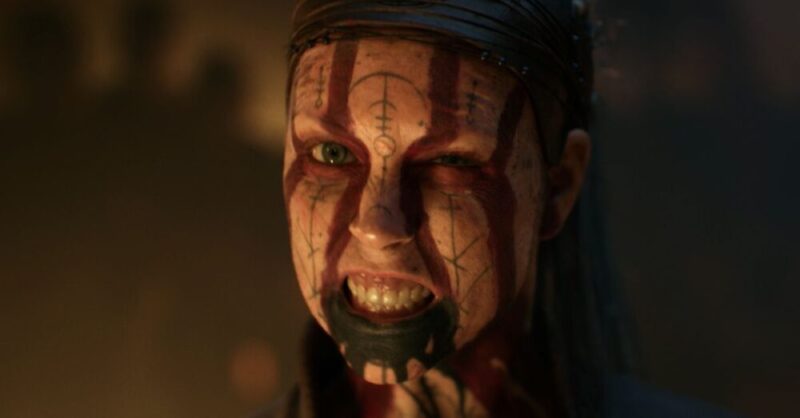
At roughly six hours in length, Hellblade II is a generally focused and often unrelenting descent into doubt and delusion. The boundaries between reality and hallucination shift constantly, and this is reflected in the environments, companions vanish, and the voices in Senua’s head never stop chatting.
If you are using headphones, particularly the Pulse or the InZone PS5 3D Audio headsets, it truly enhances the experience. It’s still deeply unsettling, but expertly executed.
Beauty Beyond Belief
Visually, Hellblade II is absolutely stunning. Iceland’s rugged landscapes are interpreted with near-photorealistic precision; there really is nothing like it. The cliffs are shrouded in fog, molten lava rivers, and flickering torchlight illuminating dark caves. The cinematography looks like something Roger Deakins would have had a hand in, with sweeping camera pans and motion-captured performances that rival film. Actor Melina Juergens once again delivers a phenomenal portrayal of Senua, grounding the character’s torment with empathy and defiance.
This new PS5 Edition builds on the already-impressive Xbox and PC release, now featuring a 60fps Performance Mode and responsive haptic feedback. Every heartbeat, whisper, and scream resonates through the DualSense controller. It’s great to see developers outside PlayStation Studios make full use of the DualSense’s capabilities.
Gameplay That Doesn’t Match the Vision
Unfortunately, for all its visual and audio perfection, Hellblade II falters where it matters most, in its gameplay. Between its cinematic cut scenes are long stretches of walking, simplistic puzzles, and repetitive sword combat. The pacing often feels at odds with its emotional intensity; the gameplay is more connective tissue than meaningful challenge.
Returning “symbol puzzles” from the first game reappear, tasking you with aligning objects to match runic shapes. These, unfortunately, are overused and, after a few hours, feel overused. The new mechanic here is the light-orb puzzles, which ask you to slightly shift the environment to reveal a path forward. Both are so trivial that they barely qualify as puzzles.
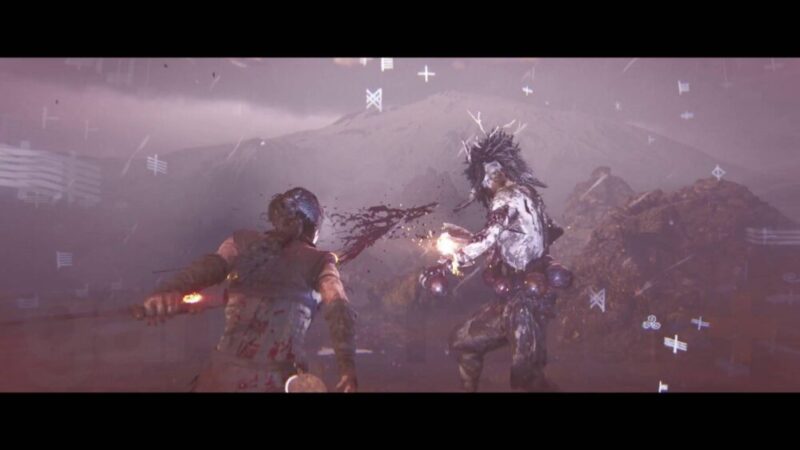
Combat, too, is frustratingly shallow. Senua can perform light and heavy attacks, block, dodge, and use her mirror ability to slow time and execute quick kills. While each fight is staged with cinematic flair, the mechanics never evolve. Every encounter, including the final boss, unfolds in the same one-on-one structure, making what should be intense duels feel monotonous by the halfway mark.
A Cinematic Experience First and Foremost
To be totally fair, Hellblade II never hides what it wants to be: a narrative experience first, and an interactive one second. When judged on that basis, it’s truly an incredible achievement. The unreliable perspective, the sensory overload, and the psychological weight all contribute to something bold and unique.
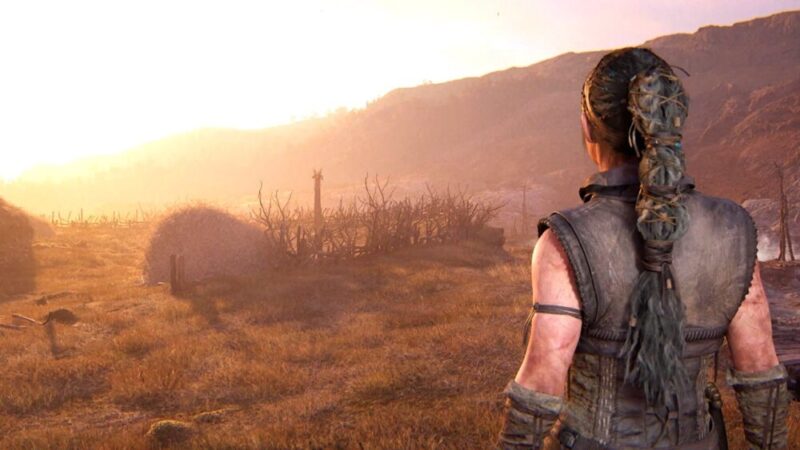
But it’s also restrictive. For all its world-building and environmental beauty, there’s little room for exploration or discovery. You admire the scenery; it looks and feels alive, but you can’t truly engage with it. The result is an uneven experience: captivating as an art piece, frustrating as a video game. Ninja Theory’s craftsmanship is undeniable, but so too is the feeling that Hellblade II belongs more in a cinema than on a high-end console.
New Additions and Modes
There are a few extras with this release on the PS5. Alongside the improved frame rate is a “Dark Rot” mode, a brutally unforgiving difficulty option that makes the series’ infamous permadeath threat real. Die four times, and your save file is wiped. It’s a clever nod to the first game’s psychological manipulation, but one that most players will likely avoid after a single attempt.
Developer commentary is also available post-main story completion, offering insight into the technical and narrative craft that went into the project. As a fan of games and film, this is the part of the game that I enjoyed the most.
Final Thoughts
For as good as Senua’s Saga: Hellblade II, it might feel like a mixed bag for some. The game is a visual feast, while also using audio and the DualSense controller to their full potential. It’s an essential experience for gamers who want to see the best of the PS5 in terms of what video games can be as an emotional and cinematic art form, but it’s a bit of a tough slog for players seeking engaging gameplay.
Still, Ninja Theory’s mastery of atmosphere, sound, and performance remains unmatched. In the growing conversation around “games as art,” Hellblade II demands inclusion. As it stands, it is one of the best-looking and best-running games of this console generation.


FOUR AND A HALF STARS (OUT OF FIVE)
Highlights: Visual feast; Flawless performance; Great sense of atmosphere
Lowlights: A small and short story that may be difficult to justify the price
Developer: Ninja Theory
Publisher: Xbox Game Studios
Platforms: PlayStation 5, Xbox Series X/S, Windows PC
Available: Now
Review conducted on PlayStation 5 Pro with a code provided by the publisher.
Featured header image also provided by the publisher.
