

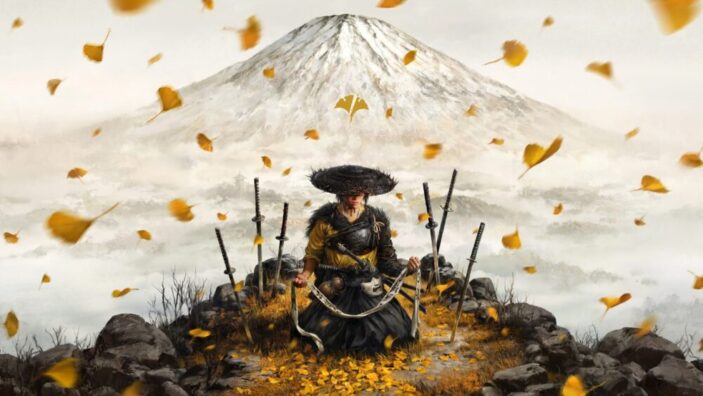
Ghost of Tsushima has certainly stood the test of time since its release, proving to be one of the most dense, engaging and gorgeous games of the last generation. So it wouldn’t really come as a shock to anyone when I say that Ghost of Yotei has some serious weight on its shoulders.
In some respects, Ghost of Yotei carries the weight of those expectations, with strong combat and incredible visuals. But in other respects, it can’t quite reach the consistent peaks of its predecessor. That’s not to say that Ghost of Yotei is bad; in fact, it’s incredible. Finding familiarity in most of its strengths is a safe bet, and one that leaves Ghost of Yotei feeling like a worthy sequel that’s more than worth your time.
A Tale of Six
Ghost of Yotei follows the story of Atsu, a warrior who, as a child, experienced the murder of her family at the hands of a ruthless gang of warlords, otherwise known as the Yotei Six. While I would rather not spoil the specific ebbs and flows of this narrative, it’s worth noting that Ghost of Yotei is a relatively straightforward story of revenge that, after a stunning intro, wastes no time in defining itself as such.
You’ll spend most of your time exploring the hills and mountains of Yotei, searching for clues on the whereabouts of each member of the Yotei Six. Unlike the more linear structure of the first game, Ghost of Yotei allows players to track down the remaining members of the Yotei Six in any order they please. Unfortunately, it is in this level of freedom that I have a slight gripe with this approach to storytelling.
When tracking down each member, we’re treated to certain cutscenes and conversations that slowly peel back Atsu’s trauma, heightening the sense of weight and emotion behind each encounter. But some members of the Yotei Six were much more memorable than others. Encounters with certain members contain more interesting fights, stunning action set pieces and interesting revelations that tie in more closely with Atsu’s need for revenge. A certain couple of members simply fall by the wayside, in the sense that their demise isn’t as satisfying as they’re given less to work with.
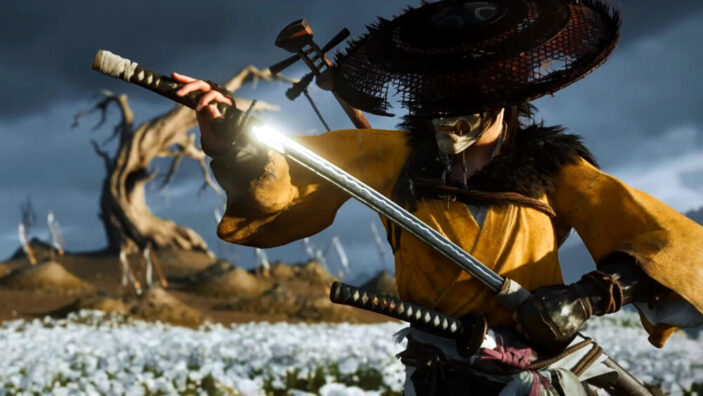
Lord Saito is the leader of the Yotei Six, and I personally loved not only his role within the story, but also actor Feodor Chin’s English voice performance. Saito himself fits wonderfully here as the main antagonist, as his motivations and ambitions are sequentially laid out and expanded upon throughout the story, tying in consistently with Atsu’s past. He’s menacing and threatening in all the right ways, and given that you run into him a few times, easily the most engaging member of the Yotei Six.
Atsu herself is a serviceable protagonist throughout the main story’s 30-hour runtime, but as her story is relatively straightforward and predictable, her performance feels somewhat underutilised, confined by the direct nature of her quest for revenge. Ghost of Tsushima’s narrative explored several themes throughout its story, which provided Jin Sakai with more room to breathe and grow as a character. Make no mistake, actress Erika Ishii’s performance and likeness are not wasted on Atsu as a protagonist. I just wish we had gotten a little more range from the character.
Players can also tap into Atsu’s memories by pressing the central touchpad, which adds some important context and emotional depth to particular scenes. Top that off with a few neat twists and emotional revelations thrown into the mix, particularly later in the story, and I feel things do swing back around to produce a story that feels not only interesting and engaging, but memorable in its own right.
Cuts and Slashes
From a gameplay perspective, Ghost of Yotei certainly feels like a younger sibling to Ghost of Tsushima. It has its own edge, but we know where most of these tricks came from. There are light and heavy attacks, the latter of which are used to break enemy stances and blocks, which are used in conjunction with blocks and parries of your own. Atsu now has access to various weapons, which are gained throughout the story. Still, these only really take the place of stances, as they’re used against certain enemy types for added effectiveness.
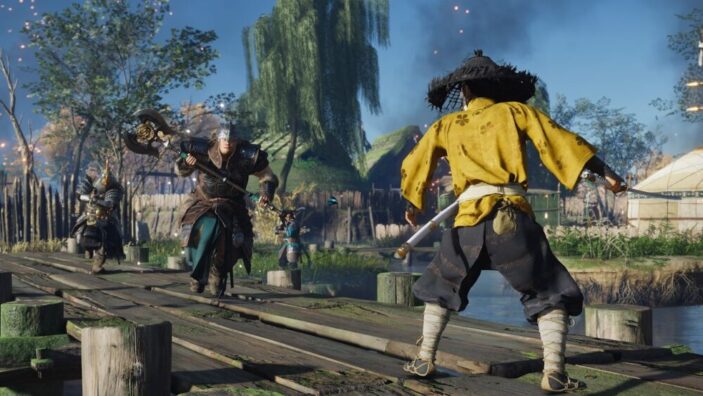
Atsu gains dual katanas for speed, spears for range, and a heavy sword known as the Odachi, for tougher enemies. She even gets to use a Kusarigama, a new weapon that ties a blade to the end of a chain for out-of-reach enemies. It made me want to say “Get Over Here” every time I used it. There’s even a fair number of firearms that, while they take a while to reload, deal tremendous damage.
When all is said and done, combat is so brutal, fluid and satisfying that it’s honestly hard to stop. You want to keep fighting endless waves of enemies, and it’s a joy to see the last few enemies cower in fear as they realise they’re done for. Atsu can also use the Onryo’s Howl, a special ability that literally scares enemies stiff and enhances your attacks. Atsu befriends a wolf who can help during combat, and while the wolf can be upgraded, it cannot, unfortunately, be controlled or called on command.
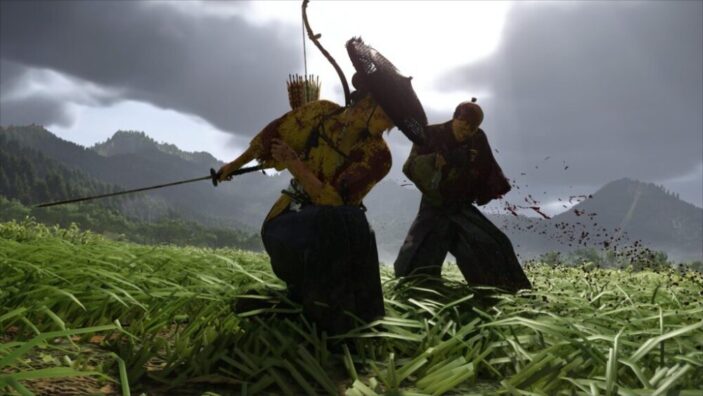
Beyond all this, Atsu will still need to sneak around certain areas. Stealth is familiar enough for those who have played Ghost of Tsushima, but I feel like it’s a little more necessary here, as the game regularly sees you sneaking into compounds and camps where Atsu is quite easily overwhelmed.
The Heart of a Warrior
Aside from her main quest for revenge, Atsu can also explore the various smaller regions of Yotei to complete several side quests. For example, Atsu can track down bounties for extra coin, which usually sees her having to track down their whereabouts before the final confrontation. You’ll also be able to chat with and befriend various villagers along the way, who can ask for simple favours in the form of fetch quests, or prompt smaller adventures that are filled with their own mysteries and high stakes.
Progression is also back in full force, with Atsu being able to level up and bolster multiple skill trees based on certain gameplay aspects. Atsu will need to find shrines to unlock new tiers in each skill tree, along with charms, which act like perks of sorts, which can also lead to new and interesting advantages during combat, stealth and exploration.
While shrines are optional, I would strongly encourage you to find at least a few of them to level up, as the latter half of the game becomes a little more demanding in terms of general combat and tougher boss battles.
Look the Part
Visually, Ghost of Yotei is stunning. It’s probably the prettiest game I’ve played on the PS5 Pro to date, which certainly takes full advantage of the PSSR enhancements. It’s packed full of gorgeous colour pallettes, incredible lighting effects and detailed textures and character models. There’s rarely any pop-ins or unrendered textures, which is unusual for an open-world experience like this.
Ghost of Yotei even goes one step further, offering a Watanabe Mode for lo-fi beats in the background during gameplay, Miike Mode, which brings the camera closer during combat and greatly enhances the level of blood on screen. Finally, there’s the now-famous Kurosawa Mode, which presents the game in black and white along with stylish audio. Each mode adds its own flair that can be accessed at any point in the game, and is certainly worth checking out at least temporarily.
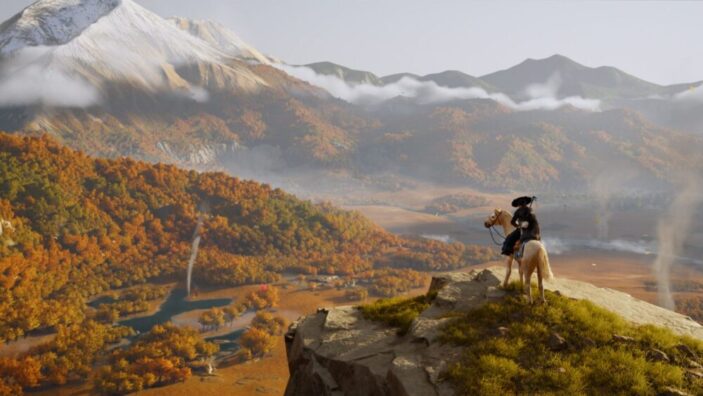
Performance and Quality modes are available in Ghost of Yotei, and they’re both fine. The former mode targets a 4K resolution at 30 FPS, while the latter mode drops the resolution in favour of a smoother 60 FPS experience. There’s also a specific Ray Tracing mode for PS5 Pro users, which gives you greater detail and lighting, along with a sharper upscaled resolution, all at 60 FPS.
Final Thoughts
Ghost of Yotei might not consistently reach the heights of its predecessor, but it certainly does enough to warrant a playthrough based on its own merit. Atsu’s tale of revenge ultimately feels rather direct, but is still littered with both emotional and tense moments that feel as engaging as they are memorable.
While the pacing suffers at times, due to a less linear narrative structure, the visuals, particularly on the PS5 Pro, serve up one of the most stunning games I’ve witnessed on the platform to date. The team at Sucker Punch Productions have certainly built upon the strengths of the first game, and the result is something to be admired.


FOUR STARS (OUT OF FIVE)
Highlights: Incredible combat; Gorgeous visuals; Solid performance; Plenty to see and do
Lowlights: Predictable and straightforward narrative with slight pacing issues
Developer: Sucker Punch Productions
Publisher: Sony Interactive Entertainment
Platforms: PlayStation 5
Available: Now
Review conducted on PlayStation 5 Pro with a code provided by the publisher.
Featured header image also provided by the publisher.
