


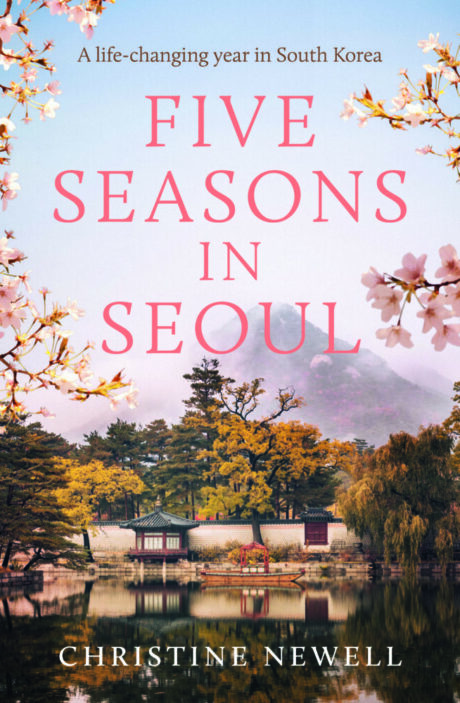
Christine Newell is a professional musical theatre performer with a lifelong love of telling stories. In February 2025, she released her debut memoir, Five Seasons in Seoul, a record of the time she spent in South Korea in the early 2000s after responding to a call for Hi-5 style children’s performers.
Prior to this, Christine had found herself in a period of anxiety, depression and grief, after the death of her father and the plateauing of her career, leaving her work as Tappy the Dinosaur and doing shows in shopping centres.
In the tradition of great travel memoirs, Christine resolved to take charge of her life, jumping headlong into a completely new experience. While she may have been determined to leave the bulk of her problems behind in Australia, the journey she took may have actually been the exact thing she needed in order to force herself to work through them.
The AU Review caught up with Christine to find out more.
The blurb for your book, Five Seasons in Seoul, details that the impetus for your year in South Korea was a chain of devastating events, leading to you pulled over on the side of the road wearing a dinosaur suit, having a good cry.
Is it safe to say that you didn’t set out to have the kind of experience people write memoirs about? At what point did you decide to write about your trip, and your life?
I don’t think anyone sets out to have the kind of experience people write memoirs about and I certainly didn’t. Before I left for South Korea and when I first arrived, I was in survival mode and just trying to get through each day. It never occurred to me, not even for a second, that I might write about it in the future. Having said that, I always knew that I was experiencing something unique and life-changing, so when I did come to write about it that’s what inspired me.
In 2016, I wrote and produced my own one-woman show about my time spent living in Seoul and a trip I did a few years later around Italy. The feedback I received from my audience was that they found the Korean part especially fascinating. It was also during that process that I rediscovered my childhood love of writing, so the decision to write Five Seasons in Seoul evolved from there.
How did it feel to spend so much time thinking about that series of difficult events and the decision to make such a big change?
I found writing my memoir extremely cathartic. It allowed me to revisit a difficult period of my life, one that was tainted by grief and anxiety, with a new perspective.
At times it was difficult, especially when writing about my childhood and the trauma of my dad’s illness, but those challenges were beautifully balanced by the joy I felt when writing about my colleagues and my love of South Korea and Korean culture.
The opportunity that took you overseas was a role with an experimental theatre company – what can you tell us about experimental theatre, and how it was different from the kinds of roles you’d done previously?
Prior to my time in South Korea, I’d performed in very traditional and well-known musicals, like The Sound of Music and The Wizard of Oz, where the story is clearly mapped out from start to finish and the music is familiar.
The theatre company I worked for in Seoul was a repertory company that performed original musical productions. Rehearsals were collaborative and highly improvised, and the performers were expected to contribute to the storyline which was constantly changing.
I really struggled with the lack of certainty during the rehearsal process and that exacerbated my self-doubt. I was also suffering with anxiety and depression at the time, and this made me want to control everything, but I wasn’t afforded that luxury.
How was the performing arts industry different overall in South Korea?
As we’re seeing from the rising popularity of K-pop, K-dramas and Korean films here in Australia and around the world, the performing arts industry in Korea is thriving. I can only speak from my experience, but I think there’s a broader scope for new and original works than there is in Australia. Koreans are also incredibly proud of their culture, and this is evident in the way that cultural beliefs and folklore are explored through the arts.
Before you got this job, were you already interested in South Korea? Without giving away too much of what people might find out when they read the book, was it anything like you expected?
I left for Korea in 2005, a long time before hallyu (the Korean cultural wave) swept the world. We didn’t have Netflix with the latest K-dramas and there weren’t any Korean restaurants in my neighbourhood. Given the little knowledge I had of South Korea, I had no expectations and was very much stepping into the unknown. As a result, my memoir follows my journey as I become acquainted with the city of Seoul, the etiquettes of Korean culture and the quintessential flavours of Korean cuisine.
You write about how, at first, when you arrived you found it overwhelming, but you soon found Gangnam ‘exhilarating.’ I wonder if you could speak a little on your relationship with the cities of South Korea, and the change of pace they represented in comparison to Australian cities and your experience of them. Do you think that these bustling South Korean cities would have the same energising effect on most people?
The beauty of South Korea is that it has something for everyone. There are vibrant cities, like Seoul and Busan, and cities rich in culture and history, like Jeonju. But, there’s also plenty of opportunities to immerse yourself in nature. Seventy percent of South Korea is covered in mountains, so hiking and forest bathing are popular with tourists and locals.
In my experience, Australian cities are more laid back, whereas Korean cities grab you by the shoulders and flood your senses. Seoul is a city of ten million people, which can be overwhelming for first-time visitors, but you don’t have to venture far to get away from the crowds and into the mountains.
Readers may not tend to think about memoirs as requiring things like settings, but of course, particularly in the case of a memoir like yours, where travel is an aspect, the book absolutely has to have a sense of place to it. How did you set about faithfully representing place on the page? Do you think it was easier to do because you were looking as a newcomer? Did you see Australia with fresh eyes when you returned home again?
Five Seasons in Seoul is written from my perspective as someone who was new to both the country and culture. Others may experience things differently, but that’s the beauty of memoir – we get to experience the world through someone else’s eyes and live in their skin for a while. It was important to me that my story came from a place of complete honesty and transparency, but also one of respect and love.
There will always be tension in memoir, because there’s tension in life, but I wanted to represent Korea faithfully by grounding my experience in historical and cultural context. Travel always makes you appreciate your own backyard and there’s no denying how fortunate we are in Australia, but I did pine for Korea when I returned home. I still miss it to this day and go back as often as possible.

Your background is in musical theatre, and prior to this, you have written a one-woman show called Places I Have Been.
What can you tell us about how different writing for the stage is to writing for the page? Which do you prefer, and which do you think you’ll go back to next?
The biggest difference is that when you’re writing for the stage you need to keep the performer in mind, even when you’re performing your own work.
A performance is also fluid, the moment is there and then it’s gone, whereas there’s a permanence about writing for the page that brings with it a different kind of pressure. Once it’s in print it can’t be tweaked or changed, but when you’re writing for the stage you have the benefit of rehearsals and previews to play with different ideas and see how they land.
Writing a full-length manuscript is also a much longer game. I wrote my show in a few weeks, but it took years to write my memoir. Performing my own show with my own compositions was extremely rewarding, but I’ve fallen in love with the process of writing, editing and publishing, so I plan to keep writing books for now.
In a review by the Korea Times, your book is described as ‘a meditation on grief, identity and the strange, winding journey toward healing…’ The travel memoir genre is certainly host to a number of books about travel and its links with healing, such as Elizabeth Gilbert’s Eat Pray Love – I wonder what your thoughts are on the relationship with travel and exploration and new experiences with personal growth. Would you say that sometimes you have to get lost in order to find yourself?
I’m not sure that you have to get lost in order to find yourself. But, I do think that times of great turmoil are often followed by periods of remarkable growth and transformation.
I believe that travel forces you outside your comfort zone and gives you the opportunity to revise your notion of self. When we travel, we’re not as confined by the things that define us in everyday life, and this can offer a sense of freedom and give us the confidence to explore new things.
Let’s talk a little bit about the structure of your book – you’ve used the seasons as a way to move the reader through your story. At what point did you decide to use the changing seasons as your framework? You say in your introduction “each season in South Korea is uniquely defined and steeped in philosophical meaning.” Could you tell us a little bit about why this idea of the seasons having particular philosophical significance spoke to you and your story?
The seasons dictate the patterns of life in Korea. The temperatures are extreme, especially in summer and winter, the cuisine is seasonal, and the landscape completely transforms every few months.
My memories of that time are very much shaped by the colours and foods of each season, so it made sense for me to structure the book that way. It happened quite naturally and the more I moved through my story the more the structure revealed itself to me.
In Korean culture, the philosophical meanings behind the seasons are grounded in the beliefs of Traditional Chinese Medicine and the theory of yin and yang and the Five Elements. According to this theory, the seasons and elements are closely related to the human condition. I found that my inner journey aligned with the seasonal cycles, and this added greater depth and significance to my own transformation.
What was the publishing process like for this book? Had you completed the entire manuscript when it was accepted by Affirm Press? How did working with an editor change or enhance the book?
I submitted a completed manuscript to Affirm Press after pitching at one of the Australian Society of Authors literary speed dating events. The publishing process that unfolded from there was an absolute dream. It’s such a privilege to have an entire team dedicated to making your work the best it can possibly be, and I found each different stage, from the structural edit to the proofread, to be very rewarding.
Overall, the editing process tightened and polished the manuscript and gave me the invaluable opportunity of looking at my work through the eyes of my reader.
Christine, thank you so much for your time in answering these questions. I hope our readers have been inspired to pick up your gorgeous book and experience it for themselves, and perhaps may even have been encouraged to plan their own overseas adventure.
Five Seasons in Seoul by Christine Newell is available now, published by Affirm Press. Get your copy from your local bookshop HERE.
Images supplied by Christine Newell
