

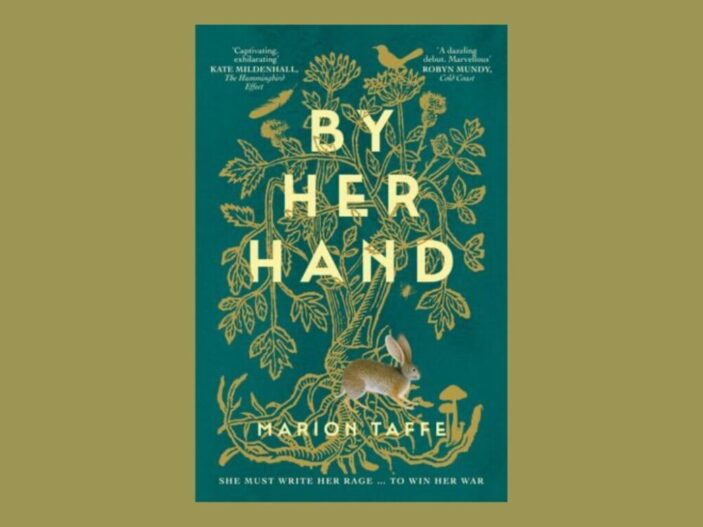
Marion Taffe‘s debut work of historical fiction, By Her Hand, released earlier this year, is already sporting comparisons to literary heavyweights like Geraldine Brooks and Lauren Groff.
Set in 10th Century Mercia, AKA England before it was actually England, the story follows Freda, a young woman whose fascination with learning, stories, and the power of those who write them sustains her after tragedy strikes when her home village – a place called Hope – is invaded by Danish raiders. Freda witnesses the brutality of the attack, narrowly escaping with her life, but her older sister and her neighbours are not so lucky.
Freda’s father – himself a man of stormy tempers – goes missing during the raid. With no other choice left open to her, Freda turns to the local priest, now a Bishop on his way to his new seat, who takes a special interest in this young girl who can read and write a little. When asked who she prayed to in order to survive the massacre, she remembers the story of Saint Juliana, and is dubbed some kind of miracle.
The bishop installs his new protege at St Ositha’s, a priory in the North East, where pilgrims pay to visit her and pay to have her pray for them. It is here that Bishop Aelle offers Freda the chance to learn to read and write properly, and where her love for poetry and story is allowed to grow. Freda learns more about the story of Saint Juliana, the saint she supposedly was saved by, but also the story of Saint Judith, whose plight resonates more strongly with her growing sense of rage at what has happened to her, and to the women around her.
As Freda learns more about the world, she begins to object to the many injustices which are perpetrated against women, and draws strength from he friendship and support of the women at the priory with whom she surrounds herself. Though she is not supposed to have any particular close friendships, she is drawn to Berhtie, a noblewoman who has become an oblate, and Wolfled, a young woman whose accent betrays potential foreign origins.
While the contents of this book are at times brutal and extremely confronting (and trigger warnings on this one for rape, sexual assault and brutal, violent deaths, among other things), this stands in stark contrast to the beauty of the novel on a sentence level. Right from the beginning, Freda’s voice is clear and distinctive, her word choices concise and poetic as if mirroring the strength and loveliness of the soul within her.
Likewise, the choices that Taffe makes about the inclusion of authentic language for the time and the region are precise and deliberate, with the meaning often able to be derived from the context without characters needing to overexplain. If some readers might be bothered by the difficult pronunciation of some of the names and words, others might find this part of the charm and authenticity of the book, lending a sense of reality to the world which is being evoked on the page. Not a word is wasted. Many of Taffe’s sentences are astounding, as befits the story of a young woman who finds herself through the written word.
I especially appreciated that, while this was a story which drew on many religious motifs and the stories of saints, the book did not seek to preach and did not require any specialist knowledge of Bible stories. As would have been appropriate for the time, the presence of the church and of religious folk in people’s daily lives was a part of the cultural fabric of this world, and anything that needed more context or explanation, such as the stories of the two woman saints whose lives inform Freda’s journey, were explained through Freda’s own discovery of them. This was reminiscent of Robyn Cadwallader‘s novel The Anchoress, or Geraldine Brooks’ The Secret Chord. Perhaps the comparison to Lauren Groff is most apparent in the book’s similarities to her novel Matrix, in which the strength of the love between women living in abbeys transcends mere romance or friendship. I also found myself thinking of Hannah Kent‘s novel, Burial Rites, for the feel of the place and the people in it evoked by the choice of point of view.
By Her Hand is a stunning debut, one which I fully expect to see on prize longlists and shortlists to come. It is a celebration of women’s rage, and the way that storytelling can be a way of reclaiming power, and putting this rage to use. It is also a treatise on the way that, historically, there have always been the kinds of men who seek to douse the inner strength that women have through violence, but that with the support of other women, this inner strength can never fully be extinguished and can instead grow into something sublime.
If you loved Joan by Katherine J Chen, this one is for you.

FIVE STARS (OUT OF FIVE)
Marion Taffe’s By Her Hand is out now through HarperCollins. Grab yourself a copy from your local bookstore HERE.
Header Image supplied by HarperCollins Australia.
