

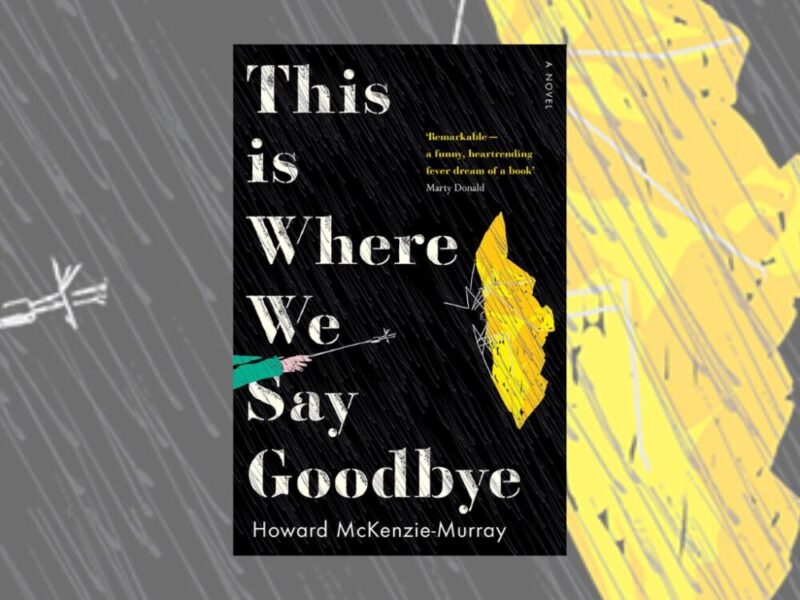
Howard McKenzie-Murray‘s debut novel – shortlisted for the 2024 Hungerford Award novel – has something of a dreamlike quality to it. The kind of dream where you are trying to get somewhere important, but increasingly bizarre obstacles keep getting thrown in your path. This is what happens to Maud Tarkington, the twenty-one year old protagonist of This Is Where We Say Goodbye, released in April by Fremantle Press.
McKenzie-Murray, a playwright from Perth, packs all of the events of this novel into one twenty-four hour period, which sees Maud making her way around Perth, from a laundromat in Fremantle, to Karrakatta cemetery, to the Wesley High School grounds, to her parents’ home in bougie Dalkeith. While the timeline is condensed, the setting is anything but, allowing the author to use a skill for dialogue honed on the stage to tell a story with a much bigger set piece.
The effect is a novel that feels at once influenced by JD Salinger and by the John Hughes movies of the 1980s (think Ferris Bueller’s Day Off but instead of skipping school, she’s going to a funeral). As Maud tells us her story, it feels as if she is confessing something. In fact, she is trying to put into the words the sequence of events that made her snap out of some sort of mental breakdown.
Said episode could have been brought on by a combination of things – the pressures of studying medicine, being left by a boy who could have been more than a friend but who is now thinking about becoming a monk, and the apparent suicide of her favourite brother. While there were many novels several years back described as being about women on the edge of a nervous breakdown, this is the first I can remember reading about a person pulling herself back from the brink.
Maud’s voice is compelling. There is something endearing about the way she keeps finding herself in these odd situations. She is frank with her readers, remarking on things such as the fact that, while she has spent the whole day hiding from he world in various toilet cubicles, there is no bathroom to be found when she really needs to go. She is also a keen observer, interested in people others dismiss, and seems to collect a sort of mental catalogue of those she meets, starting with a woman at the laundromat, and including, but not limited to a Bible-pushing bus passenger, a drunken taxi driver, and a terrified medical officer.
While at times her voice does not completely ring true as that of a twenty-one year old woman (such as when, in the previously mentioned bathroom episode, she decided to pee up against a wall, or the way she talks about the pornographic way one of her closest friends eats bananas), she also has the self-doubt and desire to be loved that one might expect of her. In some moments, she seems like a blank slate. But while her discovering her sexuality is not really part of the novel, she does decide she may actually be interested in someone, leading to her climbing over the fence of a seminary when she probably could have walked through the front gate.
The dialogue in this novel bears remarking upon, and from the way that the story is scaffolded on conversations, it’s easy to the see the influence of the author’s theatre background at work. The book itself is one big monologue, where Maud is recounting everything to us as if we are in front of her. Though she says she is writing it down, it’s easy to imagine her on a stage, pacing back and forth while the memories of her increasingly bizarre day play out in spotlights behind her.
Many of the characters she meets have very particular ways of talking, with the clipping of final consonants written out phonetically and italics adding emphasis in the middle of words. In fact, many minor characters do this in quite similar ways, seeming to lecture Maud about her shortcomings – though it’s important to remember that Maud is the re-teller of all of these dressings down and may be adding and embellishing, feeling as she does, that no one but her dead brother Lloyd really understood her.
This off-beat and charming novel is a study in people, in the strangeness of being alive, and Maud Tarkington is a protagonist who will stay with readers a long time after the final page. Read this if you have been enjoying books about feminine rage, mental health, grief and what’s known in some lists as the ‘disaster girl’ but are looking for a distinctly suburban Australian version.
Unlike the other, more selfish heroines of this type who have come before her, Maud is painfully self aware in her state of grief, and yet still unable to overcome her emotional inertia. She will make you laugh, she will make you want to cry. You will want to give her a great big hug.


FOUR STARS (OUT OF FIVE)
This is Where We Say Goodbye by Howard McKenzie-Murray is out now through Fremantle Press. Find a copy at your local bookstore HERE.
