

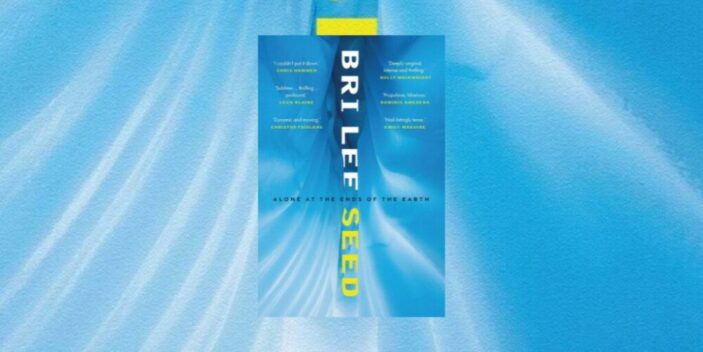
Bri Lee‘s latest novel takes us deep into the wilderness of Antarctica, to an area that some might call barren while others call it beautiful. Lee uses this landscape of dualities, in which two scientists undertake the final stages of a seed vault project to protect the biodiversity of the world’s flora, to unravel issues of the human condition, feminism, and climate grief. At once deeply moving and also challenging, Seed questions what it takes to revive our planet, and what it takes to revive ourselves in the face of overwhelming cynicism and grief.
Mitchell and Frances head to Antarctica for the final stage of the Anarctos Project: a seed vault in an isoalted, secret location. For one month each year, the two scientists live and work together in what Mitch feels is a utopia of radical equality and scientific dedication. But shortly after arriving, small things, strange things, start to happen. Window wipers breaking down. Things in places the two don’t remember leaving them. A cat, that couldn’t possibly have gotten there by any means of its own. The radios failing. And then, when the month is up, the helicopter fails to pick them up. In the face of these challenges, Mitch begins to find the fault lines in their perfect social experiment.
Even though the blurb paints this book as being about both Mitch and Frances, this story is most definitely about Mitch and his own insecurities, internal battles, and self-belief. Mitch is reflective of so many men I have met and known who think they’re progressive and equal, but for whom it all quickly falls apart when things aren’t going their way. In the face of rejection and critique, Mitch doubles down in his defensiveness, lashing out at those around him. His arrogance and pretentiousness leak off the pages.
He holds some very radical views. As the head of the Anti-natal Society which advocates for population control and having personally chosen not to have children, he struggles with the pregnancy of his now ex-wife. In one particularly poignant moment, he acknowledges that he and his ex-wife both wanted to save the world – but she wanted to save it for humans, and he wanted to save it from them.
Mitch struggles to comprehend the concept of duality and nuance and multiplicity – not just in people but in all things. He frequently reflects on Antarctica’s beauty, wilderness, and peaceful isolation, scolding older explorers for calling it barren, harsh and damaging. Similarly, he can’t comprehend the idea of his colleagues spending the time in Antarctica, having those heart-moving experiences together, now going back to their day-to-day life “building sandcastles at the beach” and “putting up a Christmas tree covered in snow”. He concludes that some part of them must be a lie – the past or the present – or alternatively that they must live “in a perpetaual state of cognitive dissonance”.
But as his ex-wife says to him, “you can’t hate humans and love me.”
As the story continues, it becomes clear that Frances, a Phillipino woman, does not see their arrangement as the perfect utopia that Mitch does, and at several points she calls him out on his behaviour and beliefs: “History has taught people like me to be wary of cliques of sad European men with big ideas for population planning. Besides, you want the world to end for everyone just as its getting good for the rest of us. It’s highly suspicious.”
Lee’s writing is a careful balancing act tracing out the immense and profound beauty of Antarctica, and through it, the world at large, while also reflecting on the very human issues that shape the individual response to these global problems. The book brims with interesting observations at both the macro and micro levels. The characters are messy and nuanced. The politics and science are contradictory. There are ethical dilemmas and social conflicts navigated in a room between a white man and woman of colour. And there are some really big questions and explorations around the topic of legacy.
A lot is left unresolved. The external conflict, secondary to Mitch’s internal conflict throughout the novel, remains secondary to Mitch’s conflict in the conclusion. There is a lot left hanging. But overall the message seems to be that it’s not about the problem, but about how we respond to it. It took some time for the ending to sink in and to feel a sort of resolution.
This isn’t a book for the faint of heart. Mitch is not always a pleasant character to read, but as a woman reading his story there is a sense of familiarity to him. His cynicism and hopelessness also ring true in an age where many of us feel helpless at the feet of billionaires and late stage capitalist conglomerates. Seed asks us to interrogate this cynicism though, to ask if it really holds the answers to help us move forward meaningfully. Or will we be constantly looking to the past with rose-tinted glasses?
Seed is not a book that you put down and move on from instantly. I suspect it will be lurking in my mind for quite some time.


FOUR STARS (OUT OF FIVE)
Bri Lee’s Seed is out now through Summit Books. Grab yourself a copy from your local bookstore HERE.
