

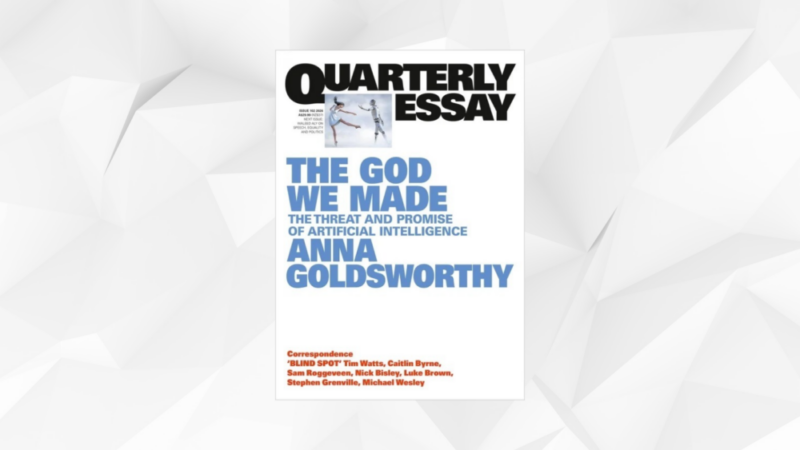
The buzz phrase of the minute; AI, or artificial intelligence, is all anyone seems to talk about these days. It has infiltrated our workplaces, our personal lives, and all industries imaginable. Anna Goldsworthy enters the discourse with the publication of a thoughtful essay for Quarterly Essay on the current (past and future) state of its impact, aptly titled, The God We Made.
Goldsworthy begins the 84-page essay, dropping the bomb that, “Just as we always suspected, the god that may destroy us is the god of ourselves” (p. 1). Here, she implies that we are the cause of our own destruction and if AI really does end up taking humanity down, we only have ourselves to blame. It really does seem that The Terminator films (particularly the 1984 original, and the 1991 sequel) are really coming to fruition.
Referring to her teenage children throughout the essay (by the first letter of their respective names), and specifically in the section titled, “The Children”, it is clear that this generation know far more of the development and use of AI. And we should probably take note, as they will be the generation to live alongside or die by it. Pretty bleak possibilities are outlined here, but we do need to be realistic. And this essay covers a lot of ground.
Goldsworthy discusses the concerns around work (What if AI can replace me?), including job displacement, loss of jobs due to AI, and the philosophical understanding of the idea of work. Here, she postures, “One of the ironies of technological progress is that although it is often designed to relieve us of labour, we have always found a way to invent more work.” (p. 22-3). Which is a really interesting notion to ponder. Because on the one side we are thrilled that AI has relieved us of the mundane aspects of our work tasks. But, now we worry that we will no longer be needed at all.
And why does work give us meaning and structure to our lives? Goldsworthy continues by asking, “What will we do with our lives when AI does the work for us, and we have more and more ‘leisure’ time?” (p. 27). Some might say there would be no problem with how they fill their days (Goldsworthy asks us to look at retirees for guidance on this one). However, some may not be able to cope. How do we fill the void, when there is one that needs to be filled?
We are invited to reflect on ourselves; what we have, that AI does not. “What is it to be a creature of time? It is patience, rhythm, renewal, decline… The AI never has to do this: age will not weary it…” (p. 56) However, we get to age. We get to know with the full experience of time what it is to grow old (many of us, at least). Goldsworthy reflects on the beauty in aging and that it is something not granted to the AI machine. She also spends some time discussing the notion of love and companionship, that some have sought out in AI. However, we must remember that we have what AI does not – a body (…and a soul?).
This essay is beautifully constructed and provides a lot of food for thought. As you have seen, this review poses more questions than answers. However, The God We Made is written in the medium that takes its time (a long, long, long time) to see the light of day (its readers). And the content concerns the most rapidly progressing technology the world might have ever seen. So, by the time you read this, and then read the essay – is any of this still relevant? And, more importantly, does humanity still exist?


FOUR STARS (OUT OF FIVE)
Anna Goldsworthy’s Quarterly Essay 102: The God We Made: The Threat and Promise of Artificial Intelligence is available now via Black Inc Books. Grab yourself a copy from your local bookstore HERE.
