
In a world where a genocide is being played out on peoples phones and the “leader of the free world” is blatantly censoring anyone who speaks out against him, the worst thing we can do is stop asking questions. Curious at the Sydney Opera House presents four talks in one day. These talks, which address topics such as gender, AI and fascism, are designed to encourage debate and critical thinking. It invites you to ask the question, although you may not like the answer.
I attended two talks: Is this AI’s Black Mirror Moment? and Is it Fascism Yet?
Is this AI’s Black Mirror Moment?
Anna Broinowski, Micah Goldwater, Karl Kruszelnicki and Jonathan Kummerfeld with host Rae Johnston
Karl Kruszelnicki AKA Dr Karl (he/him) aptly described AI as ‘predictive text on steroids’. As Senior Lecturer in the School of Computer Science at the University of Sydney Jonathan Kummerfeld (he/him) continued, AI is incapable of admitting it does not know the answer to something, it is trained to always provide a response, even if that response is incorrect information. This prompted host and multi-award-winning STEM journalist Rae Johnston (she/her) to question whether we are mistaking confidence for intelligence when it comes to AI. This lead to a discussion of what the definition of intelligence actually was, with Walkley Award–winning filmmaker, nonfiction author and Sydney University GenAI screen researcher Dr Anna Broinowski (she/her) commenting that we are giving AI more trust than it deserves.
Associate Professor of Psychology at the University of Sydney Dr Micah Goldwater (he/him) explored this idea of trust further when he discussed the risks of people forming connections to AI chat bots. AI is optimised for engagement and is designed so that you will continue to talk to it. As Goldwater states, chat bots affirm your ways of thinking to keep you engaged, it is no replacement for a therapist or psychologist who will challenge your ways of thinking. AI is not a replacement for real human connection. A point that is elaborated on when Broinowski commented that ‘one of the biggest dangers of AI is we will forget what it is to be human.’
This lead to a conversation around deepfakes and how they have suddenly entered the mainstream media. Shockingly, according to Broinowski, the creation of deepfakes as a tool to scam people has increased by 500% since 2023, with the average person unable to detect a deepfake 62% of the time. It is also important to note that 90-95% of victims of deepfakes are women and girls in non-consensual pornographic imagery. Yet, the majority of the research in this area continues to focus on how deepfakes can be used politically to potentially start WWIII. Apparently the powerful and influential men in this space would prefer to focus on a hypothetical, unrealised, fabricated and unlikely risk, than on a present threat and current reality that is actually effecting women and girls. Sounds fair.
So what is the solution? The idea of regulation was a hot topic, with Broinowski insisting, ‘It’s just tech, we are the humans, we should be controlling how we use it.’ While the panel largely agreed with this sentiment, Kummerfeld made a valid point when he said that regulations alone won’t be effective. In a world where someone can download the latest deepfake technology from China to their home computer, Kummerfeld declared that regulation is not a ‘silver bullet’, and that there is a bigger education piece that needs to be addressed.
If everyone agrees that regulation is the answer then what’s the hold up? As Broinowski succinctly put it, the ‘issue is unfettered capitalism’. Dr Karl informed the audience that in it’s first year of operation Chat GPT went from nothing to earning 1 billion dollars. It’s not that AI is progressing faster than we can handle, it’s that it turns a tidy profit so why would we reign it in. As Broinowski said, ‘don’t buy the lie [out of Silicone Valley] that we can’t control it, it’s just new tech.’
On an individual level, the answer appeared to be engaging in more critical thinking, however, as Goldwater states, it’s hard to think critically about something you know nothing about. Given that reading has largely been one of the primary sources of gaining knowledge, and only about 20% of young people read these days, you could argue the future is bleak. But like so many things within our society, it is not the tool itself that is the problem, it is how that tool is wielded. And that is something that we, as individuals, do have control over.
Is it Fascism Yet?
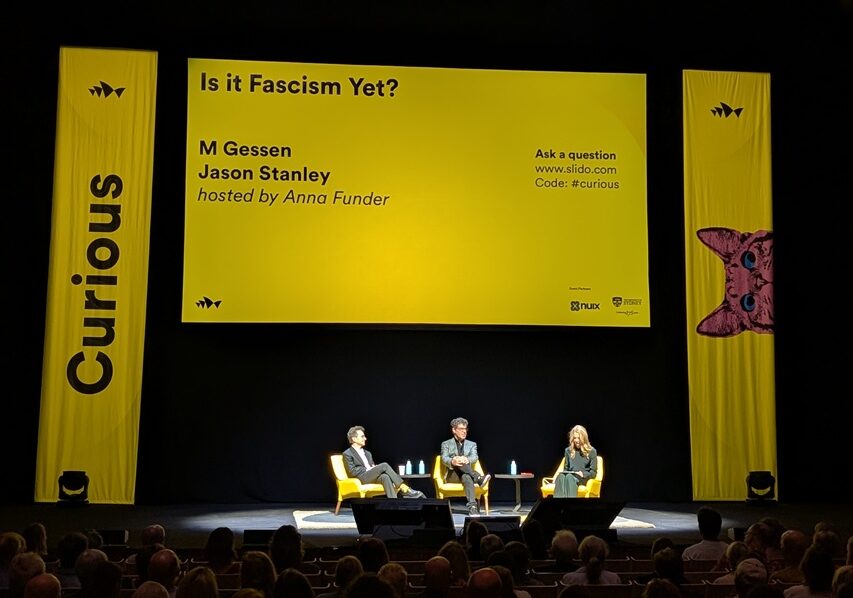
M Gessen and Jason Stanley with host Anna Funder
Comically, author and opinion columnist with The New York Times, M Gessen (they/them), began this session by answering the titular question – is it fascism yet? This question, asked in relation to the United States of America, is very easy to answer. Yes. As Gessen continued, we don’t need an hour to discuss it. But discuss it they did.
Jacob Urowsky Professor of Philosophy at Yale University and a member of the Justice Collaboratory at Yale Law School, Jason Stanley (he/him), has left the US and sought asylum in Canada with his family. His background in authoritarianism, propaganda, free speech, mass incarceration, as well as being the descendant of Holocaust survivors, makes Stanley uniquely positioned to be able to talk to the overlaps between how the Nazi Party rose to power in the lead up to WWII and the actions which US President Donald Trump is currently doing. An example he cited was the narrative constructed around federal workers being lazy and subsequently being replaced by loyalists to Trump.
The recent suspension of Jimmy Kimmel’s late night talk show was discussed and held up as a clear example of fascism. While the end of The Late Show with Stephen Colbert just a few months prior was attributed to “financial reasons” (despite being one of the highest rated late night talk shows), it was clear that Kimmel was being punished for his political opinions expressed on his show. In that short period of time they (the government, the networks, Trump) were so emboldened that they did not feel the need to hide behind excuses anymore. They didn’t have to mask the dismissal behind financial issues. It was a very clear signal to those in the entertainment industry that if they expressed opinions that Trump did not like, they would be punished for it. As Gessen comments, demonstrably targeting citizens and breaking laws is fascism.
The idea of contagion was also discussed, in particular social contagion, which is this concept of poisoning people against a particular group. We saw this in Nazi Germany with the Jewish population and we can see it now in American with trans people and immigrants. Stanley explains that contagion is essential to fascism as it ties into this idea of purity, particularly in relation to race and gender. Gessen continues, that Jews were only half a percent of the population of Germany. A fascist regime will intentionally label a minority group as a threat to a nation because they are easier to vilify. It is easier to vilify the unknown. Just as Nazi propaganda told the German people that Jews were going to steal their children, Trump is circulating propaganda that the trans community are coming for your kids. The parallels are terrifying.
Author and host Anna Funder (she/her) asked the question of whether what we see happening in America could ever come here. Is Australia at risk of heading down the path of fascism? While we would all like to believe such insanity could never be replicated here, I also never thought I’d see the day when neo-Nazis would crawl out of the holes of the internet they hide in and proudly march the streets of Sydney and Melbourne spewing their racist and hateful ideology, without any fear of repercussions. It is a smug, overly confident fool who proudly thinks that Trump’s fascism could never make it’s way to our shores. And I wouldn’t hold your breath expecting any actions from institutions or politicians, as Stanley points out, resistance lies in cultural push-back. This was proven in the case of Kimmel, when, after a momentous uprising of dissatisfaction from viewers, he was reinstated after 5 days. The irony of a country that prides itself on freedom of speech actively robbing people of their freedom of speech is an absolute joke.
It was fascinating to hear the opinions and perspectives of both Gessen and Stanley. Their insights solidified what I already knew to be true – America is currently operating under a fascist regime. The last thing we want is to see that replicated here, and if cultural push-back is the antidote, it’s time to speak up.
Curious addressed the big issues occupying our minds, and our media, at this point in time. While the two talks I attended were quite different, I couldn’t help but take away from them both a similar sentiment. In a world dominated by the 24/7 media cycle (circus), and the increasing prevalence of misinformation, it has never been more important to execute independent thought. It used to be that seeing is believing, but that is simply not the case anymore. We need to adopt critical thinking, ask questions, create healthy debate, speak up if something doesn’t seem right. The absolute worst thing we can do right now is disengage, because it’s while you’re looking the other way in denial, that shit will really hit the fan.

FIVE STARS (OUT OF FIVE)
Curious was held on the 28 September 2025. For more information head to the Sydney Opera House website.
Photo by author.
