

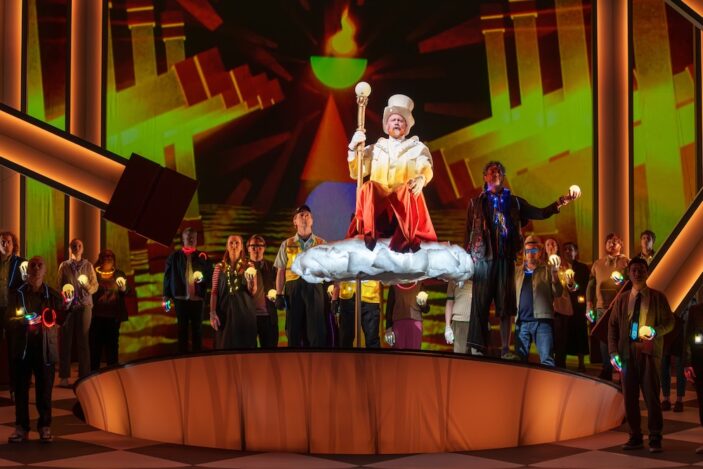
Whilst The Magic Flute has been a staple since W. A. Mozart wrote the music in 1791, this performance of the opera by the State Opera South Australia has been produced with the co-support of Opera Hong Kong, Beijing Music Festival and China National Opera House. This gives it a multicultural feel.
In the opera, the Queen of the Night persuades Prince Tamino to rescue her daughter Pamina from captivity under the high priest Sarastro. In doing so he learns of the ideals of Sarastro’s community and seeks to join it. Separately and together, Tamino and Pamina undergo trials of initiation, ending in triumph, with the Queen and her cohorts vanquished. The bumbling Papageno, who accompanies Tamino on his quest, fails the trials, but is rewarded anyway with the hand of his ideal female companion Papagena.
In this version of The Magic Flute, the action takes place in the MRT subway station and is influenced by modern themes. For example, the opening scene is an animated Armadeus, hungover and climbing out of bed to head down the MRT to busk. Director Shuang Zou and designer Dan Potra have framed the performance in eastern mythological themes, set in a bustling Hong Kong subway. The setting reflects a transient place, yet also reflecting everyman. In an interesting aside, the magical flute that is used in the show was purchased in Tibet on a spiritual retreat.
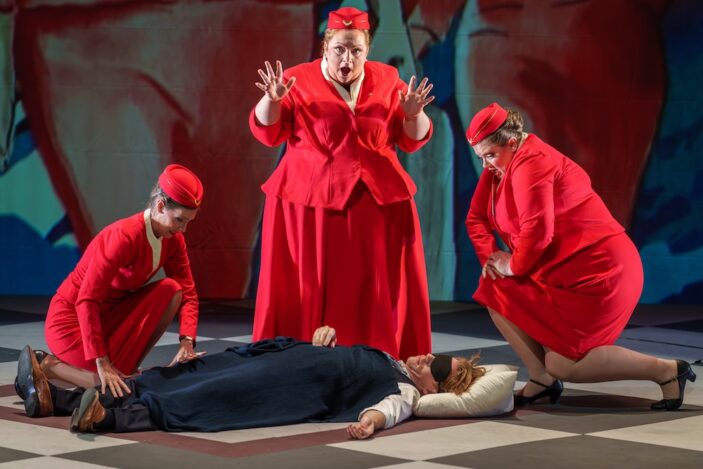
The show opens with a couple arguing, before the girl leaves on the train. Tamino (played by a convincing Nicholas Jones) is frightened by a serpent dragon and collapses. Three red-suited air-hostesses (hilariously portrayed by Helena Dix, Catriona Barr and Fiona McArdle) “emerge” from the giant poster on the wall and revive him. Clearly they find him very attractive and each offer to care for him while the others fetch the Queen. The ladies report to the Queen (a dramatic Danielle Bavli) who wants Tamino to rescue her daughter from the evil Sarastro (a powerful performance by Teddy Tahu Rhodes).
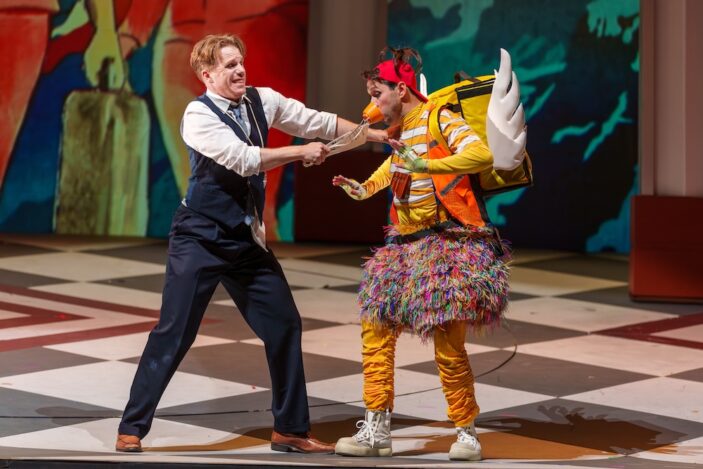
In between all this, a comically dressed bird-man, Papageno (David Greco) tries to convince Tamino that he had revived him. He is punished by being gagged. The Queen convinces Tamino to rescue her daughter Pamina (played by Stacey Alleaume in place of Sofia Troncoso who was unwell for this performance). Although she has played the part before, Alleaume had only some 48 hours to fly into Adelaide and learn the lines in German, yet she was flawless. The Queen gifts Tamino a magic flute and Papageno magic bells.
What follows is trials, love lost and love found with tests of loyalty and power. There are Masonic elements of power and ritual, from Mozart’s personal connection to Freemasonry. With such a complex plot sung mostly in German, it would be easy to lose the storyline. However, English and Chinese surtitles make understanding the plot simpler. The story, although complex, is explained quite simply.
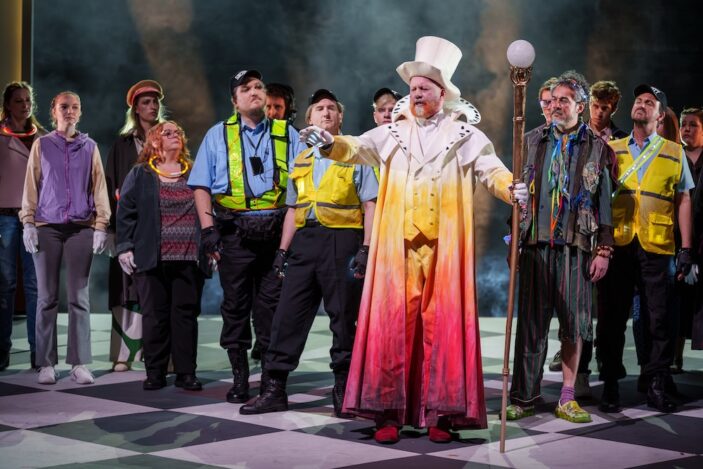
The ASO, led by conductor Dane Lam was splendid in their performance of the score. The music ebbed and flowed to reflect the changing dynamics in the story. The expansive chorus gave an otherworld feel to the performance. The set design, although minimalistic was cleverly adapted with lights and changing props. One moment it was a bustling subway, the next a temple of the high priest. Dan Potra’s set and costume design is flawless, the characters seem to jump from the stage. The three children (Phillip Cheng, Ethan Zhang and Celine Yuan) are delightful, firstly as babies in a pram, then aging gracefully into old men later in the piece.

Overall, this version of The Magic Flute is sumptuous, funny, sexy, poignant and modern. The cross cultural reinterpretation of a loved classic proves that great works can be adapted and improved. This is marvellous piece of theatre that stays with you, long after the curtain drops.


FOUR AND A HALF STARS (OUT OF FIVE)
The Magic Flute plays at Her Majesty’s Theatre, Adelaide on Thursday 4th sept and Saturday 6th Sept\
Tickets available on the website
Images copyright Andrew Beveridge
The reviewer attended on August 28th
