

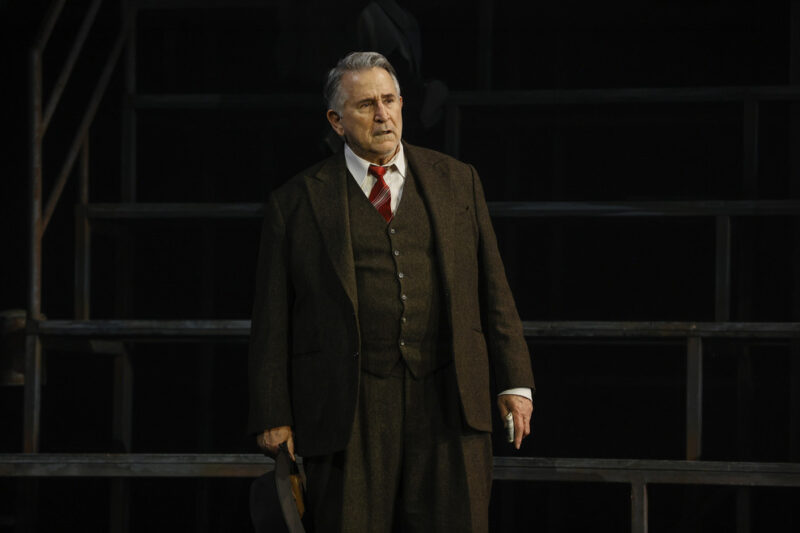
Journey into the life and mind of travelling salesman Willy Loman in Neil Armfield’s adaptation of Death of a Salesman, an exploration of the flaws of the American dream, consequences of family expectations and the perceived rules of masculine success. Arthur Miller’s timeless two-act tragedy has stood the test of time, captivating audiences through countless productions over the last 77 years, and now it has touched down in Australia for a strictly limited season that’s not to be missed.
From the moment the production begins, there’s an air of dread and despair spread through Her Majesty’s Theatre thanks to the looming presence of Dale Ferguson’s simple yet masterfully effective set design. The set takes the form of the bleachers at Ebbets Field. It’s a bold choice, considering there’s only one moment in the play that takes place at that location, but it’s a key juncture in the relationship between Willy (Anthony LaPaglia) and his son Biff (Josh Helman). This set design has the entire cast, regardless of scene involvement, sitting on the bleachers and watching every scene as it happens, giving off an eerie sense of judgement, as if the characters, present in the moment or not, are critiquing the life and decisions of Willy. It’s a fantastic update, enhancing the thematic and narrative elements of the production without distracting from what’s happening in the scene itself.
Regarding the staging, at times the actors’ movements through the set can be a little clunky given the logistics of running up and down a set of stairs, but the benefits of the design certainly outweigh potential awkward moments. The commentary box at the top of the bleachers is often shrouded in darkness, enhancing the grim nature of certain scenes while acting as a base for some neat scene transitions. The single static set is an interesting approach, relying purely on the audience’s imagination, with the aid of a few subtle staging elements, to visualise the locations and time periods that the characters move through.
Thankfully, with the help of staging, lighting and performances, it’s blissfully easy to follow exactly when the story dips from modern day into one of Willy’s delusions or memories. There’s a lot of back and forth as the narrative navigates Willy’s deterioration, but it’s very effectively translated through the use of dialogue and performance. LaPaglia carries himself differently in memory sequences, meanwhile both Helman and Ben O’Toole (playing Willy’s other son, Happy) give off an energy and sense of hope that isn’t present in their adult lives. Coupled with brighter spotlights and the subtle addition of a score, the production beautifully paints a picture of past scenes to tell us exactly where and when we are in the story.
It’s also incredibly well-paced, with the 3-hour production flying by, especially in the longer second act, where it even feels shorter than the first in some respects.
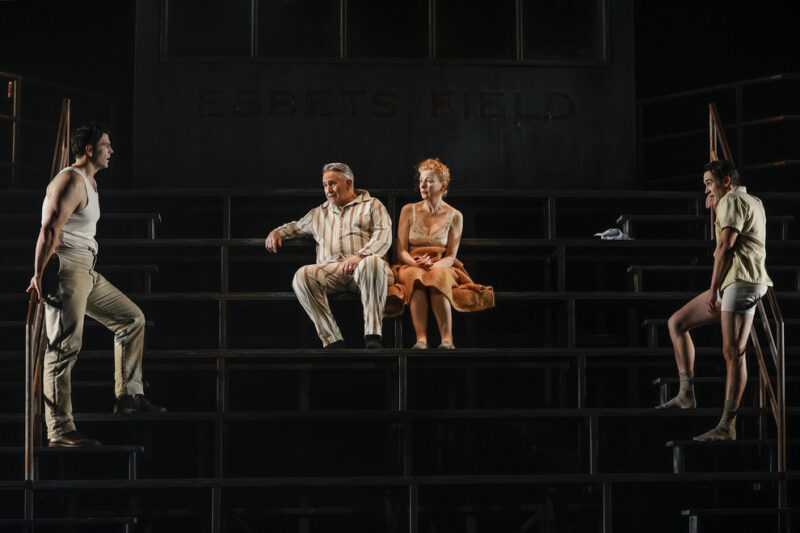
Death of a Salesman is carried by the weight of its performances, and this production features an award-winning ensemble who each bring something stellar to this tragedy.
LaPaglia lives and breathes Willy Loman through every second of this production. It’s an endlessly captivating performance of back-to-back monologues and intensely dramatic conversations, and LaPaglia doesn’t miss a beat. There’s a certain weight to how he carries himself on stage that commands the gaze of everyone in the audience, giving off a stage presence that both eclipses and enhances his co-stars performances.
Alison Whyte stars as Linda Loman and is a powerhouse in her own right. She’s tasked with bringing some of the heaviest, most emotionally distressing moments to life and nails every single one. It’s a soft-spoken performance that breaks out into hysteria at key moments, showcasing her raw acting ability and impressive believability in the role.
They’re accompanied by a stellar duo of performances from Helman and O’Toole, who complement each other incredibly well as Biff and Happy, respectively. These are two casting choices that fit the personalities of the characters flawlessly, with Biff being quite reserved and vulnerable while Happy is confident and outgoing, all the while both exhibit woefully selfish qualities. Helman delivers a more emotionally-charged performance that resonates throughout the production. He has an arc that’s captivating outside of Willy’s delusions, making him a strong character with exceptional development. O’Toole meanwhile delivers a louder, more boisterous performance with a focus on injecting humour into the production. He’s the source of multiple laughs that resonated with the audience while never taking away from the more sombre tone of the narrative.
Settle in for a production that marries Greek tragedy with the American dream; bringing Arthur Miller’s 1949 vision to life in a theatrical experience that’s not to be missed. While tragic and desperately sad, this production is lined with riveting performances from a seasoned cast of actors who each bring something unique. The gripping narrative hits its mark whether you’ve studied the play or are going in blind, and it’s all enhanced by moody set design and clever staging.
Death of a Salesman may be heavy and grounded in commentary about the human experience, but it’s a captivating watch you won’t regret.

FIVE STARS (OUT OF FIVE)
Death of a Salesman is playing at Her Majesty’s Theatre in Melbourne through to August 22nd, 2026, before moving on to Brisbane and Adelaide. For tickets or more information, see HERE.
Reviewer attended on Thursday August 13th, 2026.
Photo credit: Jeff Busby
