
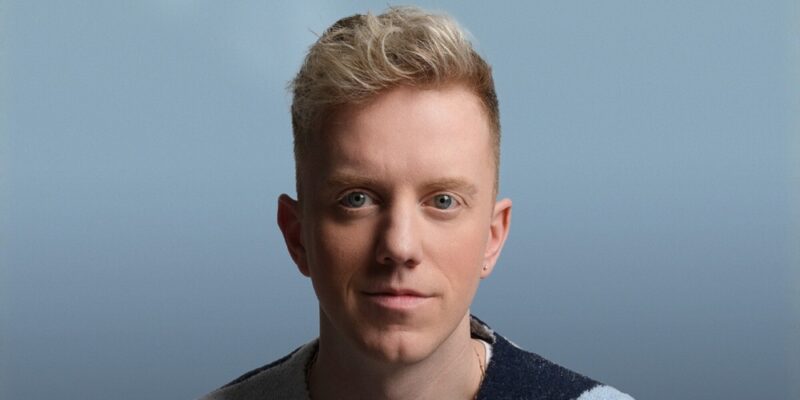
Multi-award-winning comedian, podcaster (A Gay And A NonGay), radio presenter (The Hits Radio Breakfast Show), TV host – and unapologetic gay icon – James Barr is bringing his fearless, critically acclaimed stand-up show Sorry I Hurt Your Son (Said My Ex to My Mum) to the Adelaide Fringe Festival.
A deeply personal hour of comedy, the show traces Barr’s experience as a survivor of domestic violence during a four-year relationship, guiding audiences through the emotional wreckage of abuse and the unexpected clarity that follows. By turning trauma into sharp, disarming stand-up, Barr invites laughter not as deflection, but as release – an act of reclaiming power and voice.
Speaking openly about his experience, Barr hopes to shine a light on the one in five adults in the UK who will experience domestic abuse in their lifetime – a figure even higher within LGBTQ+ communities, where reported rates are one-third higher for lesbian and gay individuals than for heterosexual people (Office for National Statistics, 2025).
Co-directed by Madeleine Parry – the Australian Directors Guild Award-winning director behind Hannah Gadsby’s Emmy-winning Nanette – Sorry I Hurt Your Son (Said My Ex to My Mum) has evolved since its first raw performances in Edinburgh in 2023 into a powerful, life-affirming work of survival through comedy. As Barr puts it: “I guess it’s a bit awkward for my ex that I’m doing a show about the things he did to me – but it’s not my fault he did this to a comedian.”
Our Peter Gray spoke with Barr about how the show has evolved over time, the differing reactions he’s receiving from a multitude of audiences, and what he feels it both takes from and gives back to him.
Your show feels like stand-up, storytelling, and activism all at once. When you were building it, was there anything you absolutely refused to compromise on — even if it made audiences uncomfortable?
Honestly, all of it. I started writing the show when I’d only just come out of an abusive relationship and was still figuring out what had actually happened. I took a break from comedy for a bit, and when I tried to go back to my old material, it just didn’t fit anymore. I didn’t relate to it. I realised that if I wanted to keep being a comedian, I was going to have to talk about domestic abuse. I’m not someone who can hide from where I’m at.
At the time, I was hiding a lot from myself. When you’re in an abusive relationship, you’re constantly doing that, because you want to stay. You love the person. You convince yourself it’s fine. It takes a long time to decode all of that. You second-guess yourself constantly. We’re told love conquers all, so you stay longer than you should. Unless you have incredible self-worth, which I didn’t at the time, you get stuck.
Over time, the show has changed massively. I’ve performed it over a hundred times now, and it evolves every single time. Early on, it was much more traumatic. Now I’m able to enjoy it, laugh at myself, and find the humour in how much I was ignoring. People who’ve seen it multiple times always say how powerful it is to watch that evolution, and I think that’s because the healing is happening in real time.
Was there a moment in previews where you realised you could actually go further than you first thought?
Definitely. I watched an early clip recently where I literally pretended to be a dog onstage! I had a woman walk me onto the stage and pet me. I was just so broken. I needed affection (laughs). There were so many moments early on where I thought, “I shouldn’t be doing this.” And every time, the audience basically said, “No, it’s okay. We’re with you.”
I was terrified of it becoming a trauma dump. That’s never been my comedy. I’ve always been silly, camp, bitchy… I didn’t want to upset people or trigger them, so I held back a lot. But over time, I found trust in the audience, and they found trust in me. Now it feels life-affirming. It frees people rather than dumping on them. I’m genuinely proud of it.
The title of the show feels like it gives your ex the final word, but then takes it back. Where did that reclaiming of authorship come from?
I was sitting in a café in Soho with my best friend, very cliché, and I just couldn’t name the show. I’d been talking about this experience for years: in therapy, with friends, with directors. It wasn’t just a show, it was me healing. At one point it was called Flamingo, because we’d adopted a flamingo together, but that felt too upbeat. Then my ex sent a Christmas card to my mum. Not to me. To my mum. It said, “Sorry I hurt your son.” And I was furious. Where was my apology? Why was he saying that to her? To me, he’d always minimised it, told me I was overreacting. But to her, he used the word hurt. That felt like an admission. So I thought: if you’re not going to take accountability, I will. I’ll take your apology and put it everywhere. That’s what the show is. I’ve monetised his apology, not very successfully yet (laughs), but emotionally? It feels great.
Have you noticed different responses from different audiences – queer, straight, men, women?
My audience used to be mostly gay men. That’s completely changed. Now I get straight couples, queer women, people I never used to see at my shows. And the responses are overwhelming. I remember talking to a straight couple who had a queer daughter in an abusive relationship. They didn’t know how to help her. We talked about how queer people grow up with so much trauma from not being accepted, and how that can bleed into relationships. But honestly, I don’t see huge differences between audiences. Everyone who comes seems ready for it. What I hear over and over is: “I’ve never heard anyone talk about this like this.” Or, “You’ve freed me.” That’s when it feels like purpose.
Do you feel the show is challenging ideas about masculinity as much as sexuality?
Yes, and that was terrifying. As a comedian, you’re meant to be confident, loud, in control. To stand onstage and admit you’ve been thrown down the stairs? You risk losing the audience. You also never want them to pity you. I hate that. There’s so much shame around abuse. People think it’s what they deserved. That shame stops us from talking. But as a gay man, I’ve already come out. I’ve already dealt with that fear of being judged. So I applied the same mindset to abuse. Now I’ll say it openly: that happened to me. And I’ll joke about it, not because it’s funny, but because abusers are embarrassing. Imagine your only way of feeling powerful is making someone else small. That’s humiliating.
What does performing the show take from you? And what does it give back?
At Edinburgh, I told myself it wasn’t taking anything from me. But I’d suddenly break down before or after shows. I couldn’t sleep. After one show, I was literally shaking in someone’s arms. It’s overwhelming because it’s all true. The laughs are huge, the response is incredible, and yet it’s still real. That contradiction is hard. But I’ve had people message me saying they left abusive relationships after seeing it. I’ve had men say it made them rethink their behaviour. That makes everything worth it.
Do you see humour as a shield, a sword, or something else entirely?
Honestly? It feels like light. Comedy can be a shield, Hannah Gadsby talks beautifully about that, but I think in this show, I’m piercing through it. I’m shining light on something dark and bringing the audience with me. Laughing removes shame. That’s what queer culture has always done, laughing at ourselves until acceptance follows. This show just applies that to something we’re usually too afraid to name.
And on a final note, what do you hope people leave with when the lights go down
That they’re not alone. That this is common, terrifyingly common, and that talking about it doesn’t make you weak. I want as many people as possible to see it. And I want other artists to make work like this too. The more we talk about it, the less power it has. And honestly? I’m proud of myself. I don’t know if that sounds big-headed, but I’ve created something that helps people. That feels good.
James Barr will be playing as part of Adelaide Fringe (February 20th – March 22nd, 2026) with James Barr: Sorry I Hurt Your Son (Said My Ex To My Mum) running between March 19th and 21st, 2026. For more information and tickets, head to the official site here.
