
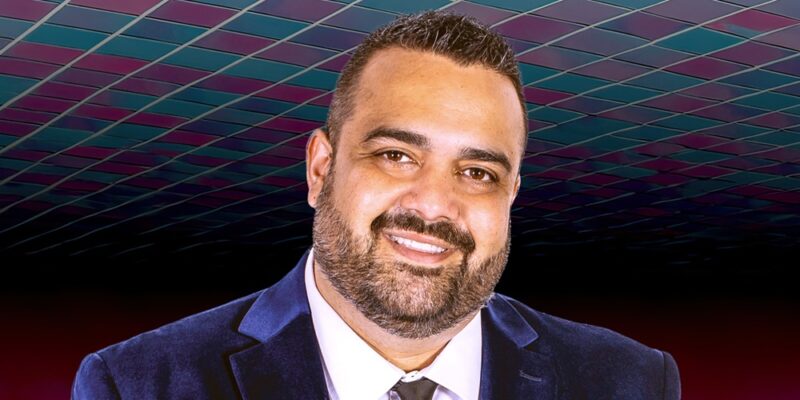
After a decade of sold-out shows, viral punchlines, and becoming one of Australia’s most recognisable – and reliably joyous – comedy voices, Dane Simpson is doing what few comedians dare: hitting shuffle on his own legacy. 100% Hits – A Decade of Dane Simpson’s Funniest Moments!, landing at the Adelaide Fringe in 2026 (running between February 20th and March 22nd, 2026), is exactly what it promises – a greatest-hits album performed live, with no filler and maximum fun.
From Wagga Wagga to national treasure status, Simpson has spent ten years building a body of work defined by warmth, precision, and laugh-out-loud storytelling. Our Peter Gray spoke with him about revisiting old jokes with fresh eyes, what it feels like to stand behind material that’s followed him for a decade, why the chase of comedy still matters, and how he instinctively knows which jokes earn their place on stage – and which ones are ready to be retired.
This show is a greatest hits album in a lot of ways. When you look back over 10 years, were there any jokes you’d completely forgotten about until you revisited them? And then did any surprise you at how well they still land?
Yeah, absolutely. It’s weird, because at the moment, these last couple of weeks, I’ve been doing shows that are clean and have that kind of family friendly vibe. I’ve been going back through gags, and the ones that stand out are obviously real cheeky, so I haven’t had a chance to do them yet on stage. I’m doing a gong show, and they’ll be revisited, but I’m excited to give them another crack.
When you’re choosing which jokes make the cut, is there a real test for you? Is it audience reaction, personal pride, or the ones that still make you laugh?
I want to have fun. I want to love doing the show. I don’t want to do gags just because other people like them. I don’t rate my jokes. I just sort of memorise the crowd reacting. But your memory is so biased (too), if the crowd didn’t react the right way to a joke, your brain absolutely tells you they love it (laughs). I am so untrustworthy as to what my mind is saying is funny. But I think there’s also a structure that has to go along with it as well. All of my shows have a little undercurrent of a chat, a yarn. I want the show to make sense, even if it’s like Frankenstein, taking bits of this and that. I want people at the end to feel like they’ve seen something, or coming away with a form of resolution.
Going off that mentality of it feeling like a conversation, is there a joke that feels like an old friend that you’ve grown up with? One that changes meaning for you as you age?
Yeah, so I talk about my dad so much, and I really want to talk about this, because I talk about him like he’s an idiot who is out of touch. He’s old, and it’s funny because he’s from Wagga, and I’m taking him to Melbourne like he’s a fish out of water. I don’t know what I’m doing. And now that I’m a dad, I look back on that and it’s like, “Oh, he was just doing the best he could do.” I have so much empathy for him. Like, he really was just trying. Now I’m the idiot. I’m out of touch to my son. I find that funny, and it’s a whole new way of looking at my dad and the way he treated my friends, or treats my friends. The way he talks about the world and that he’s never been on a plane before, and then I’m taking him the plane. I’m going to have new experiences through my son, and they’re not too far away. I almost need to be careful in the pot calling the kettle black (laughs), because that’s just going to come back at me very soon.
Going over these 10 years, do you feel that one thing has changed more than the other – your relationship with the audience or your relationship with yourself before you walk on stage? What do you think’s changed the most?
Going from 30 to 40, I think, is one of the biggest changes in later life. (30s) are like the toddler years of being old, and there’s a point where I felt like an adult. After 40 I started to feel I’m becoming an old man. The way I do jokes has definitely changed (too), like the style of comedy. When you first learn how to do comedy, you’re like, “Oh, this is how I do it,” and then you evolve and become a different comedian. There’s elements of me learning how to be a better comic and a better performer, but there’s also me maturing, or even turning into an old man and becoming a dad. I think I just see the world differently, and I’m telling the same jokes, but almost from a different perspective, because I’m a different person, for multiple reasons. I’ve gotten married. We’ve bought a house.
Was there a moment when you realised that comedy wasn’t just something you love, but something you could genuinely build a life around?
There’s been multiple moments. One that stands out foe me particularly is when I wrote a show called “Didgeridoozy”, and somebody came up after the show, and the show is me heavily talking about my culture, my people, where I come from. You know, Wagga being heavy with its Aboriginal population. But this guy came up to me after the show, an older, white guy, and he was saying how his family felt similar. He started talking about his family with me, what he took away from the show, and I was just thinking how cool it was that me, an Aboriginal man, was connecting with a non-Aboriginal through family and comedy. It made me realise that I love doing this. (Comedy) is something that I find so cool.
Another big one is having a streaming service like Paramount Plus saying they loved my show and putting it on their platform. That’s really cool. It’s validating being on the same kind of platform as Have You Been Paying Attention? and all that type of stuff. That made me really feel like I’m going down the right path, particularly from people that I love and respect. Working Dog and Rob Sitch, who is just one of the greatest comics, and Santo (Cilauro), Tom (Gleisner), they’re all incredible guys. I remember being backstage chatting to Rob, and I was eating a donut, complimenting the food. He was like, “You’re like my dad. He’s always complimenting the food. It doesn’t matter what kind of food it is, he’s always got a compliment.” He then told me that he wrote it into a movie, “I don’t know if you’ve seen The Castle?” I’m like, “Yeah, bro, we’ve all seen The Castle!” Like, if I wrote The Castle I’d be figuring out a way to work it into every conversation (laughs).
As you said having been on panel shows, like Have You Been Paying Attention?, what do you find is the biggest difference in being funny in a studio and then holding a live room on your own?
Yeah, I think that’s where I have struggled on those shows. Not struggle, but I just love being me and being silly and fun. I think there’s a big difference between being on a panel show and being yourself. I’ve talked to a few of those panelists, like Mikey Robbins, and getting some really good feedback on how to do it properly and be a better comic. It’s a different animal. It’s the same as being funny on social media. It’s a different game. And then stand-up. You need to learn them all. There’s so few spots, you need to be good at them instantly, or you miss out. I love being silly and having a laugh. I do get a little too familiar, because I love the comics I work with and taking the piss. But I’m from the country. We’re slight bullies, but in a fun way.
Is there something that you feel TV has given you that stand-up couldn’t? And then something that stand-up gives you that TV never will?
TV is always going to be validating in people’s eyes. You’ve got the Melbourne International Comedy Festival Gala being on TV, and that is so huge. To ne, it’s the biggest gig in the country. You can’t better than that in Australia. And it’s not only a live stand-up show, but once it’s on social media it becomes huge. It’s weird, people on TikTok or Instagram will watch the gala if you post it on your own social media, but they won’t watch it on TV. But because it’s on TV it’s got more clout once it goes on Instagram or TikTok. It’s so strange to me.
After 10 years of sold-out shows, big rooms, big laughs…is there a part of comedy that still scares you a little bit? And is there an answer to the question of why you think you keep chasing the feeling too?
I do get nervous before every show. Every single show. When I started touring it was with a comedian called Shiralee Hood, who’s this absolutely brilliant comic. I was so lucky to be touring around with her, but I told her I was nervous, and she said that “You’re always going to have butterflies in your stomach, but it’s about teaching them to fly in formation.” That stayed with me. That’s 10 years ago.
When I was first starting out, I missed all the open mic scenes. I ended up doing the Aboriginal Comedy All Stars, a tour around the country, which is like 76 gigs, and I jumped on that as an opening act. These were gigs with professional comics watching every night, and when we were getting in the car and talking, I’d be asking about what they found funny and how I could make my craft better. Chatting about comedy like that really shaped me quickly.
Dane Simpson will be playing as part of Adelaide Fringe (February 20th – March 22nd, 2026) with 100% Hits – A Decade of Dane Simpson’s Funniest Moments!, running between March 2nd and 8th, 2026. For more information and tickets, head to the official site here.
