
There has been a lot of discourse lately about the demise of critical thinking. With the dominance of AI, the proliferation of misinformation online – which is then fed to us by AI and a carefully constructed web of destructive algorithms – it can be difficult to know where to turn.
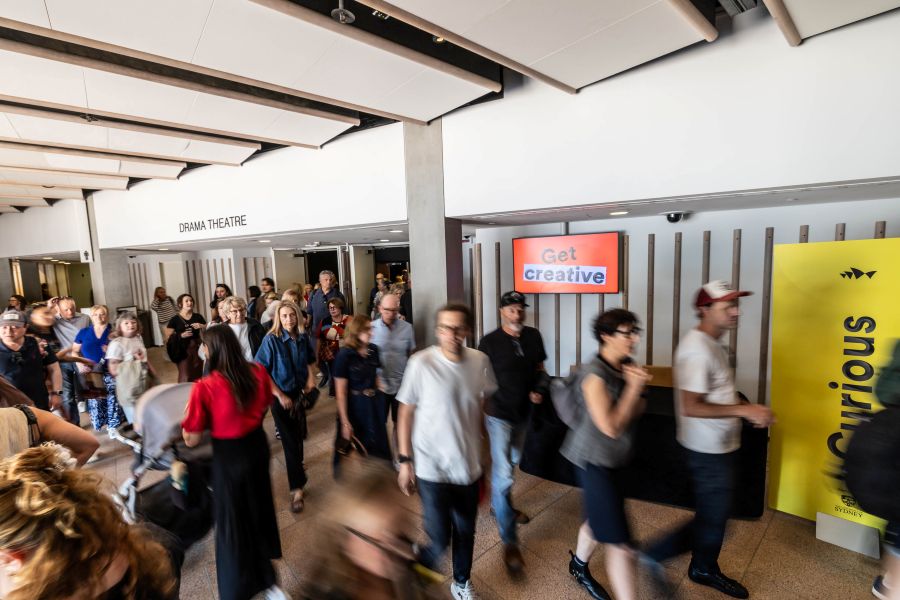
Curious at the Sydney Opera House was a day full of talks centred around some of the biggest burning questions facing our country today. Designed to promote debate and challenge perceptions, topics ranged from journeys into consciousness and the turbulent world of the Murdochs to questioning whether democracy as we know it is in decline.
I attended four talks: Caligula on the Potomac, Magda Szubanski, Where’s the AI Off Switch? and Can it Happen Here?
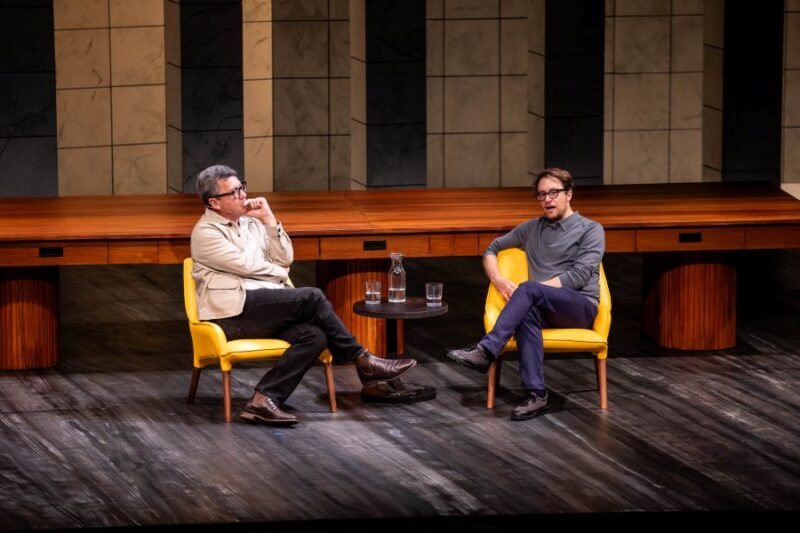
Caligula on the Potomac
Nick Bryant & Gabriel Sherman
Roman Emperor Caligula was known for his erratic behaviour over his four-year reign – remind you of anyone?
Author, radio host and former BBC journalist Nick Bryant and journalist, screenwriter and author Gabriel Sherman sat down to discuss their experiences with US President Donald Trump. Sherman first met Trump in the 1990s when he was known for his real estate ventures, observing, “He was an incredibly savvy operator of the media.”
He remarks, incredulously, “He was just a New Yorker; now he’s a world historical figure.”
Bryant recalls meeting Trump while working for the BBC, and how Trump said he was honoured to meet him, adding humorously, “I think he regarded the BBC as an offshoot of the royal family.” He continued to recall how the man behind the camera was completely different from the person presented in front of it, and when he became President, he wondered which version of Trump America would get – sensible or crazy. After references to ‘American carnage’ in his first inaugural address, he had his answer.
Sherman asserts that Trump “surrounds himself with loyalists and sycophants,” discussing the President’s desperate desire for acceptance from the elites, while simultaneously criticising them. Sort of like the boy in the playground teasing the girl he secretly likes.
There was extensive discussion around the January 6, 2021 Capitol Hill attack, with Bryant asking – how did Trump survive the uprising? Sherman responds that since Watergate there has been a belief on the far right that the media is influenced by the left, and “If ever there was a time a President should be removed from office it’s January 6.” The fact that he wasn’t demonstrated the change in the media landscape. The uprising was repackaged into something else by far right media. There were two competing versions of the story and the version with the loudest voice is the one most likely to be believed.
This inevitably leads to a conversation around Trump’s relationship with Rupert Murdoch, with Sherman presenting a vivid metaphor of two lions circling each other in an enclosure. Both lions recognise the other’s power but are unwilling to concede any ground. Any alliance they have is an alliance of convenience, because they absolutely hate each other. With this in mind, it is interesting that Bryant comments that “Trump becomes bigger than the people who created him” – this includes Murdoch.
Both journalists were covering the 2016 US election between Hillary Clinton and Trump, with Bryant waiting out the results in the Hillary camp, and Sherman following Trump. No one saw the win coming, with Sherman comparing the aftermath to 9/11 in terms of the impact and sheer scale of the outcome, commenting, “you all knew the world would never be the same.” Ten years on, this has proven to be accurate.
But how dangerous is Trump? While the insurrection on January 6 is evidence of authoritarian impulses, he hasn’t completely disobeyed the law. Yet. He still has two years left, which led to a discussion about the upcoming mid-term elections, with Sherman believing it is the “most politically vulnerable he’s been.” He’s doing everything he can to influence the vote.
According to Sherman, “His legacy will always be one of someone who has divided America, not united it.”
To round out their discussion, Bryant asks, “Is there a madman in the White House?”
“Short answer – there is,” responds Sherman.
Caligula would be so proud.
Magda Szubanski: I Can’t Tell You, But I Will
with Fran Kelly
As comedian, author and national treasure Magda Szubanski took to the stage the crowd erupted in applause. Before she had even uttered a word, the overwhelming love and support from the audience could be felt.
Sitting down with radio presenter and journalist Fran Kelly, Magda discussed her latest book, I Can’t Tell You, But I Will, her battle with cancer and what the future looks like now.
Her latest book is about her mother whom she describes as the love of her life. “I could just say my mother was Scottish and a Scorpio,” she comments, as she recounts stories of how brutal her mother’s behaviour towards her could be. So notorious are Scottish mothers for their sharp tongues, Magda recalls, “I ended up having a night on the turps with Maggie Smith,” where they bonded over their strict Scottish mothers.
They discussed how comedians often aren’t the funniest in their families, insisting that her mother was far more hilarious than her. She was just the one who blossomed. Which of course led to a conversation about what is possibly her most recognisable and most beloved character – Sharon Strzelecki. “A really good part of me is Sharon, there’s a lot of me in Sharon,” she continues, “I have the soul of a first responder.”
Magda became her mother’s carer and she insists, “The book is really about caring,” and about the emotional labour of women. The first line of the book is ‘I don’t want you to die but I think maybe I need you to.’ She admits that she wasn’t sure whether to include it. Being a carer is both a burden and a privilege, one that Magda knows well, and she discussed her mother’s generational trauma, admitting that knowing a person’s trauma does not make the experience of their behaviour easier to bear. “I couldn’t live my life crushed under the damage of hers.”
She touched on her experience of publicly coming out as a lesbian in 2012 in support of the vote for marriage equality. “I spent so much of my childhood hiding myself,” she says, “By that point I was willing to risk my popularity for the cause.”
When discussing her cancer diagnosis, Magda recognises that her life will be shortened by her illness, and despite still recovering from treatment, she insists, “It’s because I love the world that I can’t just shut up and do nothing.”
And let’s hope she never does shut up. Able to balance the devastation of grief with self-deprecating anecdotes of run-ins with fans in pubs, Magda truly is a national treasure. The standing ovation and rapturous applause that concluded her session seemed an insufficient way to recognise such an incredible performer and human.
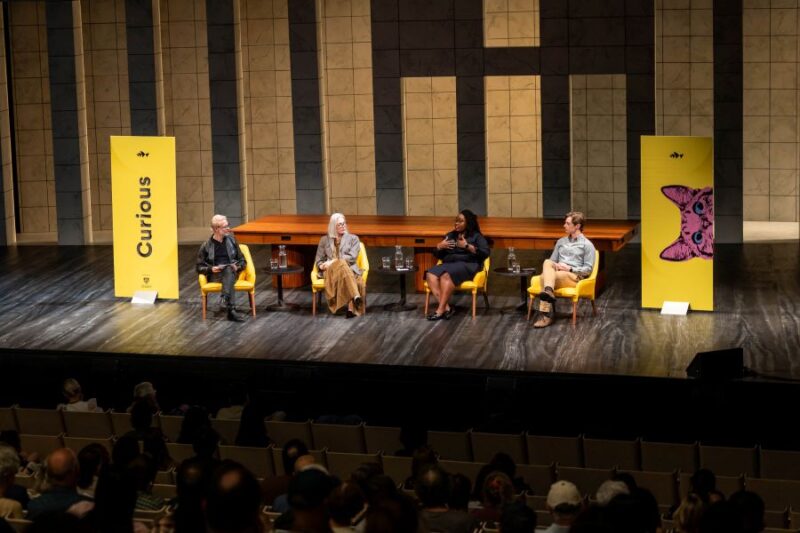
Where’s the AI Off Switch?
Sophie Gee, Shae O Omonijo & Reuben Rideaux, with Daniel Browning
Recent reports coming out of America claim that in the next decade AI could kill all humans. While this may be an exaggeration, the detrimental impact that AI technology is already having on our lives is not.
Humanist, writer and founder of Critical Thinking Labs, Shae O Omonijo believes that we should be asking these big tech companies what their design philosophy is and how do they actually want users to interact with it. Right now, there are four American companies controlling everything, and we need to start asking what are they doing with people’s information?
She continues to express how we need more diversity of models, as AI is used for different things and the people creating it may not hold the same values as you, which impacts how it interacts with you.
Senior Lecturer at The University of Sydney and Lead AI Researcher at Explore Science, Reuben Rideaux explains ‘cognitive offloading’ as the performance of a physical act to take the load off your cognitive abilities. Everyday activities such as writing a shopping list, using your GPS or having a calendar, are all examples of cognitive offloading. He explains that it’s not necessarily a bad thing, and it can be quite a useful tool, but if we become too reliant on the use of AI we will become less critical of the outputs. Using cognitive offloading too much can be damaging.
Vice-Chancellor’s Fellow at The University of Sydney, English professor, novelist and journalist, Sophie Gee delves into the creation of the humanities as a means to encourage meaningful engagement and touches on the extreme environmental, human and cultural costs of AI. She elaborates on that feeling we get when we see a film we love or read a book we can’t put down, commenting that the “arts culture causes us to recognise it but it also makes us believe it recognises us.” The arts speak to the part of us that feels seen.
Omonijo made an interesting point when she mentions how older generations (think millennials) have been educated on primary and secondary sources. At university, citing information found on the internet was frowned upon, with primary sources almost always coming from printed materials. However there is an entire generation growing up with AI who don’t understand that AI doesn’t differentiate between primary and secondary sources, or even why this distinction is important. AI will give as much weight to a YouTube video of an influencer discussing WWI as a written diary entry from a soldier stationed at the Western Front in 1914. It treats all sources the same. We need to make the distinction.
Gee believes that “our aversion to discomfort is really served by AI” as you are never without an answer. It removes the awkwardness of the unknown. But are these machines actually making our lives easier or would we be better served to choose the uncomfortable path?
When asked about an impending AI apocalypse, Rideaux says that’s not really his main concern. What does concern him are these companies that are massively overinvested, are in an arms race and moving too fast. It needs to slow down.
Gee continues that, in an apocalypse you are either damned or saved and this narrative that an apocalypse is being forced upon us takes away our agency. This serves big companies, as it is in their best interests to take away individual and small business agency, however, “you don’t need to know anything about AI to know what your values are.”
This idea of our values is a recurring theme, with Omonijo commenting, “You need to decide what role is AI going to play in my life and the life of my kids.” Because currently there are no regulations so you need to create your own guardrails and at the end of the day – you don’t have to use it.
Perhaps that’s the big takeaway. It may feel as if you can’t escape AI, you can’t even use Google these days without the platform forcing an AI overview on you, which you can’t turn off – I’ve tried – but using LLMs (large language models) like ChatGPT or Claude is a choice. One that you do have control over.
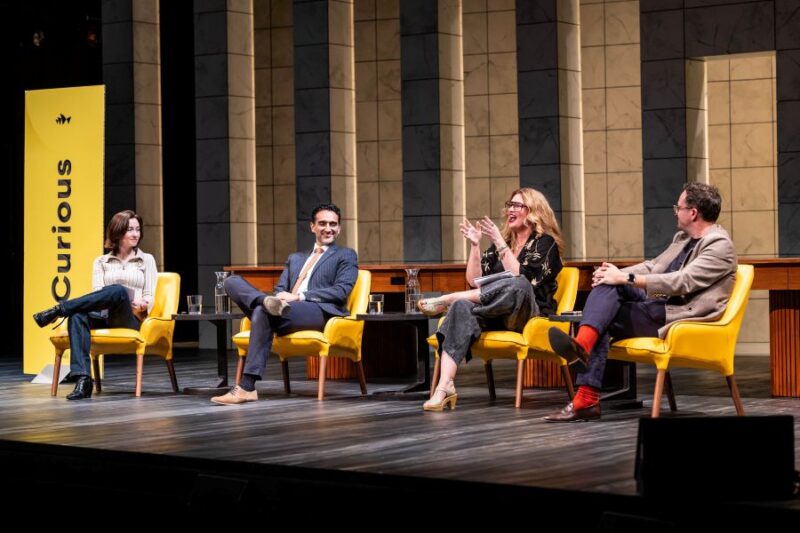
Can it Happen Here?
Waleed Aly, Rick Morton & Amy Remeikis with Maddison Connaughton
Are we witnessing the decline of democracy around the globe?
When asked if Australia could become the US, broadcaster, author and academic, Waleed Aly said yes, it can – but it hasn’t happened yet. He continues that we are currently seeing the rise of populist politics on both the right and the left.
Journalist, author and political analyst Amy Remeikis adds to this by discussing the rise of One Nation in Australia. At the last federal election in 2025 the far-right political party polled at 6%, now – one year on – that figure has reportedly risen to 33%. She believes we don’t have a mainstream left party in Australia, with people mistakenly thinking The Greens are the radical left.
Author Rick Morton states that a full-blown authoritarian regime would be harder to achieve here but it could happen, making the very accurate comment, “We always make excuses for the government we like but criticise the government we don’t like when they do the same thing.”
Remeikis comments that the laws against protesters brought in by the Labor Government are very authoritarian and protecting freedom of speech has become selective, depending on the cause. She continues that once the middle class begin to feel the weight of authoritarianism, it’s already too late. “Governments get away with what they can on the groups that can’t fight back,” such as minority groups, people with disability etc. These groups will feel authoritarianism long before it reaches the middle class.
The audience was asked whether we wanted data centres – the overwhelming response was no. We were asked if we trust Americans – again, a very loud ‘no’ rang out. This prompted Remeikis to state that our government and successive governments act against the will of the Australian people. The country is openly saying ‘we don’t want this,’ but our government is not reflecting this, prompting reporter and ABC host Maddison Connaughton to comment that there’s a malaise with the current major parties in Australia.
Aly entered into quite a philosophical discussion about the destruction of liberalism. He believes that liberalism only offers continuous improvement and that we operate under this idea that there are no limits. When we see disillusion across the spectrum what we’re seeing is a collapse of ideas and nothing to replace them with.
He makes an interesting point when he raises social media and the fact that no one asked the philosophical question about its impact on how we connect. We are now retrofitting actions, such as the introduction of the regulation to opt in to Instagram algorithms, because the alternative is unthinkable – just turn it off.
The panel discussed leaders and New York City Mayor Zohran Mamdani was a hot topic. Morton insists that governments should do the hard job to make people’s lives easier and when a government says we’ll do this thing cause it will make our lives easier, it’s the absolute worst part of government.
Aly comments that it’s easy to ask why we don’t have good leaders, but should we be asking if we are leadable – “I don’t think we are,” he says.
Reimeikis takes a slightly less nihilistic view when she says, “stop looking for leaders and be one.”
Curious feels less like a glimpse into a potential future state and more like a foregone conclusion. Trump is a madman with two years left to upend the global order, AI is already escaping its sandbox and hacking into Medicare, and the level of discontent in Australia does make you worry for the future of our democracy.
Is it less a question of ‘if’ and more a question of ‘when’?
I was surprised at how few people were in attendance at these talks (except for Magda – everyone loves Magda), and while it could be a result of being held across a long weekend in Sydney and during school holidays, the truth is perhaps a little more unsettling. And the demographic in attendance was mostly millennials and older, people who are arguably, already invested in these topics. Realistically, members of Gen Z are the most at risk from the pitfalls of AI and the disappearance of democracy, and they seemed the least represented in the room. It seems they are just not curious enough.
And why would they be? They exist in a world of validation seeking and instant gratification where people like 25-year old American influencer Alix Earle are boasting that she’s never read a book.
Under these circumstances, it’s difficult not to start catastrophising the future of humanity. But then I remember what Magda said – “It’s because I love the world that I can’t just shut up and do nothing.” And neither will I.

FIVE STARS (OUT OF FIVE)
Curious was held on the 4 October 2026. For more information head to the Sydney Opera House website.
Photos: Ken Leanfore
