

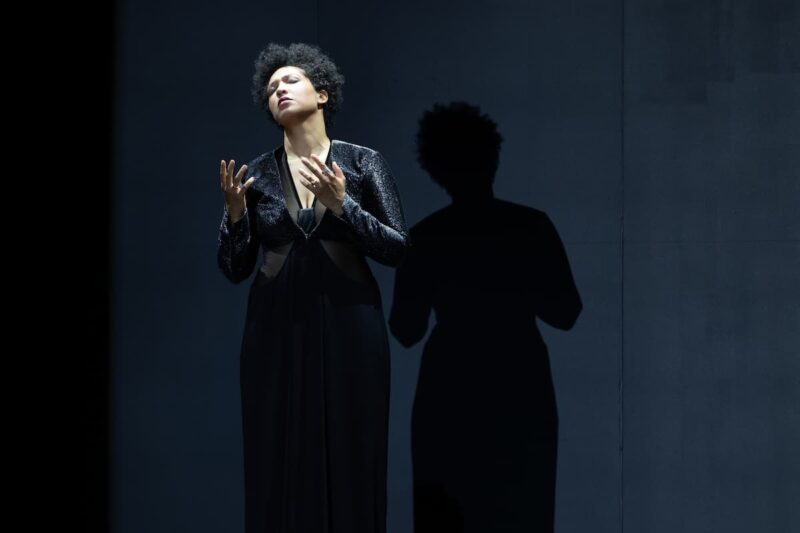
This is not the story of Josephine Baker that you know. As the title suggests, it is “for”, rather than “about” the famed singer, dancer and actress. Baker’s story defies neat narratives, and while this performance touches on many elements of her life, from her onstage persona to her Rainbow Tribe of adopted children and later role in the US civil rights movement, this is no mere homage.
Soprano Julia Bullock is tasked with capturing the unbridled onstage energy, wild optimism and deep angst of this complex and deeply wounded figure, and she delivers a mighty performance. For almost two hours she does this through spoken word, song and dance, switching between English and French as she flits constantly between musical styles.
Under composer Tyshawn Shorey’s watch, most of the songs are deconstructed to the point of being unrecognisable as the six-piece band lurches from dissonant contemporary opera to apocalyptic 12- bar blues pierced by sinuous melodies wrestled from the sax and bassoon.
Rather than impersonating Baker, Bullock channels her emotions. When she plays it straight with a brace of classic songs, including Madiana, it is merely a bait and switch that illustrates the vast distance between Baker’s crowd-pleasing onstage persona and the turmoil of her personal life. Later, she revisits this mode accompanied by a rhythmic drum beat. As it fades out, she uses her own voice as percussion, and her ecstatic gyrations slowly devolve into a morbid death dance, vividly
illustrating the toll that this constant performance takes on her.
Interspersing Claudia Rankine’s poetry with quotes from Baker, Bullock is defiant throughout – “I am no more primal than Princess Grace,” she declares at one stage. In the 1920s, Baker achieved empowerment through her fame, even as she knew she was being used. Today, Bullock forces the audience to reckon with the costs of greedily lapping up that wildly exoticised stage persona.
Perle Noire asks a lot of Julia Bullock and she gives a bravura performance that embodies all the confidence, rage and torment of Baker as she escapes the naked racism of the Jim Crow south to find a more veiled version in France. It also asks a lot of the audience, who need to sit with their complicity in the objectification of Baker and the many other Black icons who have graced the stage. The ringing phones, rustling wrappers and sense of restlessness in the theatre suggested that not everyone was up to it. That is their loss.


FOUR STARS (OUT OF FIVE)
The reviewer attended the performance on 3rd March at Her Majesty’s Theatre.
Image supplied and credit to Andrew Beveridge.
