

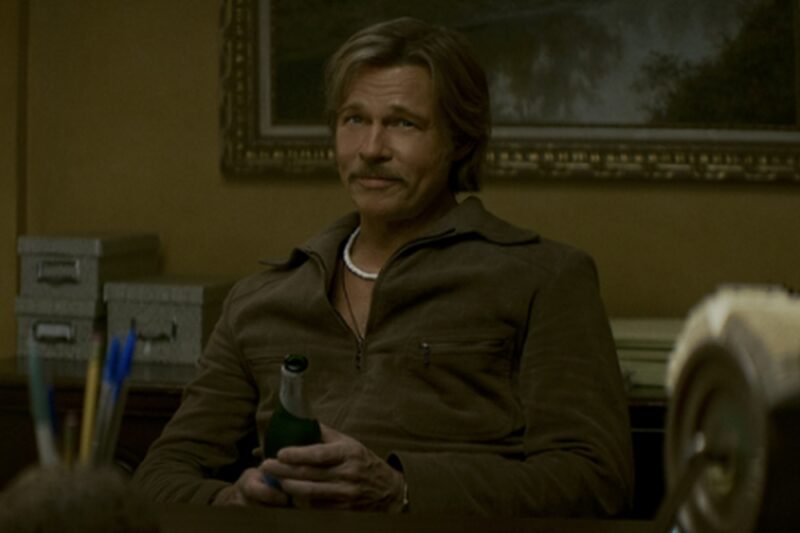
Given the combined cinematic pedigree of David Fincher and Quentin Tarantino, it feels particularly strange that The Further Mis-Adventures of Cliff Booth – a film so enamoured with the very culture of going to the movies that it introduces its titular character working as a projectionist – should be afforded such a limited theatrical existence before settling into its streaming home on Netflix. A continuation of the world Tarantino so lovingly reconstructed in 2019’s Once Upon a Time in Hollywood, with Fincher assuming directorial duties from a Tarantino-penned screenplay, the film is perhaps not the monumental meeting of cinematic minds one might have anticipated. But as an excuse to spend another couple of hours in the company of Brad Pitt’s effortlessly charismatic, morally questionable former stuntman, it’s difficult to begrudge its existence.
Picking up in 1977, eight years after the events of its predecessor, The Further Mis-Adventures of Cliff Booth finds Cliff (Pitt, slipping back into his Oscar-winning role with enviable ease) navigating a Hollywood that no longer has quite the same professional use for him. With Rick Dalton (Leonardo DiCaprio, absent here) having relocated to Australia, Cliff divides his time between tending bar, working the projection booth at the New Beverly Cinema and discreetly attending to the rather unsavoury problems of Hollywood’s rich and famous. It’s the latter profession that brings him into the orbit of television star Charlie Peters (Scott Caan), whose considerable ego has seemingly written a cheque his celebrity status can’t cash, with his Australian talent agent, Karen Crosby (Elizabeth Debicki), facilitating Cliff’s involvement in a particularly nasty predicament concerning a pair of Filipino gangsters.
As much as that particular narrative thread gives the film something resembling a traditional structure, Tarantino appears considerably more interested in the people Cliff encounters and the conversations they have than in the mechanics of the crime story itself. And whilst that leisurely disposition was one of the great pleasures of Once Upon a Time in Hollywood, it doesn’t always translate quite as successfully here. The interesting friction between Fincher’s meticulous filmmaking sensibilities and Tarantino’s penchant for conversational indulgence means the film occasionally feels as if it’s being pulled in two different directions. Fincher can certainly orchestrate the hell out of a sequence of mounting tension – and the violence, when it arrives, is often startling in its severity – but the episodic nature of the material means certain stretches are considerably more engaging than others. Even when the film delivers on its more violent promises, the conclusion may leave some feeling as if they’ve been afforded another chapter in Cliff’s life rather than an entirely satisfying story unto itself.
What is virtually impossible to fault, however, is the calibre of the performances. Pitt understands that so much of Cliff’s appeal lies in the contradictions of his personality; he’s capable of astonishing cruelty, yet possesses a peculiar sense of decency, and the actor’s seemingly unforced charm makes our willingness to overlook his character’s more questionable behaviour all the more fascinating. Caan is particularly terrific as the magnificently self-important Charlie, finding considerable humour in a man whose confidence is inversely proportional to his ability to manage his own affairs, whilst Debicki proves an especially inspired screen partner for Pitt. The sexual chemistry between the two is palpable, and the manner in which Debicki administers a series of slaps to Pitt’s face is, quite frankly, absolute poetry. Yahya Abdul-Mateen II, Carla Gugino and a particularly welcome Peter Weller all make their respective presences felt, even if the screenplay doesn’t afford them quite as much room to play as one would like.
On a purely aesthetic level, The Further Mis-Adventures of Cliff Booth is a gorgeous piece of filmmaking. Between Erik Messerschmidt’s cinematography, Donald Graham Burt’s production design and Trish Summerville’s costuming, Fincher’s recreation of late-1970s Los Angeles feels wonderfully inhabited rather than merely dressed for the occasion. Tarantino’s affection for the minutiae of popular culture is similarly infectious, with fictional blaxploitation cinema, television personalities, elaborate tiki bar concoctions and wonderfully specific conversations about actors lending the film a personality that extends well beyond its central character. And underneath all that nostalgia is something rather poignant about Cliff himself: a man who has spent much of his working life making other men look extraordinary, physically bearing the consequences of their manufactured heroism, yet who appears far more comfortable with his own station in life than the stars whose problems he’s routinely employed to solve.
Perhaps inevitably, The Further Mis-Adventures of Cliff Booth suffers in comparison to Once Upon a Time in Hollywood, a film whose deceptively casual construction ultimately gave way to something surprisingly emotional and euphorically cathartic. Fincher’s film never quite achieves that same sensation, and for all the talent involved, it’s difficult to shake the feeling that it should amount to something a little more substantial. But lesser Tarantino and Fincher is still a considerably more entertaining proposition than much of what passes for star-driven entertainment these days, and watching Pitt exercise the kind of movie-star magnetism that requires neither a particularly elaborate action sequence nor a grand dramatic monologue is a pleasure in itself. It may not be an essential return to this particular Hollywood, but it’s certainly an enjoyable one.


THREE AND A HALF STARS (OUT OF FIVE)
The Further Mis-Adventures of Cliff Booth is playing exclusively in IMAX theatres across Australia and the United States for a limited engagement before streaming on Netflix from December 23rd, 2026.
