

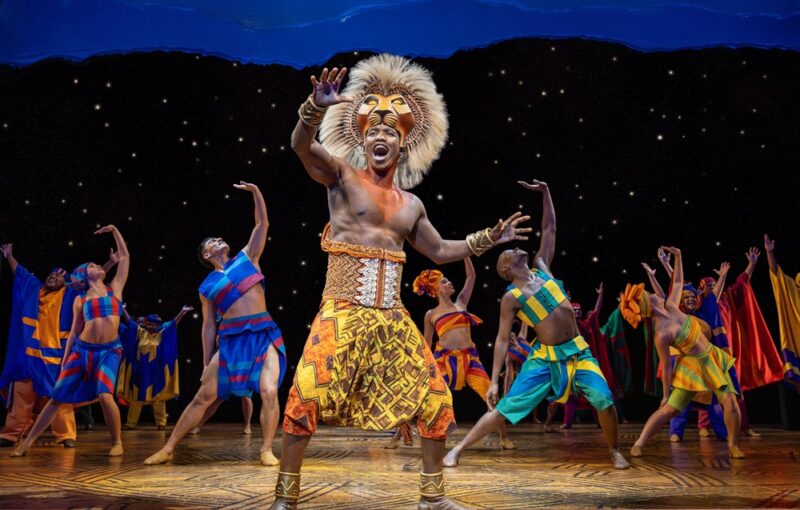
Some stories are so deeply embedded in our collective consciousness that revisiting them feels less like discovering something new and more like returning to an old friend. Disney’s The Lion King is undoubtedly one of those stories. Yet, as the opening notes of “Circle of Life” reverberate through QPAC’s Lyric Theatre, something rather extraordinary happens. The familiarity falls away, replaced by a sense of wonder that reminds us why live theatre, at its most imaginative, remains an experience no screen can truly replicate. More than a decade after its last Brisbane season, Disney’s theatrical juggernaut returns to Queensland with all the spectacle, musical grandeur and emotional sincerity that have sustained its global success for almost thirty years. And while Simba’s journey from carefree cub to reluctant king is hardly unfamiliar territory, Julie Taymor’s extraordinary stage interpretation continues to make audiences feel as though they’re encountering the Pride Lands for the very first time. That sensation begins before the story has even properly announced itself, as towering giraffes, graceful antelopes, soaring birds and an enormous elephant transform the auditorium into a living, breathing ecosystem. It’s an opening of such astonishing theatrical confidence that the audience is practically surrendering to the production before the first number has concluded.
What makes The Lion King so remarkable, however, isn’t simply the scale of its spectacle, but the complete absence of any attempt to conceal the mechanics behind the illusion. Unlike productions that increasingly rely on digital technology to construct their worlds, Taymor’s vision celebrates the human artistry responsible for bringing its animals to life. We see the performers manipulating their puppets, balancing beneath elaborate costumes and moving in synchronisation with the creatures they represent. Rather than undermining the fantasy, this transparency somehow makes it more magical.
Lions exist somewhere between human and animal, their expressive masks positioned above the performers’ faces, while dancers become shifting grasslands, fabric transforms into landscapes and shadow puppetry communicates entire journeys with poetic simplicity. Richard Hudson’s scenic design, Donald Holder’s evocative lighting and Garth Fagan’s nature-inspired choreography work in beautiful harmony, creating a theatrical language that feels simultaneously ancient and contemporary. There’s something genuinely moving about watching such intricate craftsmanship unfold in real time, particularly in an entertainment landscape where technological realism so often takes precedence over imagination. Here, the audience is invited to participate in the illusion rather than simply observe it, and that distinction is precisely what makes the production so transporting.
The music, naturally, remains an essential part of the experience, though the stage production’s greatest musical achievements often extend beyond the Elton John and Tim Rice compositions audiences know by heart. “I Just Can’t Wait to Be King”, “Hakuna Matata” and “Can You Feel the Love Tonight” provide those irresistible moments of recognition, but it’s the African-inspired compositions, rich choral arrangements and rhythmic intensity of Lebo M‘s contributions that give the musical its distinctive emotional identity. The live orchestra, under the musical direction of Laura Tipoki, lends the score an appropriately expansive quality, while the percussionists flanking the stage create a pulse that can be felt throughout the auditorium.
“He Lives in You”, in particular, carries a spiritual weight that deepens the story’s exploration of ancestry, grief and responsibility. At the centre of this musical landscape is Buyi Zama, whose performance as Rafiki is nothing short of commanding. Having previously portrayed the character in earlier Australian productions, Zama brings an unmistakable authority to the role, effortlessly balancing playful eccentricity with profound emotional sincerity. Her vocals are extraordinary, but she’s equally effective in the character’s lighter moments, ensuring Rafiki feels less like a mystical narrative device and more like the emotional heartbeat of the production.
The principal cast is equally impressive, with Nick Afoa bringing a compelling combination of warmth and authority to Mufasa. Having previously played Simba, his return to the production as the character’s father adds a rather beautiful sense of continuity to a musical so concerned with generational responsibility. His Mufasa is appropriately regal, but it’s the tenderness beneath that commanding exterior that makes the relationship with his young son so affecting. Opposite him, Daniel Frederiksen is deliciously calculating as Scar, finding considerable pleasure in the character’s bitterness, aristocratic affectations and theatrical villainy. As the adult Simba, Aphiwe Nyezi brings an appealing vulnerability to a character whose journey is fundamentally one of emotional avoidance, while Emily Nkomo gives Nala a welcome sense of independence and determination. Their chemistry is engaging, with Nkomo’s vocal strength particularly impressive.
The supporting performers provide an equally enjoyable counterbalance to the story’s heavier moments, with Jamie McGregor and Rutene Spooner finding an effortless comic rhythm as Timon and Pumbaa, and Benn Welford delivering a wonderfully fussy Zazu. The occasional Australian reference, including some distinctly Brisbane-flavoured humour, gives the production a welcome local personality without compromising its broader appeal. Meanwhile, Ezra Williams, Winston Hillyer and Mat Verevis embrace the grotesque physicality and anarchic energy of the hyenas with infectious enthusiasm, their performances another reminder of just how much skill is required to make these elaborate puppets feel like fully realised characters.
For all its extraordinary theatrical invention, The Lion King isn’t entirely immune to the limitations of its source material. The underlying narrative remains relatively straightforward, and the expanded stage material occasionally exposes the simplicity of Simba’s emotional journey. The second act doesn’t always sustain the exhilarating momentum established by the opening, with the transition from Simba’s carefree existence alongside Timon and Pumbaa to his eventual acceptance of responsibility feeling somewhat hurried. Some musical sequences also function more effectively as showcases for movement and design than as meaningful developments of character or story. But these are relatively minor concerns within a production whose ambitions extend well beyond the mechanics of its familiar narrative.
Indeed, what becomes increasingly apparent is how much of the musical’s enduring appeal comes from its willingness to trust an audience’s imagination. It asks us to look at a performer holding a bird aloft and believe, without hesitation, that we’re watching it fly. It invites us to recognise the human beings beneath the costumes while simultaneously accepting the animals they’re portraying. And perhaps most importantly, it reminds us that the most powerful theatrical experiences aren’t necessarily those that disguise their artifice, but those that transform it into something emotionally meaningful.
Nearly thirty years after its Broadway debut, The Lion King remains an astonishing example of what happens when commercial entertainment and uncompromising artistic imagination are allowed to coexist. Its return to Brisbane is more than simply another opportunity to revisit one of Disney’s most beloved properties; it’s a reminder of the extraordinary possibilities of live performance, and of what human beings can create with movement, music, craftsmanship and a little collective imagination. For younger audiences, it may well be the production that introduces them to the transformative power of theatre, while those returning after its previous Brisbane season will find considerable pleasure in discovering that the magic hasn’t diminished with familiarity.
The story may be timeless, the songs instantly recognisable and the destination inevitable, but there’s still something profoundly affecting about watching an entire auditorium fall under the spell of such unapologetic theatricality. In a world increasingly accustomed to spectacle being manufactured on a screen, The Lion King achieves something far more rewarding by allowing us to witness the imagination behind the illusion.


FOUR STARS (OUT OF FIVE)
The Lion King is playing at Brisbane’s QPAC Lyric Theatre through to March 7, 2027. For more information and ticket purchases, head to the official site here.
