

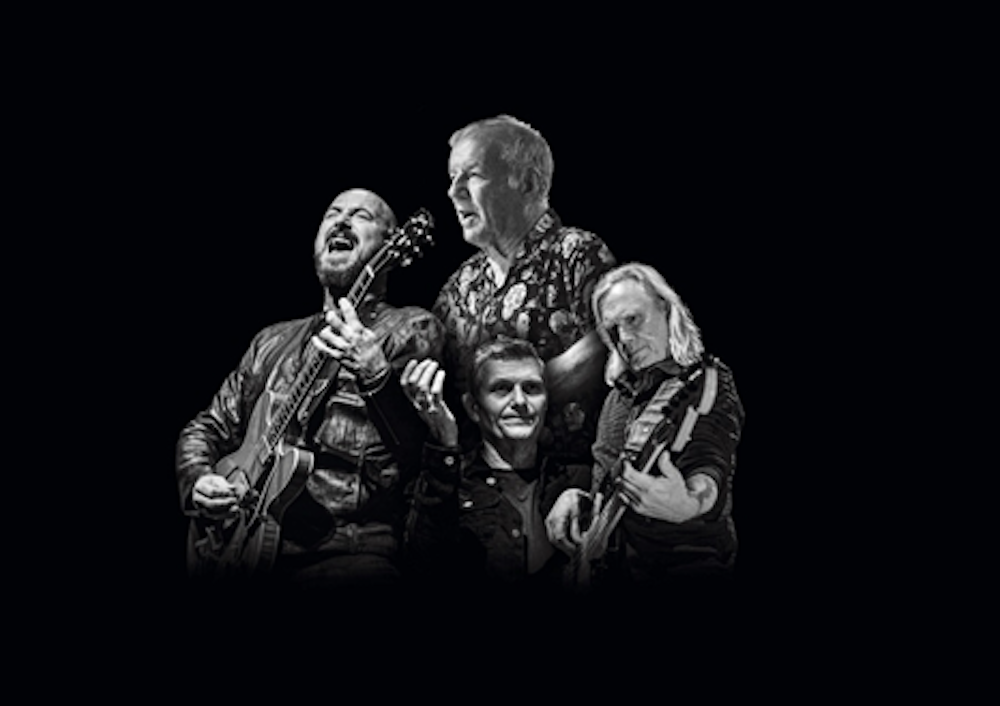
THE ANIMALS were a major force in the British Invasion of the 1960s, blending blues, R&B, and rock into a sound that has inspired generations. Their music remains as relevant and powerful today as it was back then! On the eve of their Australian tour, we chatted to founding member John Steel about his illustrious career.
You’ve been a part of The Animals now for over 60 years. How has that journey been?
Well, it all started back in 1956. Eric Burdon and I first met and performed our first little band back then, and that just developed into what became the Animals by 1963, so we go back a long way back.
I was reading that you started off more trumpet-based.
Yeah, that period in our teenage years was just about on the cusp between Dixieland jazz and rock and roll. Dixieland jazz was the dance music for teenagers and then rock and roll completely took that over. I started off playing trumpet because I was a jazz fan, you know.
What was the impetus to change to drums?
Well, Eric had a little band when we first met, and it was Eric on trombone, a guy on banjo, a guy on trumpet and a guy on drums. Well, the drum set was one snare drum and one set of hi-hats. Anyway, the trumpeter wasn’t going down too well. So, when I met Eric, he says you want to come and play with us and see what we feel like? So, I went along to one of their guys’ houses, and we did a few numbers, and that was how I got the job. But within weeks or months at the most, Eric said, “I don’t want to do this anymore. I want to be more like rock and roll. He wanted to be a singer. So, the banjo player said, “Okay, I’m going to get an electric guitar and see what else.” The guy on drums said, “I want to play this new instrument, the electric bass guitar.” I said, “Okay, well. I’ll just play drums then.” That’s where it started.
Your drum playing style had that jazz swing influence which was one of the founding sounds for The Animals.
It was ‘66 when the original band finally broke up. I quit the band in ‘66 because I could see that it was all falling apart anyway. Chas Chandler, the bass player who had been with us for forever, Bless him, said, “You know, when Johnny Steel quit The Animals, the swing went right out of it.”
That has to be like one of the best compliments you can get.
Yeah, I treasured that.
Obviously, The Animals have got so many great songs. “House of the Rising Sun”, “Don’t Let Me Be Misunderstood”, “Bright Lights, Big City”, but I don’t think people realise that a lot of the songs are covers themselves. It’s just that The Animals made them famous. To me, it’s like the way an artist presents a song; they give their own influence on it.
Yeah, John, you got it right on the nail there. I always say we didn’t write those songs, we just we just made them the definitive versions. By whatever means we did, we managed to make the song identifiable with The Animals.
They’ve endured for, like we said, 60 years, and what gets me is, they’re still as fresh as they were back then. These are timeless songs.
That’s great for me and the band because they’re still fresh, they still stand up. People identify with them, so they never wear out. They never get tired, which is great for us playing stuff.
What keeps you going? The audience reactions or the touring; what is it that drives you?
It’s the pure pleasure of doing it, and with a good band, it’s a treat every night. We get along well together, so there’s no friction on that side, and the audiences love what we’re doing. I’ve been saying for several years now, I guess this is probably going to be my last game. They go, yeah, yeah.
There are some videos up on your Facebook page of your recent shows in Europe, and you look 20 years younger than I was expecting. You still have a very youthful, energetic look about you. It’s like someone who’s still in their prime playing music.
I’ve been told that before, John. It’s very nice to be thought of that way. Danny, Danny Handley, he’s the lead guitarist and lead singer. When we’re hanging out together and doing a bit of banter and stuff before we go on, he says, “It’s just amazing, man. You’re just one of us. You’re not an old man.” My theory is you’re only as old as you feel.
So, the latest lineup, you mentioned, Danny, and you’ve also got Barney Williams and Norman Helm. How did the band come together?
It evolved just gradually, you know. But I mean, Barney on keyboards is just absolutely brilliant. You know, he’s as good as Alan Price ever was in his best day. I mean, Danny, you get two for the price of one. You know, the guitarist fantasy. He’s a lot younger than me, but he loves the era, and he’s like a walking encyclopaedia about ’50s and ’60s music. It’s just a good lineup and good fun to play with and be on the road with.
What would be some of the highlights along the way? Like when did you first realise that you were going to be a musician?
Well, it started in the usual way, you know, playing little pubs and things like that. But then there was a guy called Mike Jeffries, who became our manager, opened up a club, upstairs in what used to be some warehouse, called the Downbeat Club, and we were playing there regularly. And then he opened a club called the Club A-Go-Go, which was in the city centre, and it was like a two-room thing. We had what he called the jazz lounge, which was you know with a licence and sort of an older crowd, and you had the young set room where the pop bands played. We became the kind of house band, and we had visiting guests, one like John Lee Hooker, another one was Sonny Boy Williamson.
We got to play with them, you know. That’s when I thought, bloody hell, I’m playing with the grown-ups here. And then, before you knew it, the end of ’63, we were persuaded to go and have a go at London. That was through playing with the Graham Bond organisation at the Club A-Go-Go. Graham Bond was a jazz man originally, but he was playing the Hammond organ. He had Ginger Baker on drums and the bass player from Cream, Jack Bruce. So, they were a terrific little band. But he loved what we were doing. We played a set before he came on, and then we played the closing set. He got up and jammed with us, and it was Graham who told Mike Jeffries, “You want to get these guys down to London.” He said, “I’ll give you some introductions.”
So, at that time, we were called the Alan Price Rhythm and Blues Combo, which is a right mouthful, because Alan had reformed the band after we’d had a bit of a breakup. Anyway, Graham set this thing up where Mike went to London and he met up with Giorgio Gomelsky, who was manager of The Yardbirds at the time, and a guy who founded the first pirate radio station, Ronan O’Rahilly, who had a club called the Scene Club, right in the middle of Piccadilly. Mike came back to us at the Club A-Go-Go, and said, “Right, we’ve got a great deal here. The Yardbirds are going to come up here and do your gigs for a week or two. You’re going to go down there and do the Yardbirds gigs.” And he says, “But by the way, you’ve got a new name. Graham came up with a great idea.” He says, “We’re going to be called The Animals.” We thought that was outrageous. We said fine, all good. Apart from Alan, who didn’t like it. But that’s how we became The Animals. Graham gave us the name.
I understand that you managed to get over to the Ed Sullivan show at one stage.
Oh, we did. We did. I think three at least Ed Sullivan shows. Yeah, when we first went over to New York, that was one of the big deals we had. We opened up the Paramount Theatre in Times Square for a week, a full week’s gig there. We got to do the Ed Sullivan Show, which was massive in those days. It was such an important plug. That’s where Elvis broke his record, and so it was really important. It was a peculiar show, though. It was like a kind of old-style variety show. You know, you had jugglers. One act was a boy-girl roller skating. So peculiar, but you know, it didn’t do Elvis any harm. Didn’t do us any harm.
On the flip side, you’ve had shoutouts from people like Bruce Springsteen who have called you out for influencing his style.
Absolutely, he’s very generous. Must be must be a few years now, three, four years ago. He was on a major world tour, and every night he said to the audience, “I’ll tell you three songs; “We Gotta Get Out of This Place”, Don’t Let Me Be Misunderstood”, “It’s My Life”. They’re the foundation for every song I ever wrote, and these were sung by The Animals.”
The thing is, they’re still as relevant today as they were, 50 odd years ago.
Yeah, yeah. I mean, we’ve just been doing some tours, some work in Europe, Sweden, Germany, and finished in Portugal. Danny’s girlfriend came along to the to the gig in Portugal. She was in the audience, and it was a sold-out house. She said a 10-year-old boy sitting next to her with his with his mum and dad, and he was singing all of the lyrics.
So, it’s cross-generational. It’s not just like there’s old people in the audience who go, “Oh, I remember in the day”.
No, not at all. We usually go out front signing merchandise, doing selfies and stuff after each show. Very often there’s three generations, in the same family. The kids brought the mum and dad, and the mum and dad brought their mum and dad.
So, for all the young up-and-coming musicians, would you recommend a music career as a good choice?
Oh yeah, I would. You know, you know, it’s not all glamour. You got to do some road. But if you’re lucky and you’ve got some talent, it’s a great life.
Header image supplied
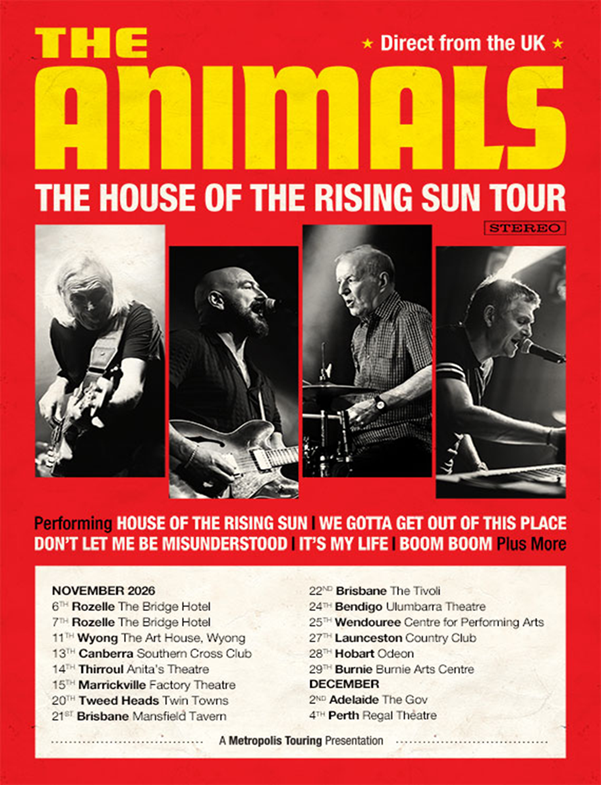
THE ANIMALS November / December 2026 Australian Tour Dates
Sunday 8th November, KINGSFORD, The Juniors
Wednesday 18th November RICHMOND, The Regent Theatre
