

Revenge may be a powerful motivator, but what happens when there’s nobody left to punish and the man who has sacrificed everything must find a reason to keep living? That question sits at the heart of the second season of Prime Video’s The Terminal List, which sees Chris Pratt return as Navy SEAL Commander James Reece in an adaptation of ‘True Believer’, the second novel in Jack Carr’s bestselling series. Where the first season was a relentlessly brutal examination of grief, vengeance and moral compromise, this new chapter expands into a globe-trotting espionage thriller, taking Reece from the wilderness of Mozambique into a dangerous international conspiracy. Yet beneath the explosive action and political intrigue lies something considerably more intimate: a story of redemption, fractured identity and the difficult process of rebuilding a life when everything that once defined it has been taken away.
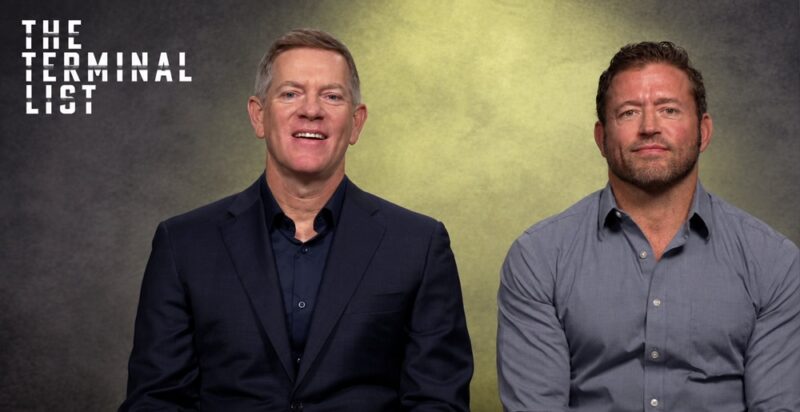
For executive producers David DiGilio and Jared Shaw, that emotional evolution is as important as the show’s commitment to military authenticity, a guiding principle that has shaped the series from its inception. With Shaw drawing on his own experience as a former Navy SEAL, and DiGilio continuing to explore the moral complexities of men and women who operate in the shadows, the second season examines not only the extraordinary capabilities of special operators, but also the psychological and personal costs of their service. As the show premieres on Prime Video, our Peter Gray spoke with DiGilio and Shaw about shifting James Reece’s journey from vengeance to violent redemption, navigating the uncomfortable line between understanding and forgiving a character’s actions, balancing realism with what they affectionately call a little “Hollywood hot sauce”, and why true heroism is often defined as much by its sacrifices as its achievements.
What I found fascinating about this second season is that the first was driven by everything James had lost, whereas this one is about discovering what he might still have to live for. I’m curious, was it actually more challenging to construct a man finding purpose than a man seeking revenge? And how did that change the way you approached him?
David DiGilio: I think the first thing we had is an incredible book in ‘True Believer’ by Jack Carr, and when we were making season one, at that point we had read that second book (so) we knew what was coming. We knew that there was going to be this story of violent redemption after this story of vengeance without constraint. And there’s something wonderful about a redemptive path, that healing arc for the character. It’s a really cool theme to tackle while still adding in all the incredible action and violence that the franchise is known for.
And Jared, given your experience in special operations, I’m interested in the idea of identity. When someone’s entire life has been defined by service, what happens when that sense of purpose is taken away? Was there something about James’s journey this season that you felt compelled to get right?
Jared Shaw: Yeah, absolutely. Coming from a background like that and not having, like you said, that sense of purpose can make somebody go crazy. Go deep down in the rabbit hole of their own mind. So it was a very healing process for James as we go through that journey with him on this season and see him able to apply the skill sets and the knowledge and the experience that he has to solve the on-going problems that are presented to him.
Obviously seeing the first season helps with viewing this, but I love that this season feels very self-contained. It has a completely different identity. It has its own distinct way of telling the story. David, something I found interesting about James is that we’re obviously conditioned to root for him, even when he makes morally uncomfortable decisions. When you’re writing someone who’s capable of extraordinary violence, how conscious are you of that fine line between asking an audience to understand his actions and then asking them to forgive him?
David DiGilio: It’s a wonderful question. I think when you have a character like (James), you always look at the moral center of the character and how far he’s willing to compromise that moral center to seek justice or consequence. In season one, we took him as far as we possibly could. Probably the darkest moment is as he’s dragging a teenager down the beach to potentially drown him in order to get what he needs from the father. That is a brutal moment to come back from this season. Chris Pratt, in what I think is probably his best performance ever, wears all of the pain and suffering that he took upon himself in order to mete out the justice of season one.
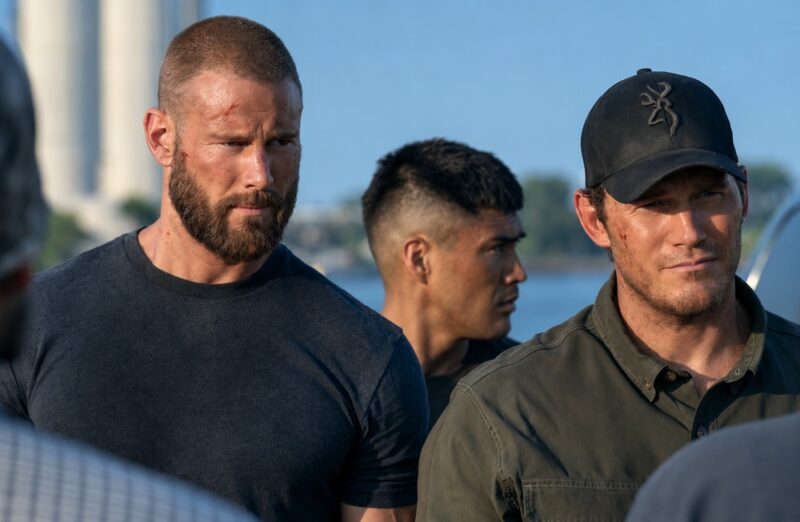
You start with him literally as a warrior adrift at sea. You see him staring to find a place in the wilderness of Mozambique. Then he’s ripped from that and put back on a mission. The idea of his season is that everybody needs to find a new path, a new mission. It’s multiple warriors adrift. (James), Katie (Constance Wu’s character) is a warrior of truth, right? Raife Hastings. Dark Raife (and) Tom Hopper plays him so well. He’s a guy who has not found a kind of through line in his life. I think what’s cool is not only is it a metaphor for the veteran experience coming home after being deployed, it’s really a story for all of is as we get through tragedy. How do you rebuild?
I’m obviously going to shout Luke Hemsworth walking in with that bravado…
David DiGilio: Yeah, let’s go!
Jared, I wanted to ask about what Hollywood gets wrong, because so much of the way we understand special operations comes from how Hollywood portrays it. Is there something about the psychology of these individuals rather than their physical capabilities that you feel audiences still don’t fully understand?
Jared Shaw: What I appreciate so much about this team, having now worked together for six years or so, is that everyone, from Chris and Antoine (Fuqua) to our showrunner here, (and producer) Kat Samick, has always been on the same page about authenticity being our north star. It’s something Dave, along with CP and Fuqua, has pushed from the very beginning. We wanted to do things differently, but more importantly, do them the right way.
We have what we call an 80/20 rule: 80% authenticity and 20% Hollywood hot sauce. Sometimes you have to bend things a little for dramatic effect, but never at the expense of our veteran or military communities. We never want someone with that experience watching and thinking, “That’s ridiculous. I’m turning this off.” It’s about knowing where we can take those creative liberties while maintaining credibility. We always say that if we can get it right at the operator level, that authenticity trickles down to everything else. That’s what we continually strive to maintain.
There’s always got to be a little bit of sauce peppered onto it. And just before letting you both go, I wanted to ask a question about heroism, because the series is dedicated to people who operate in the shadows, often without recognition. Has working on this show changed or challenged your own definition of heroism? Particularly the difference between doing something heroic and someone actually considering themselves a hero?
David DiGilio: There are a lot of people who talk the talk, but it’s interesting to explore what it actually means to walk the walk. What’s fascinating about this show is that we explore special operators, these men and women of service, on a very human level. You see the rewards of the job, the patriotism, the sense of purpose that comes with being the sheepdog protecting the flock, but you also see the cost.
For me, some of the most compelling performances and characters are those who demonstrate that cost. I’ve got to give a shout-out to Luke Hemsworth as Jules Landry. Whether you’ve seen Dark Wolf or not, you’re going to witness the toll it’s taken on a man who’s tried to do good in his life, but who may be grappling with some darker vices this season.
The Terminal List Season 2 is now streaming on Prime Video.
