

The shelf life of smartphones is changing profoundly. As flagship prices continue to climb and year-on-year improvements become increasingly difficult to distinguish, there’s a growing argument for looking backwards whenever a major manufacturer releases its latest phone.
Oppo is a good example. The brand’s latest Australian flagship, the Find X9 Pro, is an impressive piece of tech when it comes to specs, with a 200MP Hasselblad telephoto camera and an enormous 7,500mAh battery. But with a $2,299 price tag, it’s also a reminder of just how expensive premium smartphones have become. And I suspect that whenever a company like Oppo makes a major flagship release, there’s a corresponding spike in interest around its previous models.
We also have the X10 series just weeks away, promising a wide range of improvements. Given the milestone-ness of it, I’m guessing Oppo, which has become my favourite Android manufacturer after Google, is going to put forth an extraordinary piece of kit.
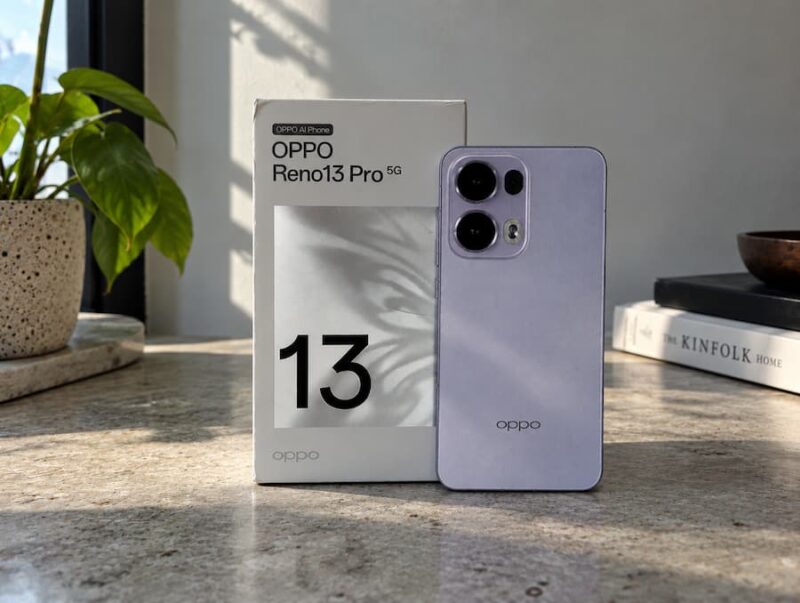
But I want to focus on a phone that came out over a year ago now. The Oppo Reno13 Pro. Released in Australia in April 2025 for $1,299, the phone arrived with an impressive camera system and a generous battery, wrapped in one of the more attractive designs in its class. I’ve spent time with the device over the past year, including taking it around New York City earlier this year, and I’m surprised by how little it feels like an ageing smartphone.
That’s impressive considering how aggressively Oppo has been developing its broader ecosystem. I’ve also been testing the Oppo Watch X2, and using both devices together has given me a greater appreciation for where the brand is heading.
With more consumers looking backwards, instead of forwards, when it comes to upgrading their smartphones, this device is positioned beautifully right now.

Design
Oppo has always had a good eye for design with its Reno series, and the Reno13 Pro remains one of the more handsome smartphones I’ve used in recent years.
There’s a pleasing simplicity to the construction. The aerospace-grade aluminium frame gives the phone a reassuring sense of solidity, while the sculpted glass back flows neatly into the camera housing. Rather than treating the cameras as an enormous statement piece, Oppo has integrated them into the overall design with a little more restraint.
At 7.6mm thick and weighing approximately 195g, the Reno13 Pro is also surprisingly manageable for something with such a large display.
That display measures 6.83 inches, with a 120Hz refresh rate and a resolution of 1272 x 2800 pixels. It’s a beautiful panel, with excellent contrast and enough brightness to remain practical outdoors. I appreciated the size when travelling, as I often rely on my phone for navigation and reading lengthy articles between appointments.
Durability is another advantage. The Reno13 Pro carries IP66, IP68 and IP69 ratings for dust and water resistance, which is reassuring for anyone who frequently travels with their phone exposed to unpredictable conditions.
Even a year later, I don’t think the design has aged much at all. It looks and feels suitably premium, which is important when you’re spending this kind of money.
Specs
- Display: 6.83-inch AMOLED, 1272 x 2800 resolution, 120Hz refresh rate
- Processor: MediaTek Dimensity 8350
- RAM: 12GB
- Storage: 512GB
- Operating system at launch: ColorOS 15, based on Android 15
- Rear cameras: 50MP main, 50MP telephoto with 3.5x optical zoom, 8MP ultrawide
- Front camera: 50MP
- Battery: 5,800mAh
- Charging: 80W wired SUPERVOOC and 50W wireless charging
- Water resistance: IP66, IP68 and IP69
- Weight: Approximately 195g
- Current Australian price: $1,179 (from Amazon)

Performance
For most people, the Reno13 Pro has more than enough processing power to handle daily demands without feeling compromised. The combination of 12GB RAM and Oppo’s increasingly refined ColorOS software makes for a responsive experience, with apps opening quickly and multitasking feeling very fluid.
I’ve long thought that smartphone manufacturers have reached a point where improvements in everyday performance are becoming increasingly difficult to appreciate. Unless you’re playing demanding mobile games or regularly pushing your phone through intensive editing tasks, there’s only so much additional processing power that makes a meaningful difference.
ColorOS 15 deserves some credit here. Oppo’s software has become cleaner and more intuitive over successive generations, with smoother animations and a greater emphasis on useful customisation. There’s still some unnecessary pre-installed software, which remains one of my criticisms of the brand, but the overall experience is polished enough that I rarely find myself missing Google’s approach to Android.
Oppo’s growing collection of AI features is also worth considering. AI Writer and AI Summary are designed to help with everyday productivity, while the photography tools are arguably more useful for someone like me who spends a great deal of time travelling. Of course, the usefulness of these features depends on how frequently you engage with them. I remain unconvinced that every smartphone needs an enormous collection of AI tools, especially when some feel like solutions looking for problems.
Where Oppo has impressed me more is with its ecosystem.
I’ve been testing the Oppo Watch X2 alongside the Reno13 Pro, and the pairing makes a compelling argument for buying further into the brand. The watch runs Wear OS by Google, giving you access to familiar applications like Google Maps and Google Wallet, while Oppo’s OHealth platform handles fitness and wellness tracking.
The Watch X2 also has a useful 60-second health check-in feature, which brings together several health indicators in one place. Its dual-frequency GPS is another welcome inclusion for anyone who spends plenty of time exploring unfamiliar cities on foot.
Battery life is perhaps the watch’s greatest strength, with Oppo quoting up to five days in Smart Mode and as much as 16 days in Power Saver Mode.
The Reno13 Pro and Watch X2 make a convincing combination, with notifications and navigation working across both devices. You also have the convenience of controlling compatible phone camera functions remotely from the watch. It’s a good example of how Oppo is developing a more complete Android experience, and one of the reasons I think Oppo is now one of the smarter choices for Android users.

Camera
I took the Oppo Reno13 Pro around New York City earlier this year, and one of the most memorable opportunities to put its camera system to work was from the Top of the Rock observation deck.
Rockefeller Center’s famous observation deck is one of my favourite places to photograph Manhattan. You’re looking directly towards the Empire State Building, with the city’s extraordinary density unfolding around it, and the elevated perspective provides an excellent opportunity to experiment with different focal lengths. It’s also a challenging environment for smartphone photography. There’s an enormous amount of fine architectural detail, while bright skies can create significant differences in exposure between buildings and their surroundings.
The Oppo’s 3.5x optical zoom gives you more flexibility than the standard wide-angle lens, allowing you to isolate sections of the skyline without relying entirely on digital cropping. For travel photography, I think this is one of the most useful features a smartphone can offer.
I’ve never been too interested in the enormous digital zoom figures manufacturers like to advertise. What matters more is whether a phone can produce a convincing photograph at the focal lengths you’re actually likely to use. The Reno13 Pro’s telephoto hardware makes a strong argument for itself here, especially when photographing architecture or capturing more intimate details within a much larger scene.
The 50MP main camera is similarly capable, producing detailed images with the kind of lively colour reproduction Oppo has become known for. The processing can occasionally lean towards a more saturated look, which won’t necessarily appeal to anyone who prefers a restrained, natural aesthetic.
The weakest link is the 8MP ultrawide camera. It simply doesn’t offer the same level of detail as the two 50MP sensors, and the difference becomes more noticeable when examining images on a larger display. That’s a shame because ultrawide photography is useful in cities like New York, where you’re frequently trying to fit enormous buildings into a single frame.
Oppo’s AI editing features help compensate for some of the limitations. AI Eraser can remove unwanted objects from photographs, while AI Unblur attempts to recover detail from images affected by movement. These tools have become increasingly common across Android, but their inclusion helps the Reno13 Pro remain relevant as smartphone photography becomes more dependent on computational processing.
The 50MP front-facing camera is another strong inclusion for anyone who frequently records video or takes selfies while travelling.
Overall, I still think the camera system is one of the Reno13 Pro’s strongest selling points. The dedicated telephoto lens gives it an advantage over many similarly priced devices, even if the ultrawide camera leaves something to be desired.
Battery
The 5,800mAh battery is generous for a phone this thin, and it’s supported by 80W SUPERVOOC wired charging.
I’ve always placed enormous value on battery endurance when reviewing smartphones, especially when I’m travelling because my work often involves spending entire days exploring cities with very little opportunity to recharge. When you’re travelling, your phone becomes an essential part of practically everything you do. Navigation alone can place considerable demands on the battery, especially when you’re constantly switching between mobile data and GPS.
The Reno13 Pro has the capacity to handle a demanding day without requiring the same level of battery anxiety that I’ve experienced with some competing smartphones.
The 80W charging is another advantage. With a compatible SUPERVOOC charger, a relatively short charging session can restore a substantial amount of power, which is useful when you’re preparing to head back out after spending some time at a hotel. There’s also support for 50W wireless charging with compatible hardware, giving the Reno13 Pro another feature that isn’t always guaranteed at this price point.
A year into the phone’s life, the battery specifications remain impressive. Battery degradation is inevitable with any lithium-ion device, but the generous original capacity provides a useful buffer as the phone ages.
Verdict & Value
The Oppo Reno13 Pro launched in Australia for $1,299, and interestingly, the price hasn’t fallen as dramatically as you might expect from a phone that’s now well over a year old.
At the time of writing, JB Hi-Fi still lists the phone at its original $1,299 price, although stock availability is limited. Other Australian retailers have advertised it for approximately $1,140 to $1,200, which makes it a little more attractive.
The 6.83-inch AMOLED display remains excellent, while the 5,800mAh battery is generous enough to compete with much newer devices. More importantly, the 50MP telephoto camera gives the Reno13 Pro a degree of photographic versatility that still makes it appealing to travellers.
I’ve never been enthusiastic about Samsung’s interpretation of Android, and for years Google has been my preferred alternative to Apple’s tightly integrated ecosystem. Oppo is now making a convincing argument for standing alongside Google as its hardware becomes more refined and ColorOS continues to mature.
That’s ultimately what makes the Reno13 Pro such an interesting phone to revisit. It arrived at a time when Oppo was beginning to find greater confidence in its premium hardware, and much of what made it appealing in 2025 remains relevant today.
Highlights: Excellent AMOLED display; versatile 3.5x telephoto camera; generous battery capacity; premium design; strong compatibility with Oppo Watch X2
Lowlights: Ultrawide camera trails the other sensors; processor isn’t flagship-grade; limited discounts from Australian launch pricing; some unnecessary pre-installed software


FOUR STARS (OUT OF FIVE)
Manufacturer: Oppo
Australian RRP: $1,299
Current Australian advertised pricing: Approximately $1,140 to $1,299, depending on retailer and availability
