

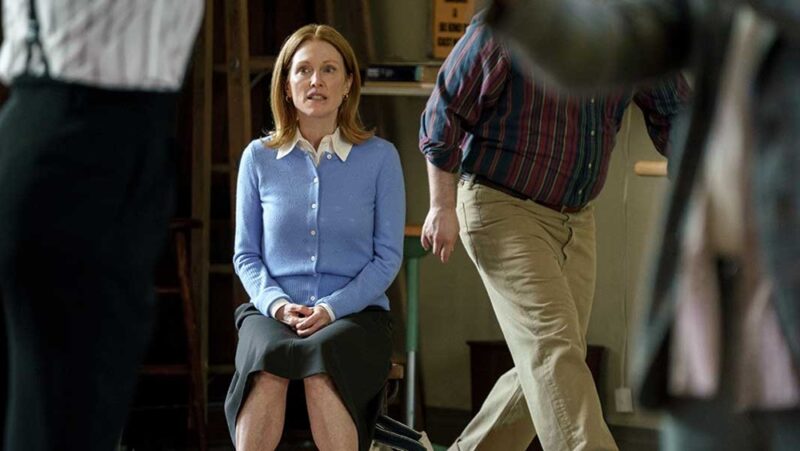
Community theatre is an inherently strange little ecosystem. It’s a place where people with wildly different levels of talent, ambition and self-awareness come together and, for a few fleeting nights, treat a modest suburban stage as if they’re opening on Broadway. For some it’s a hobby. For others it’s a calling. And for the particularly committed, the line separating the person from the performer can become dangerously thin.
Jesse Eisenberg understands that distinction intimately, and The Debut, his third feature as writer and director, may be his most assured work yet. A wonderfully peculiar love letter to community theatre that gradually mutates into something far darker, Eisenberg’s film moves between comedy, psychological drama and something approaching surrealist horror without ever entirely announcing when one has bled into the other.
At the centre of this increasingly unclassifiable experience is Julianne Moore, delivering the type of fearless, go-for-broke performance that reminds you just how thrilling it can be when an actor of her calibre is handed material that allows them to become completely untethered.
Moore plays Mona Friedman, a painfully withdrawn New Jersey housewife who has spent so much of her life being ignored that she appears to have accepted invisibility as her natural state. Her emotionally vacant husband, Howard (Patrick Fabian), barely registers her presence, her near-adult children treat her with similar indifference, and even supposedly social occasions seem designed to reinforce how little space she occupies in the lives of those around her.
Moore initially plays Mona with an almost childlike meekness. Her voice barely rises above a sing-song murmur, her body seems permanently apologetic for occupying space, and every interaction carries the suggestion that she’s preparing herself to be dismissed before she has even finished speaking.
Then she sees an audition notice.
The production is Nosy Neighbors, a knowingly hokey community musical centred around the colourful residents of an apartment building. Mona has no meaningful acting experience, but nevertheless auditions for the small role of building superintendent Ms. Danielle, performing badly enough that director Jerry (Paul Giamatti) cuts her off before she can finish.
The role initially goes elsewhere (theatre fans will appreciate the cameo), but circumstances ultimately leave Jerry with Mona as essentially his only viable option. And so begins an artistic partnership that proves considerably more consequential than either could have anticipated. What follows is best experienced with as little knowledge as possible.
Eisenberg could have easily used The Debut to sneer at community theatre, but there’s genuine affection underneath every deliberately awful lyric, questionable costume and overenthusiastic cast member. He understands the peculiar sincerity of people behaving as if their local musical is the most important production ever mounted, and the film never suggests that caring this much is inherently ridiculous.
If anything, The Debut understands why such spaces become essential. The theatre gives people permission to be louder, stranger and more emotionally expressive than everyday life permits. For Mona, a woman whose personality has seemingly been compressed over decades, that invitation proves intoxicating.
And increasingly terrifying.
There’s a classicality to Eisenberg’s direction that initially disguises just how formally adventurous the film will become. His compositions have a deliberate, almost storybook quality, whilst Mona’s domestic surroundings carry an artificial suburban neatness that subtly reinforces the constructed nature of the life she inhabits. But as Mona begins interrogating what it means to actually inhabit another person, Eisenberg allows the filmmaking itself to loosen.
The result is a film that grows progressively stranger without sacrificing its emotional logic. Eisenberg occasionally brushes against the surreal, and there are moments where The Debut feels capable of transforming into an entirely different movie before your eyes. Yet those flourishes never feel like affectation. They reflect a woman discovering an interior life with such ferocity that reality itself almost seems incapable of containing her.
And then there is that rehearsal scene.
Around the film’s 40-minute mark, Jerry attempts to coax a particular reaction and line reading out of Mona. On paper, what he’s asking of her is hilariously mundane. In execution, the sequence becomes an astonishing two-hander between Moore and Giamatti that escalates and escalates until you can scarcely believe where it has arrived.
It is difficult to adequately describe the scene without diminishing the pleasure of experiencing it, but Moore’s commitment alone is worth the price of admission. What begins as an acting exercise gradually becomes something euphoric, uncomfortable, hysterically funny and faintly horrifying. Giamatti, meanwhile, understands that his job is largely to hold the space and allow Moore to keep pushing further.
And she does.
Then further.
And somehow further still.
It’s the type of sequence where you become conscious that you are watching an actor do something extraordinary as it is happening. Not merely because Moore is loud or physically committed – though she certainly is – but because every absurd escalation reveals another piece of Mona. The comedy and tragedy become inseparable. You’re laughing at her whilst simultaneously realising you perhaps shouldn’t be.
That tension courses through the entire film.
Mona’s desire to become a better actor could have been treated as nothing more than an avenue for comic humiliation, but Eisenberg is interested in something sadder and more complicated. What happens when someone who has spent decades without a meaningful sense of self is suddenly encouraged to search inside themselves? And what happens when there isn’t enough there, so they begin looking elsewhere?
Jerry encourages Mona to find truth in her performance, but neither of them seems prepared for how literally she will interpret the assignment.
It gives Moore extraordinary territory to explore. Mona is pathetic, hilarious, frightening, sympathetic and occasionally infuriating, sometimes within the same sequence. There are shades of cinema’s great obsessive outsiders in her evolution, but Eisenberg crucially avoids simply reshaping a familiar male antihero archetype around a woman. Mona’s behaviour is inseparable from the decades of domestic and emotional neglect that preceded it.
Moore understands that completely.
For all the extremity of the performance, she never loses the frightened woman introduced in the film’s opening passages. Even at Mona’s most outrageous, you can still recognise the person who spent years making dinner for people who barely noticed she was sitting at the same table. That emotional continuity is what prevents the performance from becoming merely an acting showcase.
Though, make no mistake, it is one hell of an acting showcase.
Giamatti proves the ideal counterweight. Jerry could have become the stereotypical tyrannical director, screaming about artistic integrity whilst terrorising amateur performers, but both Eisenberg and Giamatti find considerably more humanity in him. He can be impatient and abrasive, but he genuinely wants Mona to succeed, which makes his gradual recognition of precisely what he may have unleashed all the funnier.
The surrounding ensemble similarly understands the heightened wavelength Eisenberg is operating on without overwhelming it. Halle Bailey brings warmth and a lovely vocal confidence as Stef, Eldar Isgandarov is particularly funny as Jerry’s gentle assistant Piotr, and Eisenberg himself appears in a small role that allows his naturally nervous comic rhythm to slot comfortably into the theatrical chaos.
But this is unquestionably Moore’s stage.
Awards conversations inevitably attach themselves to performances this visibly transformative, and The Debut has all the superficial ingredients of something engineered to inspire them: a beloved actor disappearing into an eccentric role, a story about performance itself, emotional devastation, physical transformation and enough show-stopping sequences to populate an entire campaign reel.
Yet reducing Moore’s work to “Oscar bait” would misunderstand what makes it so remarkable. Nothing about the performance feels calculated. It’s too weird for that. Too abrasive. Too funny. And, eventually, too genuinely upsetting.
Eisenberg has created something equally difficult to categorise. The Debut is hilarious until suddenly it isn’t; heartbreaking until something completely ridiculous makes you laugh again; theatrical in its construction whilst becoming increasingly cinematic in its execution. There’s a quirkiness to it, certainly, but also an unexpectedly old-fashioned confidence in allowing actors, dialogue and carefully calibrated escalation to command the screen.
For a film about an amateur performer desperately searching for authenticity, The Debut ultimately understands something beautifully ironic about acting: pretending to be somebody else can sometimes expose the parts of ourselves we have spent a lifetime trying not to see.
Mona Friedman simply takes that philosophy considerably further than most. And Moore follows her all the way.


FIVE STARS (OUT OF FIVE)
The Debut is screening as part of this year’s Toronto International Film Festival, running between September 10th and 20th, 2026. For more information, head to the official site here.
