
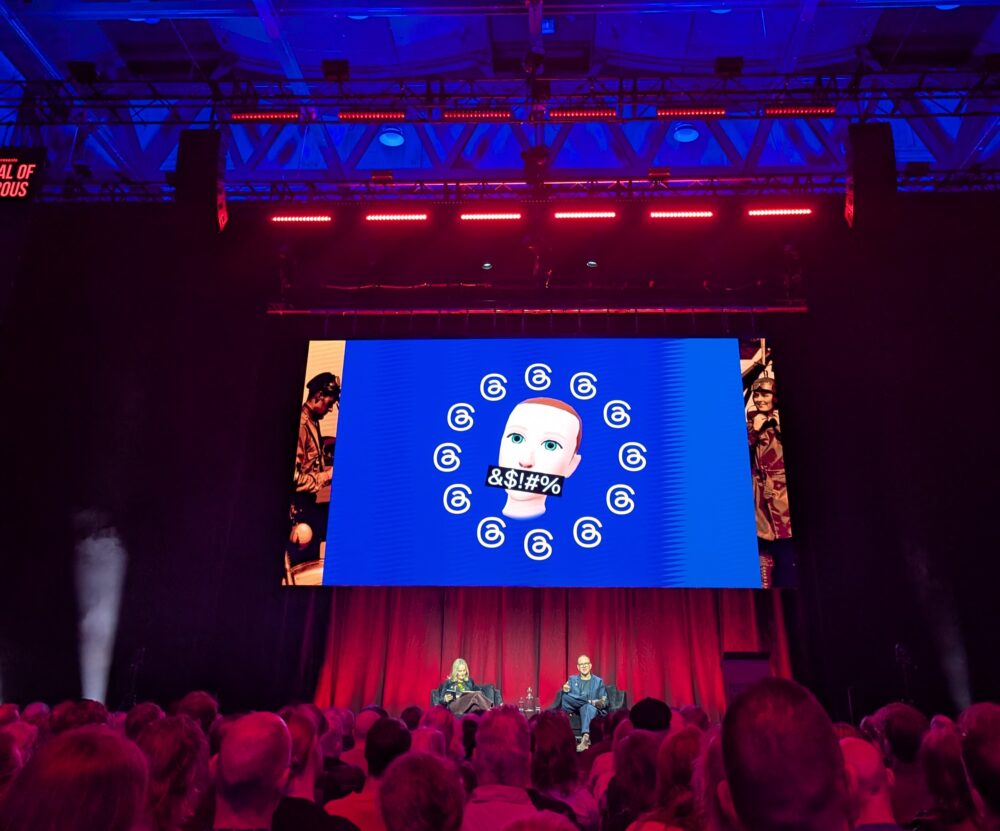
We currently live in a world that has lost its sense of nuance. Discussions, particularly those conducted online, quickly devolve into chaos where being right, while proving others wrong, is the entire goal. The world has suddenly become very black and white, with people uncomfortable to exist in the grey. Curious minds have become few and far between, and two views cannot possibly coexist. There has never been a more appropriate time for the Festival of Dangerous Ideas (FODI).
An exploration of ideas and attitudes across 10 days, the Festival encompasses talks, films and activities across different locations in Sydney, with the main Festival weekend occurring on 22–23 August at Carriageworks. Designed to challenge and invite conversation, this year’s topics ranged from the swift rise of AI, to what it means to belong, to whether Trump is the symptom, not the cause.
I attended 2 talks: Contemporary Art in a Time of Crisis and Enshittification.
Contemporary Art in a Time of Crisis
Venue: Museum of Contemporary Art
So far this year three major musicals – Back To The Future, Waitress and Beetlejuice – were forced to cut short their national tours due to unsustainable touring costs. Ticket sales and box office numbers were not enough to cover production costs. In a report released this year by Creative Australia, 60% of Australians cited cost as the biggest barrier to engaging with the arts. Given the state of the world and the never-ending cost of living crisis, it begs the question – in times of crisis what is arts role?
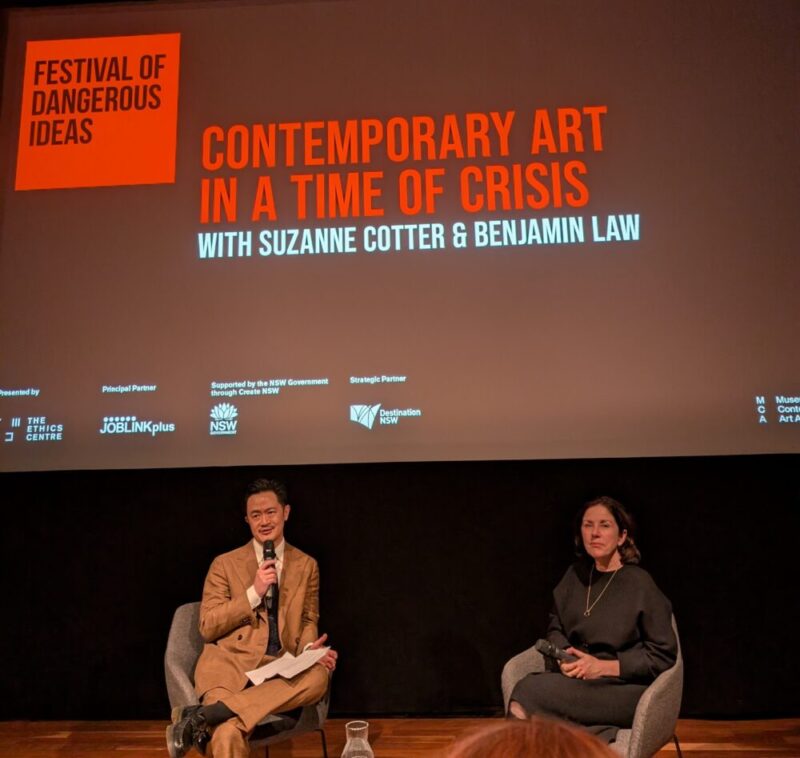
Australian writer and broadcaster Benjamin Law sat down with Museum of Contemporary Art Director Suzanne Cotter to discuss the current state of the arts in Australia and whether or not it still has a place in our society.
Law began by asking whether Australia considers itself an ‘arts nation’. While Cotter remarked that Australians have a “huge appetite for the arts in all its forms,” we don’t project ourselves as an arts nation. In fact, despite being home to the oldest continuous living culture on Earth, a prevailing notion is that there is always something better “out there” in other countries.
Perhaps this is because of the lack of investment in the arts in Australia as compared with other countries, such as Ireland, who have adopted the Basic Income for the Arts (BIA) Scheme, which provides 2,000 professional artists and creative practitioners with a weekly income to support their practice. Cotter comments, “The Arts” are taken up as a punching bag when it’s convenient and routinely seen as the “least necessary” during times of economic downturn.
Law questions if art needs a rebrand and wonders if there is a perception in Australia that “art isn’t for me.” This is not a new notion, the arts have always suffered from an image problem. One way in which this is being addressed at the MCA is through education. Cotter says that school groups are an important way to introduce people to art institutions and to begin to foster that relationship. Creating excitement around galleries at a young age will hopefully de-stigmatise the elitism often associated with art.
Continuing this discussion of audience engagement, Law asks, if we want to encourage all audiences, does it result in showing middle-of-the-road art? “It’s not about playing it safe,” Cotter says, “I don’t believe in playing it safe. You can have seat belts but you can still drive the car.”
“I’m interested in possibility,” she continues, “Is there something for everyone? I don’t quite know what that means.”
Both Law and Cotter touched on this idea of cultural safety and the importance of an audience feeling wanted and invited into a gallery space. This idea is balanced against another misconception that contemporary art is intentionally controversial. Cotter comments that “art is the arena where complexity can exist,” and we need spaces where we can encounter new ways of seeing the world.
“One of the biggest challenges for those working in the arts is self-censorship.” Cotter believes, continuing, “We need to take risks.”
Interestingly, many audience questions for Cotter centred around the MCA’s decision to introduce a general admission entry fee at the beginning of 2025. After 25 years of free general entry, it now costs $20 to walk through the doors, and it seems people had questions.
Considering part of the earlier discussion had centred around how to make art more accessible for a wider audience, particularly during an economic crisis where art is losing its relevance, is adding a financial barrier the best idea?
Cotter responded that the gallery does continue to receive sponsorship from Telstra but that the financial amount has not increased in 26 years. This combined with the costs involved with running exhibitions continuing to increase, introducing general admission seemed to be the only option left. And when compared with other galleries – the National Gallery of Victoria’s current Cartier exhibition being the example Cotter uses – $35 for museum admission and entry into the Tony Albert: Not a Souvenir exhibition is not as extravagant as $85 (cost of adult flexible entry to Cartier at the NGV).
Perhaps more than money, it’s the cultural attitudes in Australia which are the biggest threat to the arts. Gallery exhibitions and theatre productions are competing with brunch at the cafe down the road and the latest sports final. There is so much vying for people’s free time; how do you convince them that the arts are a good investment?
Enshittification
Venue: Carriageworks
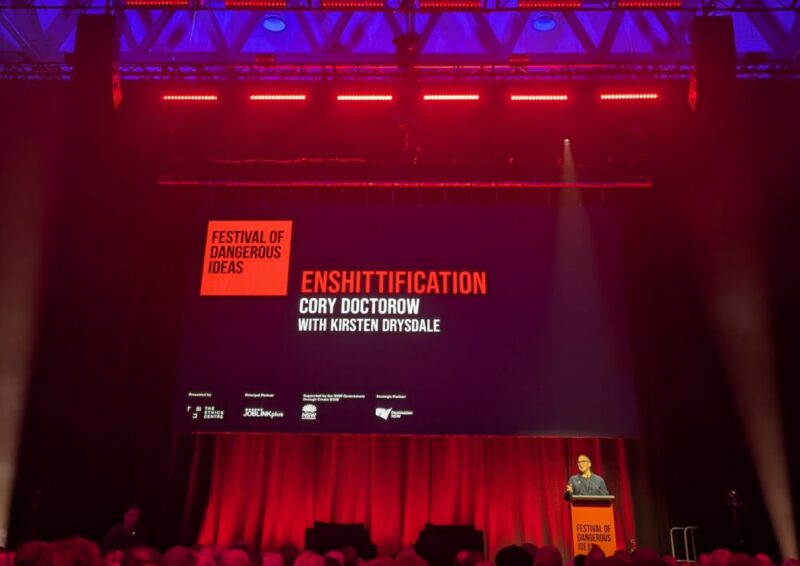
Chaired by Kirsten Drysdale
“Like all the best Americans, I’m Canadian.”
Cory Doctorow is a science fiction author, activist and journalist, but is perhaps best known for coining the term Enshittification.
He explains that Enshittification is a 3-stage process –
1. Good for users. People are welcomed in; everything seems great. Your friends are joining. It’s what Doctorow refers to as the “collective action problem”. You get locked in.
2. Good for business. Advertising is introduced to the platform. Conditions are made worse for the user because they know people won’t leave. The company starts spying on its users.
3. Decay. The experience is made worse for both users and advertisers, while making things better for the companies investors. All value is harvested from the platform.
When you pause on Netflix, and you’re shown an advertisement for other shows – that’s enshittification. But Doctorow says that Facebook is the worst perpetrator of enshittification.
Knowing all this, why do we keep using these platforms if they’re so terrible? He mentions a theory created by economists called “reveal preferences” that figures out what consumers want by observing their purchasing choices instead of actually asking them. However, as he states, in order to reveal peoples real preferences you need to give them real choices.
In 2021 iOS introduced a privacy framework that requires apps to get explicit user permission before tracking user data across other companies’ apps and websites. Basically it gave people the choice to opt out of letting Facebook spy on them. 96% of users chose this. But then Apple decided to spy on it’s users instead, in breach of its own privacy framework, with no choice to opt out.
Doctorow discusses the privacy invasion industry and the emergence of data brokers. He relays a story of an app in the United States which he terms “Uber for nurses”, where a nurse can opt in for a shift. These data brokers uncover the credit history of the nurse and depending on how in debt they are will impact the rate they are offered. The more in debt, the lower the rate, with the assumption being they will be desperate for work. He calls this “algorithmic wage discrimination”. So why do data brokers exist? Because no one has made it illegal.
“Google spies on you for the same reason your dog licks its balls – because they can and no one stops them.”
So how can we stop this? As Doctorow states, systemic problems have systemic solutions. Up til now the policy makers have failed us. He is adamant that “shopping isn’t politics” and while it’s lovely that you refuse to buy a Tesla, Elon Musk doesn’t give a shit. “Move fast, break kings” – get involved in local politics, join the union, join an organisation like Electronic Frontiers Australia and boycott. Your shopping habits effect nothing.
As Doctorow says, “I can’t do anything about enshittification. You can’t do anything about enshittification. But we can.”
The Festival of Dangerous Ideas was a pleasant reminder that difficult and uncomfortable conversations can occur when respect is in the room. Asking questions is not only acceptable, it should be encouraged. Opinions are not set in stone, they can and will be changed over time. This is what growth looks like. Curiosity may have killed the cat but it might be just the thing to set you free.
The Festival of Dangerous Ideas was held 22 – 23 August at Carriageworks, 20 – 30 August at various Sydney locations.
For information head to the Festival of Dangerous Ideas website.
Photos by the author
