


Off Campus understands exactly what it is selling within the first ten minutes. Beautiful people. Hockey players with tragic backstories and perfect jawlines. College hookups shot like perfume ads. Emotional vulnerability wrapped in towels (and sometimes not) and locker-room lighting. It knows the “girls, gays, and theys” audience it is chasing, and it goes after them with the confidence of a show engineered to become a streaming obsession.
The surprising thing is that it actually works.
Adapted from the wildly popular romance novels of the same name, created by Louisa Levy, the series initially feels like it’s operating at maximum CW melodrama levels. The early episodes lean hard into cheesiness: lingering shirtless montages, hyper-stylised party scenes, banter sharpened into flirtation at every possible opportunity. It almost dares viewers not to roll their eyes.
And then, almost annoyingly, it becomes addictive.
Not because it reinvents the college romance formula, but because it understands why audiences keep coming back to stories like this in the first place. Levy’s creator letter reveals the real emotional engine underneath the hockey aesthetics and romantic fantasy. She talks about college as a liminal space between childhood and adulthood, about finding your people before the world hardens you, about friendship becoming survival. That longing pulses through the show constantly, even when characters are making catastrophically messy decisions between hookups and hockey practice.

For millennials, watching Off Campus can feel strangely nostalgic. Gen Z may be the target demographic, but the show taps into the same emotional addiction that series like Dawson’s Creek and The O.C. once perfected. It understands that viewers do not necessarily come to these stories for realism. They come for yearning. For emotionally articulate fantasy. For impossibly attractive people behaving as though every crush, betrayal, and misunderstanding might permanently alter the trajectory of human existence.
And honestly? Sometimes that sincerity is refreshing.
At the centre is Ella Bright’s good girl archetype Hannah and Belmont Cameli’s quite-the-opposite Garrett, a dynamic the show milks for maximum swoon potential. Their relationship knowingly plays with the “helping the girl win over another guy while secretly falling for each other” formula, with the series openly referencing A Midsummer Night’s Dream along the way. Hannah initially pines for Australian singer-songwriter Justin, played with gentle charm by Josh Heuston, while Garrett positions himself as the arrogant hockey golden boy helping orchestrate the romance.
Garrett could easily have become insufferable in lesser hands. Cameli instead gives him a surprising softness beneath the lothario façade. The character’s growing awareness of the pressure created by his legendary father hangs over much of the season, and Garrett arguably undergoes the strongest emotional evolution of the ensemble. By the back half of the season, the cocky player archetype has given way to something more vulnerable and textured.
The supporting cast helps deepen the show beyond pure romantic fantasy. Mika Abdalla gives Allie a simmering frustration beneath her outward confidence, while Stephen Kalyn’s Dean transforms what could have been a one-note “man-whore” caricature into one of the show’s most unexpectedly charming presences. Dean remains proudly promiscuous, but Kalyn imbues him with enough warmth and emotional intelligence that the performance gradually sneaks up on you.
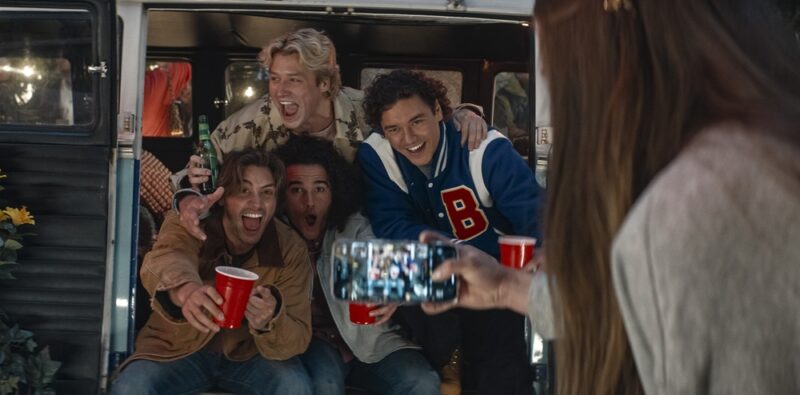
What elevates Off Campus above disposable binge fodder is its willingness to brush against darker material underneath the glossy surface. The show touches on domestic abuse, sexual assault, emotional insecurity, and the ways young people weaponise intimacy against themselves and others. It does not always dig deeply enough into those themes though, and some viewers will likely find the series frustratingly hesitant to fully interrogate its heavier subject matter. The trauma often functions more as emotional shading than narrative centrepiece.
Whether that restraint feels mature or evasive will probably depend on the viewer.
Still, there is something oddly compelling about the way Off Campus balances tonal extremes. One moment it is serving pure horny sports-romance escapism; the next it slips into genuine emotional vulnerability without warning. The transitions should feel ridiculous. Somehow, they mostly do not.
The hockey itself almost feels secondary. This is not really a sports drama so much as a fantasy about emotional belonging disguised as one. Brotherhood, found family, friendship, and romantic obsession matter far more than who wins the next game. That emotional accessibility is likely why the show feels primed to explode online in the same way fandom-heavy romances like Heated Rivalry have captured intensely devoted audiences.
Off Campus may begin like guilty-pleasure fluff, but by the time it settles into itself, the show reveals a surprisingly effective understanding of loneliness, intimacy, and the desperate desire to feel chosen by someone. It is messy, melodramatic, oversexed, occasionally shallow, and absolutely engineered for viral obsession.
Watch this become one of those rare teen soaps that turns ironic curiosity into genuine emotional investment.
All eight episodes of Off Campus are available to stream on Prime Video from May 13th, 2026.
Related Posts:
- Prime Video tease YA series adaptation Off Campus with first-look trailer
- Prime Video's YA obsession: A fandom-first strategy for the next generation
- The Off Campus obsession continues with Funko POP! collection announcement
- Interview: Josh Heuston on Off Campus and the comfort of truly being…
- Book Review: Be prepared to stay up all night reading Alex Dook's…
- Photo Gallery: Split Enz + Vika and Linda - TikTok Entertainment Centre…
