

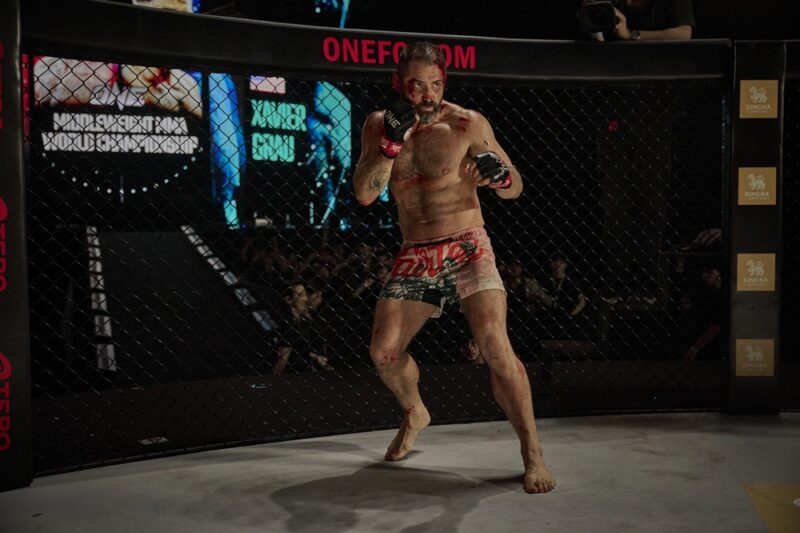
Beast doesn’t pretend to break new ground. It moves along a well-worn path – fall from grace, one last shot, the hope of redemption – but what sets it apart is how seriously it treats that journey. Directed by Tyler Atkins, working off Russell Crowe and David Frigerio‘s script, the film is less interested in spectacle than in the emotional toll of trying to put a fractured life back together.
At the centre is Daniel MacPherson, delivering a performance that’s deliberately stripped back. His Patton James isn’t a fighter chasing legacy or ego, but a man cornered by circumstance. Now living as a fisherman and struggling to hold onto his role as a husband and father, Patton returns to the cage out of necessity, not ambition. That distinction gives the film its backbone. Opposite him, Bren Foster’s Xavier Grau provides a physically imposing threat, but the real weight of the conflict lies elsewhere – in what Patton stands to lose if he fails.
The film finds its footing in those quieter pressures. Patton’s relationships – with his brother (Mojean Aria) and his partner (Kelly Gale) – carry a sense of wear and history that grounds the story. There’s an honesty to how these connections are portrayed, even if the writing occasionally overstates its themes. Some of the dialogue, particularly in the domestic scenes, spells things out more than it needs to. Still, the emotional intent remains clear: this is a story about someone trying, imperfectly, to change.
That idea extends to the film’s take on masculinity. Strength here isn’t framed purely in physical terms, but in the ability to take responsibility, to repair what’s been broken, and to choose family over pride. It’s familiar territory, but handled with enough conviction to feel sincere rather than perfunctory.
When the film does step into the ring, it delivers. The fight sequences have a raw, tactile quality, even if the editing sometimes interrupts their momentum. There are moments where the action feels slightly overworked – slow-motion beats that don’t quite earn their place – but when the choreography is given space, particularly in the grappling exchanges, it pulls you in. The climactic fight follows a predictable arc, yet still manages to generate that underdog tension the genre thrives on.
There are missteps along the way. Luke Hemsworth’s promoter leans into a heightened, almost caricatured sleaze that jars against the film’s otherwise grounded tone. The score, too, has a habit of overemphasising emotion, nudging scenes that might have been more effective with restraint.
Even so, Beast holds together because of what it’s aiming for. Beneath the familiar structure is a genuine belief in the possibility of change – that people can confront their past and choose something better. It’s a simple idea, but one the film treats with enough care to make it land.
By the end, Beast doesn’t need to surprise to be effective. Its impact comes from its persistence, echoing its central character: sometimes, the real victory isn’t in the fight itself, but in the decision to keep going.


THREE AND A HALF STARS (OUT OF FIVE)
Beast is now screening in Australian theatres.
