

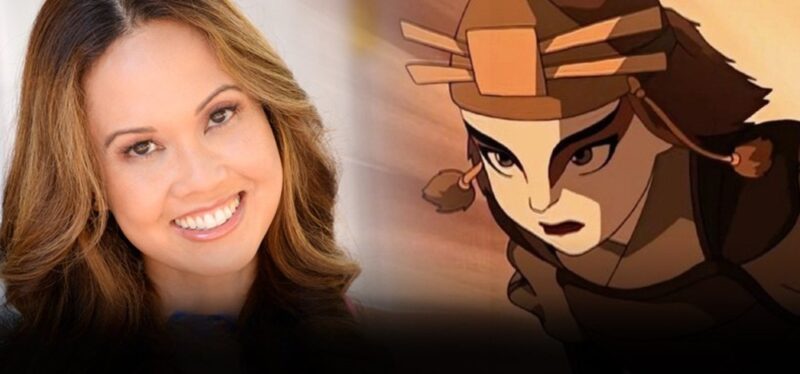
For anyone who grew up on a steady diet of Saturday morning television, Jennie Kwan is a face – and voice – you’ve likely carried with you far longer than you realise. From her breakout as Samantha Woo on California Dreams to voicing fan-favourite warrior Suki in Avatar: The Last Airbender, Kwan’s career has quietly spanned decades, mediums, and generations of fandom.
What began at just 11 years old with a performing troupe quickly evolved into something much bigger, with Kwan landing the coveted lead role of Kim in the first national tour of Miss Saigon – a life-changing opportunity that set the tone for a career defined by versatility. Since then, she’s moved seamlessly between stage, screen and voice work, appearing in series like The Rookie and New Girl, performing in musicals like Avenue Q, and even earning a Gold record as part of the pop group Nobody’s Angel.
But for many, it’s her voice that has left the most lasting impression. Whether stepping into iconic franchises like Street Fighter 6 as Chun-Li or bringing emotional depth to beloved animated characters across anime and gaming, Kwan has built a body of work that continues to resonate with audiences old and new.
Speaking with our own Peter Gray as she prepares to travel to Australia for the Supanova Comic Con & Gaming, what becomes immediately clear is that while her résumé is extensive, it’s the journey behind it – the uncertainty, the persistence, and the passion for storytelling – that has truly defined her path.
Like a lot of people here in Australia, my Saturday mornings in the ‘90s weren’t complete without shows like Saved by the Bell and California Dreams. That whole block was such a huge part of growing up.
I really appreciate that. You never know who’s going to connect with what, so it means a lot. I’m always hoping that when I meet fans, they’ll want to talk about Dreams, because it was such a special part of my life – not just my career, but my childhood too. So thank you.
Looking back at your career, you started incredibly young. Not everyone keeps that passion alive into adulthood – was there a moment where you realised this wasn’t just something you did, but who you were?
It’s funny, because it really did start as a hobby. I was extremely shy as a kid, and acting classes were what brought me out of that. They let me explore and play, and that helped me grow in confidence.
But it actually took a long time for me to accept this was my life. Honestly, probably not until my 30s. Acting in Los Angeles is tough – you go through so many auditions and so much uncertainty, constantly asking, “Is this the right path?” But something always pulled me back. Usually it was a job, which felt like a sign.
Eventually, I realised I needed to stop resisting it. This is part of who I am, and I just needed to accept it.
You were cast as Kim in Miss Saigon at such a young age, essentially becoming someone else’s dream casting. Did that feel like pressure, or like being thrown into the deep end?
All of it – yes, yes, and yes. I had just turned 18. A friend introduced me to the show, and then suddenly I was auditioning. It felt like something out of a movie. There were hundreds of people at the audition in LA, then I got called to New York. I remember seeing this incredibly famous actress audition before me and thinking, “There’s no way I’m getting this.”
When I performed, I just cried through the entire duet. I don’t even know if they could tell if I could sing – I was crying the whole time. Then I got the call that I booked it… and I hung up because I didn’t process it.
Rehearsals were amazing – that was my favourite part. But once the show opened, that’s when the weight hit. Performing every night, carrying the show – it was a huge responsibility. I had to learn very quickly how to take care of myself.
Theatre demands emotional openness in front of a live audience every night, whereas voice acting is more internal. Which feels more vulnerable?
That’s a really great question. Live theatre is unmatched. Anything can happen, and often does. When you hit those emotional moments with an audience, it’s euphoric. Voice acting is different. If you capture something truthful, it lives on forever. The vulnerability is there too, but in a different way – it’s about creating something that lasts.
There’s a huge wave of ‘90s nostalgia right now. When fans approach you about California Dreams, are they remembering the show – or the feeling of growing up with it?
Both. And honestly, fans remember more than we do!
Sometimes I have to go back and rewatch episodes because they’ll ask about something and I won’t remember. But what people really connect to is the feeling – and that’s why I still do what I do. I’ve always wanted to make people feel something, whether it’s joy, nostalgia, or something deeper.
Looking back now, is there anything about Samantha that you understand differently as an adult?
That’s a really great question. Looking back, I realise the writers really shaped that character around me. She wasn’t stereotypical – she was smart, but also unexpected in other ways. Now I can see how much of myself was in her. And maybe that’s why people still feel that connection.
Those shows felt surprisingly fearless in the topics they tackled.
I really appreciate you saying that. We were coming off Saved by the Bell, and it wasn’t easy to create depth in that format. But we were part of something that helped pave the way for future teen shows. I remember there was pushback at the time about Samantha’s interracial relationship. I was nervous, but the producers stood firm. They didn’t change it – they believed in showing relationships as they naturally exist. And that meant a lot.
Speaking of nostalgia, I have to bring up Nobody’s Angel. When you hear those songs now, do they feel nostalgic, or do you go straight into “studio mode”?
First of all – these questions are amazing. I really appreciate them. I definitely remember being in the studio. I came in on the second album, but I remember working with so many producers and really curating the sound.
And honestly? Some of those songs still hold up. They’re pop – and I’ve embraced that now. Pop music is powerful.
We need a Nobody’s Angel TikTok revival.
(Laughs) You know what? I produced a couple of California Dreams shows recently and someone brought me a Nobody’s Angel vinyl. I was like, “Wow!” That was really special.
When it comes to voice acting – especially with something like Avatar: The Last Airbender – do fans talk more about Suki’s strength, or what she meant to them growing up?
Both. A lot of people say the show was their childhood – even younger fans say that. Suki resonates because she’s grounded, strong, and authentic. She represents being true to yourself and serving your community. I feel very lucky to have played her.
And with your involvement in such huge franchises like Street Fighter, do you think about fan expectations – or just focus on your performance?
I focus on the performance. With games, you often don’t even know what you’re working on at first. When I worked on Chun-Li, I didn’t think about previous versions – I just focused on doing the best job I could. Later I found out about the legacy, and it was an honour. I just hope I did the character justice.
That leads into craft – do you ever accidentally bring elements of one character into another?
I try not to. Every role deserves its own space. Although in Avatar, there was a fun moment – I voiced Yue in one episode as a little Easter egg, which I’d actually forgotten about until I rewatched it!
Reflecting on your career, is there a role that taught you the most about yourself?
Honestly, every role teaches me something. I’ve learned about my process, my limits, my anxiety – everything. That’s why I never want to go on autopilot. Each role deserves something fresh. That discipline really comes from theatre – doing the same show multiple times a week but keeping it alive each time. That training has helped me across everything I do.
And finally – if 11-year-old you could see your career now, what would she be most excited about?
I can’t believe I’m saying this… but it’s the journey. When I was younger, I just wanted the job. I didn’t care about the journey – I just wanted to get there. But everything has been about learning and growing along the way.
Sometimes I need to be reminded of how far I’ve come. But I think she’d just be amazed at the journey.
That feels like the perfect place to end. I grew up watching you, so this has been really special. Thank you so much for your time.
Thank you – that really means a lot.
Jennie Kwan will be appearing as a guest at this year’s Supanova Comic Con & Gaming convention in both Gold Coast (April 11th and 12th, 2025) and Melbourne (April 18th and 19th, 2026). For more information on each event, head to the official Supanova website.
