

There’s no easy way to watch Wasteman – and that’s exactly what makes it so compelling.
From the moment it locks you inside its grey, suffocating world, director Cal McMau makes it clear this isn’t a prison drama interested in comfort, catharsis, or even conventional morality. Instead, it’s a clenched, nerve-fraying character study that trades sentimentality for something far more unsettling: honesty.
At the centre is David Jonsson’s Taylor, a man nearing parole after more than a decade inside. Jonsson plays him like someone already half-erased – physically present, but emotionally worn down to the bone. There’s a fragility to him that never tips into cliché; every twitch, every hesitant glance feels like it’s carrying years of regret and quiet desperation. It’s the kind of performance that doesn’t beg for your sympathy but earns it anyway.
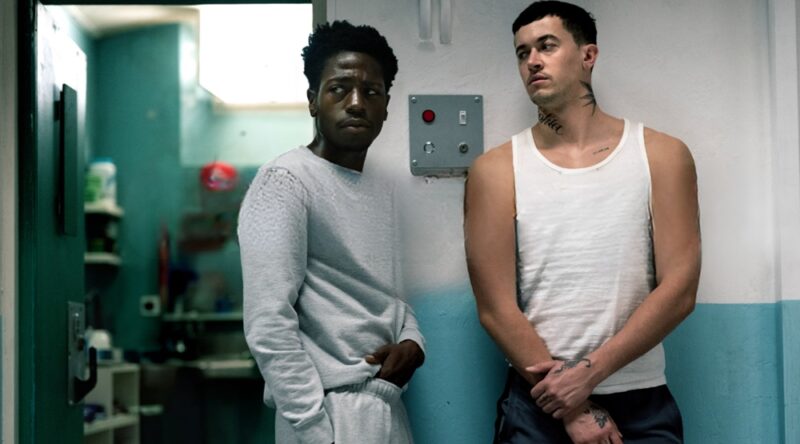
The film follows Taylor as he clings to the possibility of early release and a chance – however fragile – to reconnect with the teenage son he barely knows. That hope is destabilised when he’s assigned a new cellmate, Dee (Tom Blyth), whose volatile presence quickly entangles Taylor in a web of drugs, violence, and coercion. What begins as an uneasy alliance spirals into something far more dangerous, as Taylor is pushed toward choices that could destroy any chance of freedom. The title Wasteman – a British slang term used to describe someone seen as worthless, disposable, or beyond saving – hangs heavily over the narrative, reflecting how easily these men are written off by the world around them, and how dangerously close they come to believing it themselves.
That sense of looming chaos arrives in full force with Blyth’s Dee, who storms into the film with a kind of coiled, unpredictable energy. Where Taylor shrinks, Dee expands – swaggering, volatile, and impossible to ignore. Blyth resists turning him into a one-note antagonist; beneath the bravado is something wounded and feral, which makes him all the more dangerous. Together, the two actors create a dynamic that’s less “odd couple” and more slow-motion collision. Their relationship is the film’s engine, and it never once settles into anything resembling safety.
What’s striking about Wasteman is how deliberately it sidesteps the emotional blueprint of films like The Shawshank Redemption or Papillon. There’s no redemptive friendship here, no comforting arc of mutual salvation. Instead, McMau asks a more disquieting question: what happens when two deeply damaged people find themselves with no way out of each other?
Formally, the film is just as effective. Shot in a tight, boxy frame by cinematographer Lorenzo Levrini, the visuals feel oppressive in the best possible way – like the walls are inching closer with every scene. The use of handheld footage and smuggled phone clips adds an extra layer of unease, blurring the line between observation and participation. At times, it feels less like you’re watching a film and more like you’ve stumbled into something you shouldn’t be seeing.
But beneath all the brutality – and yes, it can be brutal – there’s a sharp awareness of the system surrounding these men. Wasteman doesn’t preach, but it doesn’t flinch either. The prison is overcrowded, under-policed, and quietly chaotic, a place where violence isn’t just inevitable but almost structural. McMau captures this without losing sight of the human story, threading social commentary through the tension rather than stopping to underline it.
If the film occasionally edges toward narrative excess in its final stretch, it’s a minor stumble in an otherwise gripping debut. By that point, you’re so locked into Taylor and Dee’s unraveling that the ride remains absorbing, even when it threatens to tip over.
Ultimately, Wasteman is less about survival in prison than it is about survival around other people – especially when those people reflect the worst parts of yourself. It’s harsh, claustrophobic, and unapologetically raw, but anchored by two exceptional performances and a director with a clear, uncompromising vision.
It may not be easy viewing, but it’s the kind of film that lingers – long after the cell door finally opens.


FOUR STARS (OUT OF FIVE)
Wasteman is screening in North American theatres from April 17th, 2026.
