

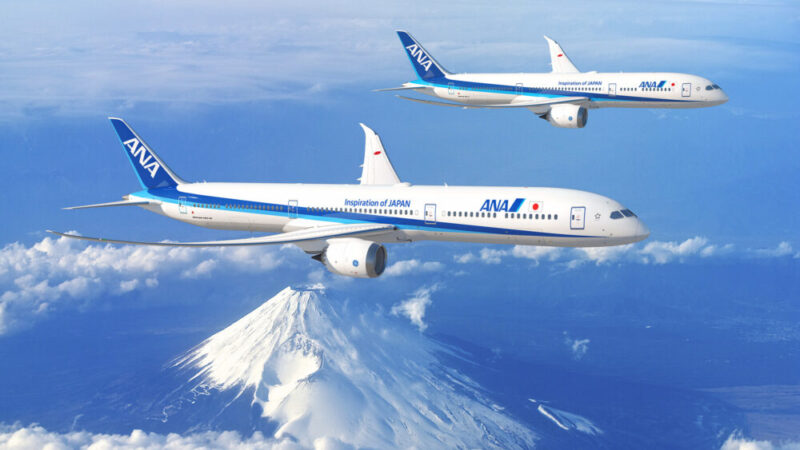
As of early this year, I’d never flown either of Japan’s major carriers, ANA or JAL. However, that all changed last month when I flew from Seattle (USA) to Tokyo (Haneda) on All Nippon Airways (ANA) for the first time. I booked this flight using Virgin Australia’s Velocity Points, for whom ANA is one of their airline partners.
While I’d had positive experiences on ANA’s budget partner Peach Aviation, this was my first time getting the full experience of a Japanese carrier, and I was impressed to say the least. In fact, it was one of the best Economy flights I’d ever had, and changed the way I look at air travel forever. Read on to find out why.
Airline: All Nippon Airways (ANA)
Flight Route and Number: NH 117 – Seattle (SEA) to Tokyo Haneda (HND)
Seat: 23G aisle middle 3-3-3
Aircraft Type: Dreamliner 787
Flight Time: 10 hours and 5 minutes
On Time? Yes
Arriving at SEA and Checking In
Since I purchased the ticket by way of Virgin’s Velocity Frequent Flyer program, I was only given a Virgin PNR. So, to check in online with ANA in advance of the flight, I had to use the e-ticket number, rather than the PNR. When I’ve flown with other partner airlines on a Virgin ticket, a PNR for the other airline had been provided, but in this case that didn’t seem to be the case. Or at least I couldn’t find it. In either case, keep that in mind when checking in if you’re in the same particular situation.
If you’re spending time in the beautiful northwest city of Seattle, getting to Seattle-Tacoma International Airport (SEA) is easiest by way of a streetcar/tram that takes you comfortably to the airport for US$3. It takes about 45 minutes. You can also take a taxi or an uber – I did the latter and it cost about US$65 and took a little more than 20 minutes on a Friday afternoon.
Once I got to the airport, check-in was quick and easy. There were no queues to speak of, and I made my way through security in minutes. But you won’t get any additional benefits on this routing as a Velocity Gold or Platinum passenger.
Velocity Status benefits like Priority Check-In, Priority Baggage and Additional Checked Baggage Allowance are only available on ANA operated flights between Australia and Japan with a VA or NH flight number, and ANA operated flight within Japan with a VA flight number. So flights out of the US don’t enjoy any of these benefits – even though I was able to get on the flight using points.
After security, you have to get a train to Terminal S, which has limited offerings. So if you have time, look at exploring other areas of the airport for food and shopping. There was plenty of places to plug in devices scattered around Terminal S though, so I just used it as an opportunity to get some work done.
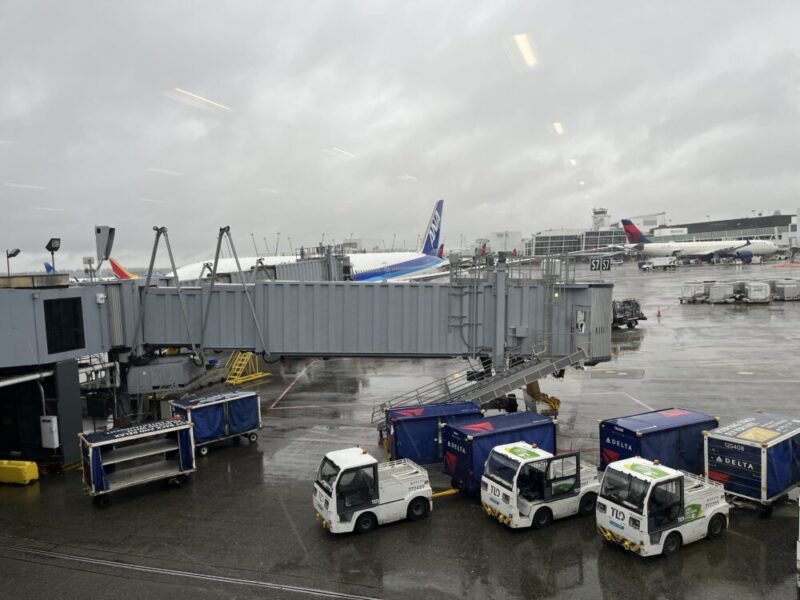
Boarding The Flight
There were 5 boarding groups, with your group specified on your ticket. Unsurprisingly for a Japanese airline, the group system was efficient. Even though there were hundreds of passengers to board this 787 Dreamliner, things moved quickly and boarding finished 15 minutes before scheduled take off.
There was plenty of room in the overhead bins for my backpack, and no one going through the cabin telling you what you could and couldn’t put up there. I tell you what, there are a number of airlines that could and should take a lot of notes from ANA.
What’s at the Seat
When I got to my aisle seat on this Boeing 787 Dreamliner, an ANA branded pillow (with a notably good quality case) as well as a blanket, and headphones, were waiting for me on the seat.
The legroom was decent and there was a footrest on the back of the seat in front of you – something unheard of in economy these days. The seatback headrest is movable and has side flaps that work well to carry the weight of your head (it shouldn’t need to be said, but it does).
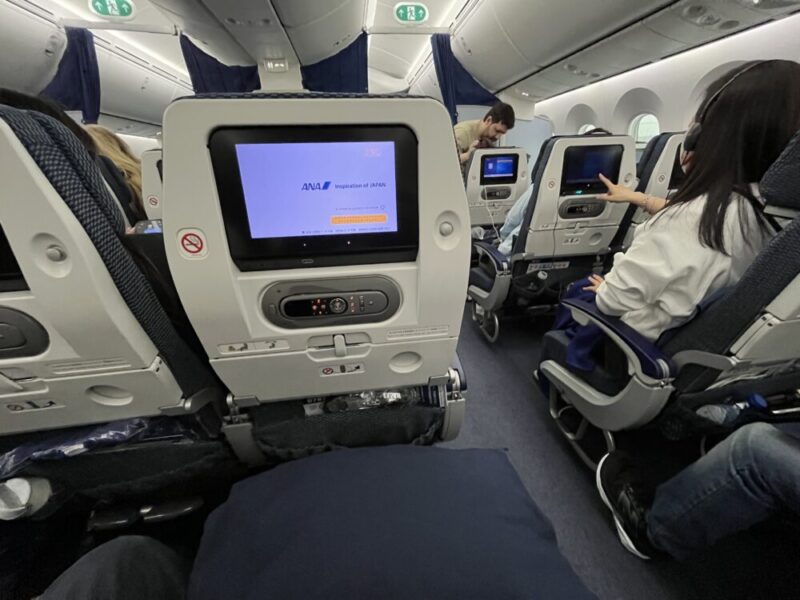
There’s also an AC plug under each seat, with lights above but no air vents to adjust. The disposable bag was waterproof, a nice touch – and it’s also where you’ll find the Wi-Fi details. Now that’s just economical.
In Flight Entertainment
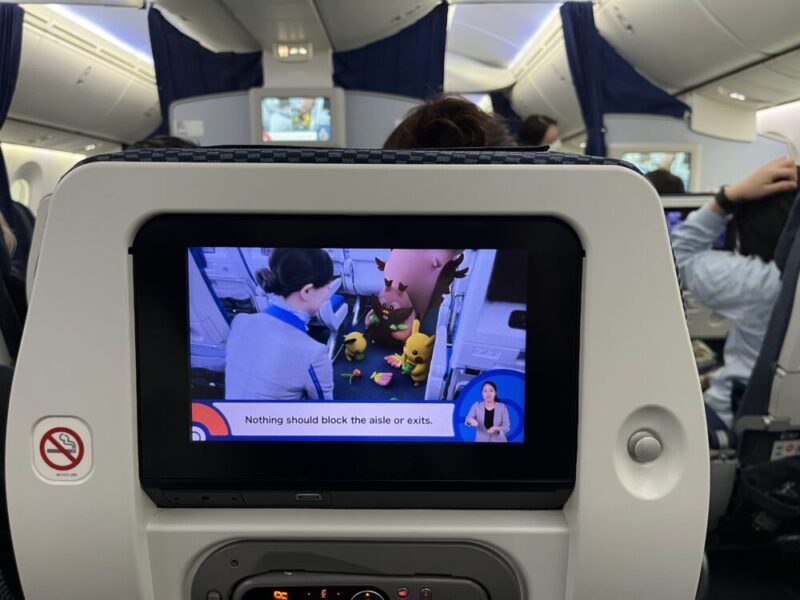
The seat back TV screens are the older design with the handheld controller, plus a touch screen with standard USB and headphone jack. But before we could dig into the unit and see what there was to enjoy, we had a Pokémon themed security briefing to enjoy. And the kids on the plane were beside themselves.
Texting is available for free to all passengers, with the option for full Wi-Fi for 21.95 USD for the whole flight, or from 6.95 USD for 30 minutes. The satellite connects to the Wi-Fi service shortly after take off, and the messaging worked well for the majority of the flight.
There’s superb security tinting on the TV unit, making it difficult to see the screens around you. Which is a relief if you’re watching any film that contains nudity. In terms of the entertainment included, you’ll find a solid selection of films, including plenty of new releases from Hollywood and Asian cinema. Though the western TV selection is notably lacking compared to other carriers.
There is decent recline to your chair, but you can’t move the entertainment unit at all, as on many other aircraft, which means the angle can get weird unless you recline your seat to match.
Duty free shopping takes place through the entertainment unit, which is how it should be. It’s wild it still exists in the first place, let again by way of a travelling salesperson down the aisle.
Meal Service
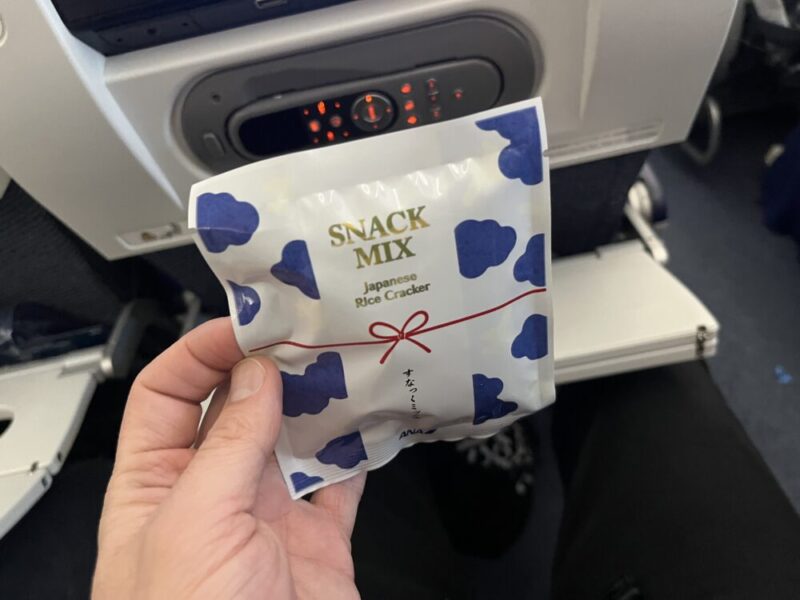
A refreshing towelette is given to every passenger first, then a Japanese rice cracker “Snack Mix” less than an hour after take off, and before the first drink service.
Beer, wine, soft drinks, juices, tea and spirits are amongst the diverse selection of available complimentary beverages. The tray in front of you has two different places for your drink – one is a hole hat perfectly fits the cup when you extend the tray. And the other, a normal indent when you’ve got half a tray open. The drink holder hole is a nice touch – especially given how much food they end up giving you. It makes great use of the space and will ensure there are less spillages. Just one of the many great design choices on board this ANA flight.
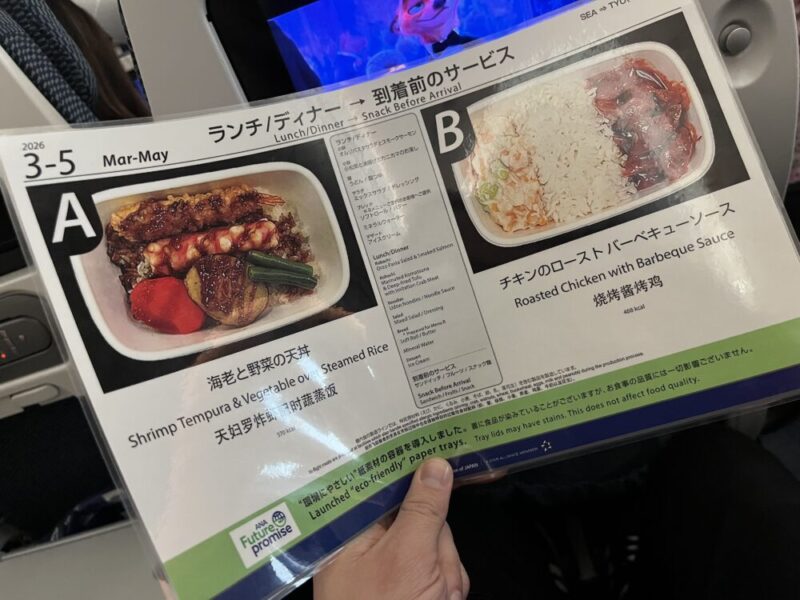
When lunch service arrived, they provided a laminated menu with two options, a shrimp tempura and vegetables over rice or a BBQ chicken with rice, corn and edamame.
The main was served in an “eco-friendly” paper tray, with a number of sides and a water. There was a salmon and feta salad and a crab and tofu salad. There was also roasted seaweed, noodle sauce (for the soba noodles with egg) and wasabi amongst the sides, as well as a dressing for the salad.Chopsticks along with metal cutlery and a toothpick. Vanilla Ice cream came separately while we were eating.
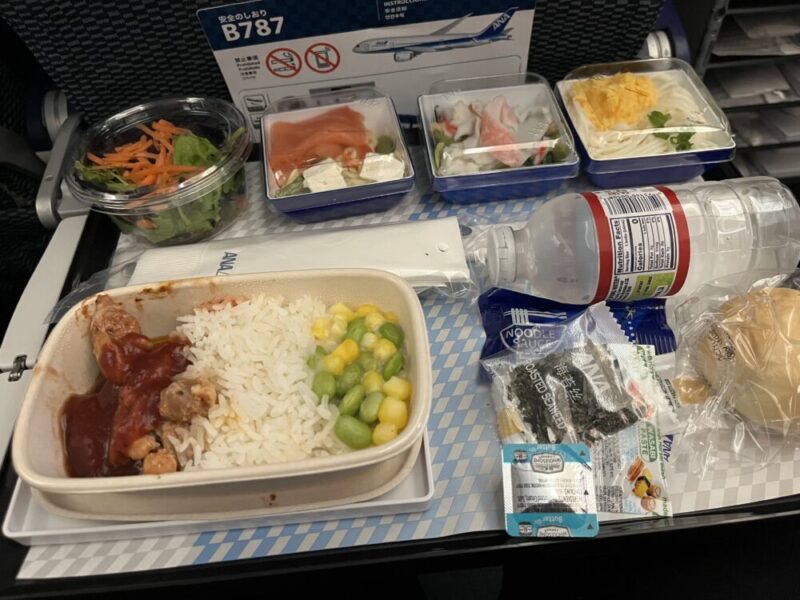
Food was delicious and plentiful, and the quality of the sides was particularly impressive. I left comfortably full, which is rare for an economy meal these days. A second drink service happened at the same time as the meal service. And then they offered tea (green or black) or coffee as they collect meal plates.
While this was a day flight, travelling along with the sun for the entire flight, lights were turned off and the windows were dimmed for a good majority of it. Lights came back on about two and a half hours before landing. Shortly after which the second meal and final drink service came through.
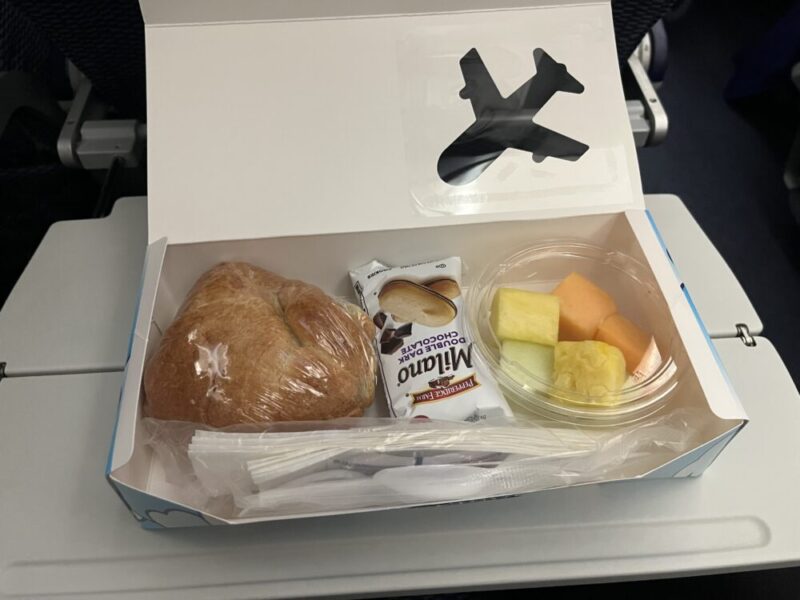
Everyone received the same box for this one, unless you’d requested something in advance. It included a croissant sandwich, with lettuce and tuna mayo, a Milano cookie and fruit salad. For a 10 hour flight I was surprised it wasn’t another hot meal, but it hit the spot before we landed in one of the best food cities in the world.
They have what in their bathrooms!?
The bathroom design was different to what I’m used to, with hands free bathroom doors from the inside, encouraging you to use your arm or elbow. It’s great to see such health consciousness aboard the flight.
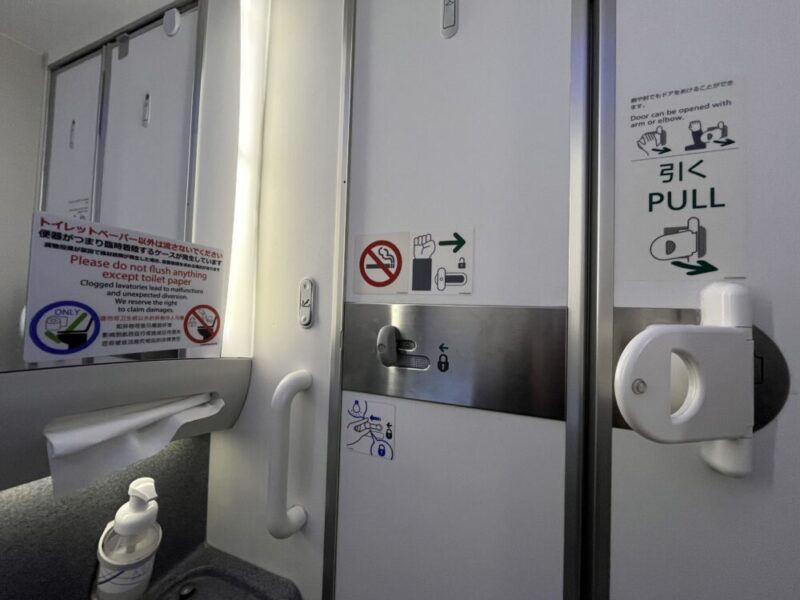
But it was the toilet that changed the way I will see travel forever. Like most places in Japan itself, the toilet was fitted with a bidet which dispensed warm water. You can control the pressure and there’s a front and a back spray option. You’re telling me we could have had these on planes this whole time!? This is a gamechanger for the flying experience, I’m telling you. I’ve never felt fancier in any class, than when I have been given the privilege of true cleanliness on a long international flight.
I demand a petition to get this onto every aircraft in the world.
On arrival at Haneda
Make sure to fill out your eVisa form before you arrive, and gave your QR code ready for inspection – otherwise it gets a little confusing on arrival. And things are confusing anyway, if you’re not used to the system. But staff speak English and are happy to help.
It took a little bit of time to get through security and collect our bags, and then we were in Haneda Airport, which has some great immediate options from high end restaurants, to food courts and 7-11s.
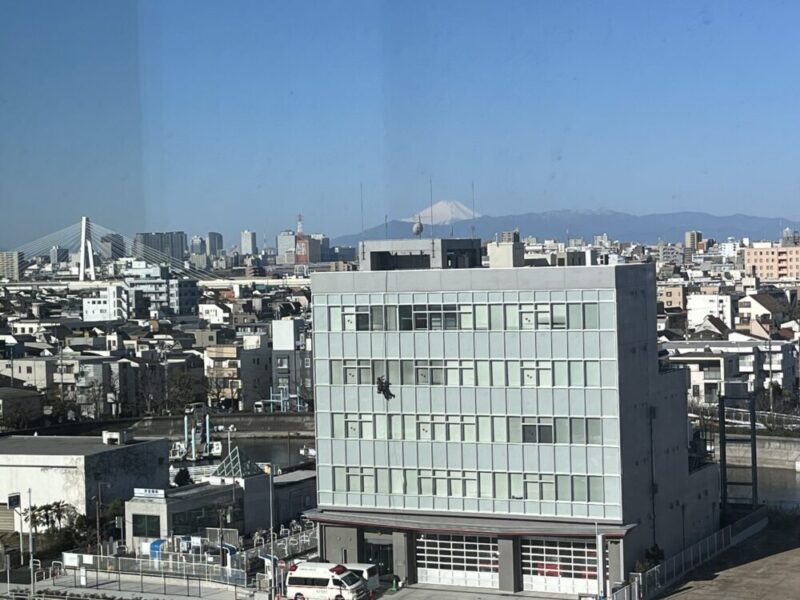
While at Haneda, we spent the night at Hotel Metropolitan Tokyo Haneda, where we woke up with a surprisingly clear view of Mount Fuji. Highly recommend that hotel, too – I love the way they’ve brought airport designs into the space. You’ll see when I mean if you stay there.
Final Verdict
Y’all better be taking notes – ANA do so much right, it makes it frustrating that so many other airlines do so much wrong.
The boarding process was organised and efficient. The food was delicious. The service friendly. The seats comfortable, and with a foot rest to boot. I have zero complaints about anything that was offered on board his flight. If anything, I just wanted more.
This is one of the best – if not the best – economy experiences I’ve ever had.
And I’m serious about this bidet petition. We are getting ripped off on every other airline, I’m telling you.


FIVE STARS (OUT OF FIVE)
To book your next flight with ANA, head to their official website.
The author flew at his own expense, on points from Virgin Australia. Learn more about the ANA partnership with Virgin Australia HERE.
Photos except headline photo (from Boeing) taken by the author.
